One thing that makes humans rare among species is our ability to shape and craft and use tools. This was on my mind last night as I went to bad.
A couple of years after my dad died, I wrote a post about using his Milwaukee right angle drill. I still have that drill and while I rarely use it, it still brings back memories.
Yesterday I added a new tool to my toolbox. Well, to my set of tools: a portable table-saw. When I first moved into the house, decades ago, my dad gave me his old table-saw as he had upgraded to a much heavier duty one so he could build cabinets and the like. When he passed, I decided to keep the larger one, but had no place for it, so I gave it on “permanent” loan to a friend who went above and beyond the call of duty to help me during my dad’s illness. He had the room I didn’t.
In the meantime, I had gotten rid of the original one, for a variety of reasons, including that it had some bad memories. You see, back in my senior year of high school I was using it to cut some cedar shingles and it kicked back on me. I’ll be honest, I’m lucky to still have all 10 fingers. And that’s in part because of receiving some sutures at the local hospital.
As for the new table-saw, it had been on my bucket list to obtain for awhile and I finally bit the bullet and bought it on Sunday, assembled it yesterday and used it to start finishing some projects that really needed what a table-saw can offer. And so far, I love it. It has a number of safety features my old saw didn’t and it’s much easier to adjust. I think it’ll be a very useful addition to my toolbox.
But I wasn’t done with saws with with memories of my dad’s tools. Turns out I needed to cut out a notch in the piece of trim I had just cut on the table-saw. There’s no real safe way of doing all the necessary cuts on a table-saw. But that’s ok, I realized I needed a coping saw, something my dad had. Sure enough going to his toolbox in the basement I found it and got my cut started. (I’ll admit I cheated for the rest, once I had enough started to fit a jigsaw blade, I used my jigsaw to finish it.)
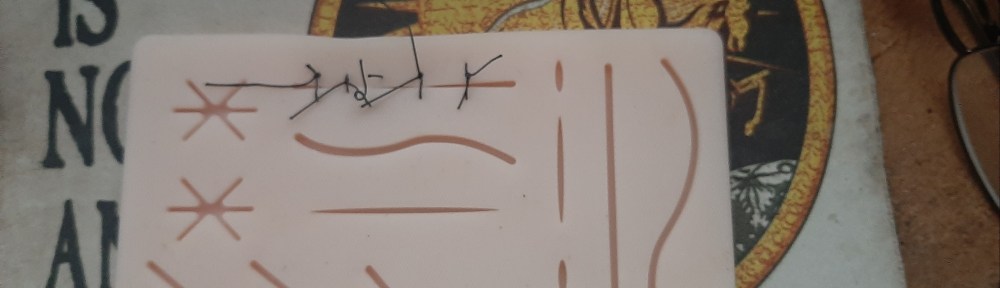
But I want to circle back to sutures. One of the skills I’ve watched a lot of in the ER is doctors and PAs putting in sutures. The overall mechanics didn’t seem complex, but I wanted to get in practice before I had to PA school in May. Fortunately one of my members of the Council of Moore was able to set me up with some of the items needed. A quick shopping trip on Amazon got me a practice suturing pad. I’ve had the items for a couple of weeks, but finally last night decided to pull them out and pull up Youtube.
And I was right. The hand motions are just as I thought. Pierce the “skin”, rotate the wrist to drive the needle through, pull the suture mostly through, wrap the suture twice around the needle driver, grab the end pull through and voila, the first knot.
Or so I thought. My suture kept unravelling. I watched more videos, they all showed the same thing. I was baffled. I kept trying, suddenly I had something that looked right and didn’t slip. But I had no idea what I had done, so I didn’t count that one.
After getting fairly frustrated I decided to hand-tie one to see confirm what it should look like. That was easy. Back to using the needle driver. No luck.
Then it hit me. While the videos talked about wrapping in two different directions, clockwise and counter-clockwise, there’s really two other directions! The first, which is what I had been doing was wrapping the suture with the tip of the needle driver pointing towards the wound (and hence the free end). The second, was angling it the other way so effectively the tip of the needle driver is towards the needle end of the suture. It’s subtle but once I did that, I was able to create the knot I wanted.
The clockwise/counter-clockwise comes in when tying the knot twice to ensure it’s correctly tied (strictly speaking it’s what’s called a surgeon’s know which is much like a square knot, but with an extra wrap on the bottom half.
I’ll admit I’m still working on getting this part right, lest I end up creating the surgeons knot equivalent of a granny knot. But that’s honestly a minor issue and one that I’ll soon solve with muscle memory.
There’s obviously a lot more to learn about suturing, but getting this part down is a huge win for me.
So in one day I’ve come full circle, from a table-saw, to a coping saw, to a suture. But this time the suture was simply practice by me, not necessary on me.
One last comment: my statements above are not endorsed by my employer, Albany Medical Health System nor do they reflect the views of my employer.
 Green Mountain Software