
To state the obvious, any grad program, but I think among them, especially PA school requires intense studying. In some ways, PA students will cover more in a semester than many med students in the same amount of time. Time is at a definite premium. As mentioned previously, for every hour we spend in lecture, we’re expected to spend roughly two hours outside of lecture on that same subject. So if we have a single hour on a topic like Inflammation, we should probably plan for two hours or more of studying on that outside of class.
Related to that though is some advice they’ve given us very early in the semester and that is to a point, grades don’t really matter. Obviously they do, there are some program minimal requirements and the like. For example, to continue to the next semester or next year will require a minimum GPA of a 2.70. In order to be eligible for the overseas service trip requires a GPA of 3.0. But, for an individual subject, they’ve told us if we get a 70% or better on it, we should be OK for the PANCE. That said, I think everyone wants to do well and to do better than “just enough.” I know I do. But, we don’t have class ranking and we’re not competing for residencies, so honestly, they’re right, beyond a certain minimum doesn’t matter.
I say this because it does impact my approach. I mentioned in a previous blog how I had a major test on Tuesday (Medical Terminology) and hoped to do well. We were all nervous about it and several of us, including myself, had dreams about it. Mine was particularly weird. But we all took it. I don’t think any of us required the full amount of time. They’ve warned us that often tests will take several days to grade (there’s a complex process to it, even though the tests are given electronically). But today, it only took a couple of hours. I’m proud to say I got an 89.69. Yeah, just short of a 90. But I’m ok with it. Yes, I’d have loved to have gotten higher, and honestly where were two questions I know I got wrong that I probably should have known a bit better. But, the reason I’m ok with it is, I based on the amount of time I spent, I got a grade I’m happy with. I was hitting a cost/benefit ratio on time. Had I spent another 5 hours studying, I might have gotten those two right. Another 10 hours, perhaps four more right. But, in the end, there were a couple of terms that I honestly never would have thought to study, so it’s unlikely I would have gotten a 100% on it. And I’m ok with that.
And that leads me into my part of this post. HOW I am studying. For medical terminology, one of the approaches I took was to ensure I knew a number of Latin roots and prefixes and suffixes. This meant that if I encountered a term I had not studied for, I had a better chance of figuring them out. Sure enough there was at least a few terms I had not specifically studied for, but that I was able to figure out. I’ll probably talk more about the “language” of medicine in a future post.
Now, that said, the medical terminology exam was a critical one to pass, but honestly, I didn’t think it was hard to study for. Coming up tomorrow is our first major exam in a class called Mechanism of Disease. This has been far harder to study for.
Below are two pictures of some of the things I’m doing to study. I’m going to work on this process over the coming months as I realize what works and doesn’t work.
Since I started taking my prereqs, I’ve gotten quite adept at using Microsoft’s OneNote for taking notes and outlining things. Here I’ve taken all the objectives from various lectures that are covered in this first exam and put them in one place. I’m slowly going through and color coding what I feel very comfortable with (green), only moderately comfortable with (orange, or not at all comfortable with (red). Black is for stuff I haven’t reviewed yet. This images is from Tuesday night.
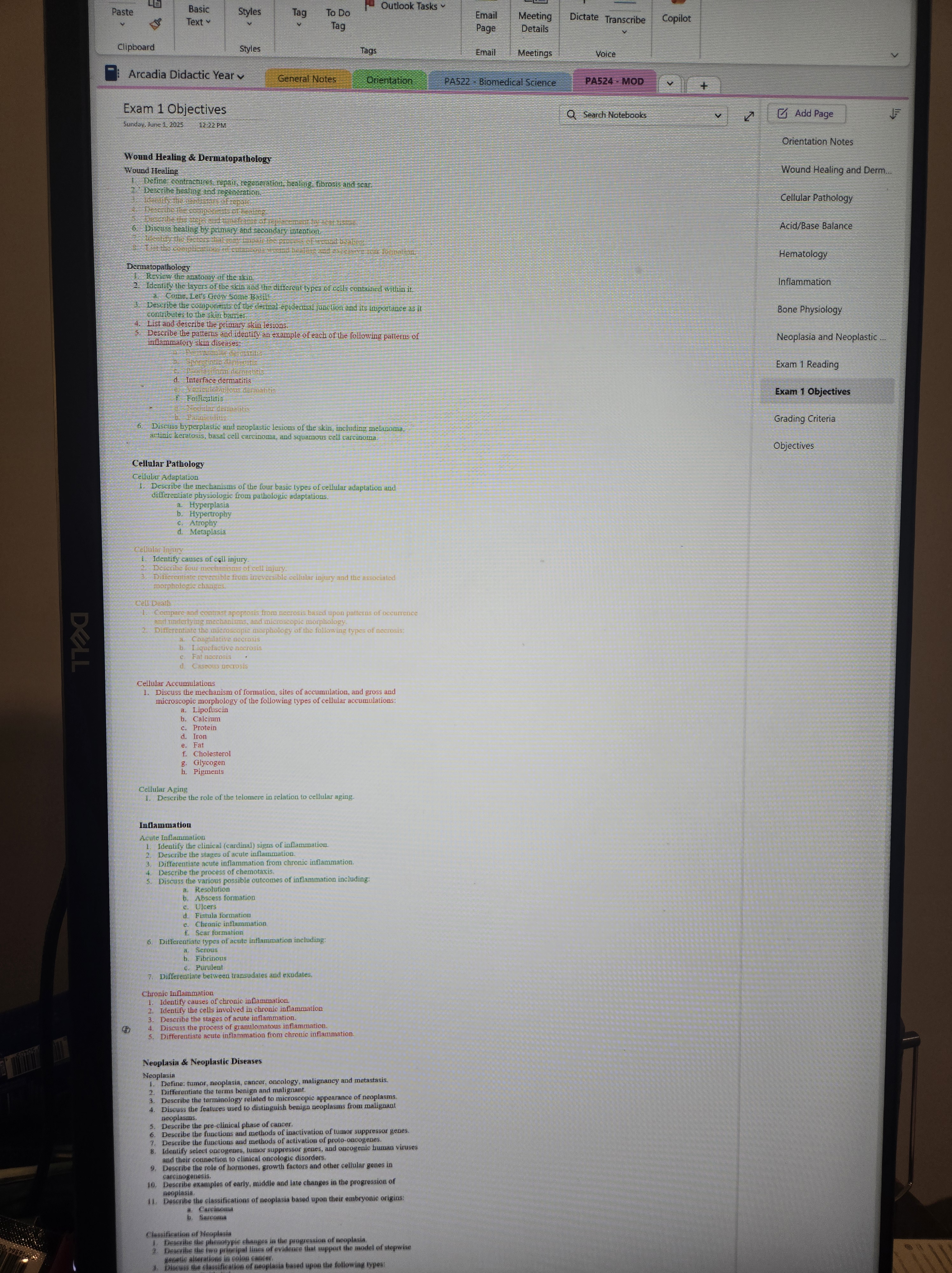
Using this will hopefully allow me to decide where over the next few days I need to focus my limited time. If it’s already green, I’ll spend very little time on it. If it’s red, I’ll definitely spend time on it, and if it’s orange, I’ll have to determine how much time to allocate to it.
You’ll note that I don’t have any actual comments within the objectives. That’s generally elsewhere in my notes on other tabs.
But I also have a second thing I’m looking at. That’s the whiteboard shown in the following photograph. This is definitely something I’m going to be changing over time as I find out what works and doesn’t work.
I’ve broken out each lecture that will be covered on this exam. Then below it I’ve put several items (and this is the area most subject to change). Here, the colors mean nothing. They’re simply the markers I had available.
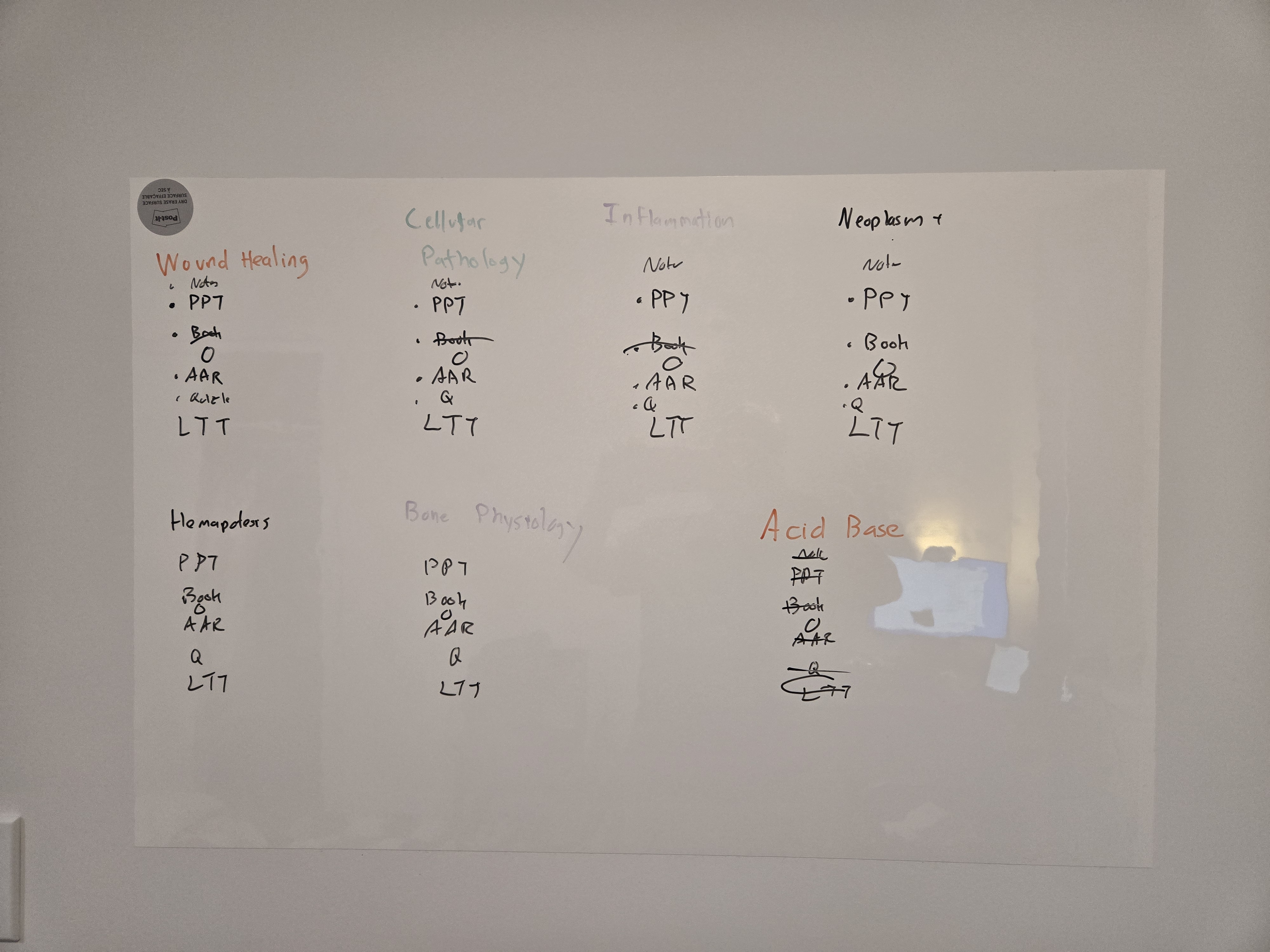
But to decode it:
- Notes – Have I reviewed my notes (or in a few cases, even made them!)
- PPT – Have I reviewed the PowerPoint slides. I’ll be honest here without naming names, but some professors make better PowerPoints than others. For example some will include notes with the slide. This can be very useful so that I can put the contents of the slide in context.
- Book – Have I read the assigned chapters in the book? If not, I need to go back to it. Sometimes the book will explain things the lecture didn’t cover or explain it differently which will help.
- O – Outline – have I outlined notes and organized them in a readable fashion.
- AAR – Alternative Academic Resources – did they provide a link to a video. Are there videos I need to read.
- Quiz – Have I made or looked for a Quizlet? To be honest, I find this hit or miss because if someone else is making them, they put in topics I don’t need to know or alternatively not put in stuff I do need to know.
- LTT – This is the critical one and ultimately the only one I’m going to care about at the end.
- Learn – Do I feel like I’ve learned the material? This will be true when I have all, or perhaps mostly green in my OneNote outline.
- Teach – Do I feel like I can teach the material to someone else, or even better, have I. If I feel comfortable teaching it, then I’m going to be comfortable that I’m ready for the final T
- Test – How did I do on the test? This of course is the ultimate metric.
For the whiteboard, I don’t necessarily plan on or hitting every single mark there. They’re more of reminders. “Hey, you’re having trouble with this topic, have you tried all these ways of learning it?” The only one I really care about is being confident in the LT portion of LTT.
The combination of these two resources will hopefully help me make sure I don’t go down a rabbit hole of a particular lecture and forget to study for another. For example, if I wake up Sunday morning finding I’m green on almost everything, but perhaps orange on two things and red on one, I’ll focus on the red topics first, so I can at least get them to what I consider an orange level.
What’s this translate to in the end? I can’t put hard numbers on it, but my thinking is something like:
- Everything green – I feel like I should walk into the exam expecting something solidly in the 90s.
- A majority of green with a few oranges – ok now I’m talking solidly the 80s, perhaps approaching 90.
- Mostly oranges but no reds – I’ll start to worry. I’ll probably pass, but not solidly in the 80s.
- Mostly oranges with some reds – I’ll be in panic mode. I’ll have to spend more time.
But, this is a feedback. If I think I’m green at that amount of effort and I’m getting a much lower grade on tests than I expect, that means in the future I’m going to have to increase my study time, or change how I study.
Alternatively, if I find myself in the orange a lot because I ran out of time, but doing really well on tests, then perhaps it means I’m overestimating how much I don’t know and need to revise.
I started this blog Tuesday night and am posting Sunday night. At this point, I’m green on most items and I think I’m ready to go. But we won’t know for sure until tomorrow!
 Green Mountain Software
Pingback: PA School: Tools I’m Using | greenmountainsoftware
Pingback: One Semester Down | greenmountainsoftware