PA School: Tools I’m Using

So my first exam for Mechanisms of Disease (we just call it MOD, it’s easier) is out of the way. Due to how they grade things, it may be a few days before I get a grade on it. This is a bit frustrating, but I can’t do much about it. So, rather than talk about that or whether I’m on the right track when it comes to how I’m spending my study time, I thought I’d talk about some of the tools I’m using.

OneNote

I’ve mentioned this multiple times in the past. It’s nice in that it allows me to free-form write notes draw images, do outlines, add checkmarks, etc. It’s still a heavy go to to help me keep things organized.

Screenshot of my OneNote page for Human Gross Anatomy
OneNote Screen Shot

This is a current page out of my OneNote. You can see across the top I have a tab for various classes or important topics. On the right I have pages for each lecture plus some other details I want to track. The main section is a portion of the objectives for Exam 1. You can see here I’m using checkboxes instead of colors to mark what I think I know and I don’t. I obviously still have a bit to review here (and note that the scroll bar shows I’ve got a lot more objectives to look at.)

Whiteboards

I mentioned this in my previous post. Once I get to my newer apartment, I’ll get more sheets of whiteboard paper to put on the wall or even some actual whiteboards to mount on the wall. I find this HUGELY useful to help me draw out structures or organize notes. Sometimes just putting “pen to paper” makes a big difference here. One can’t have too many whiteboards in my opinion. I’ve even seen one of the attendings where I work wheel one down so he can teach residents a few things.

I should note, at one company I consulted at as a Database Administrator, their IT/Dev department had very few whiteboards. I never really understood how they got things done.

Quizlet

Some of my fellow students love this app. I’ll admit I use it and sometimes I use old-fashioned notecards. But I find it has limitations. It’s useful for learning “facts” but harder in my mind for learning interactions. Yes, it can be done that way, but it’s more work. So, for example, it’s useful to quiz me on what artery serves the trapezius muscle (main ones are the transverse cervical artery and the dorsal scapular artery in case you’re interested). But less so on fully visualizing where it is and what it does (though I do have a card asking about action). What it has limited use for in my opinion is what are called second-order questions. This might be, “patient is stabbed in the back along the upper back near the neck, what muscle might be show limited to no movement?” The answer (especially if it’s multiple choice and some are obviously wrong) is most likely the trapezius because the nerve that runs to it is in that area. Here it helps to understand where things are and how things operate.

Complete Anatomy

I’ve previously mentioned the Anatomage tables we use for anatomy class. These are awesome, but there’s only two per campus and they’re not portable so I can’t take them with me. Enter Complete Anatomy from Elsevier. I have a copy on my phone and on my desktop. It’s incredible. Very much like the Anatomage tables, I can select a specific structure to examine, add in or remove surrounding structures, look up details on a specific structure and more. I can even tell it to show me how specific muscles move. This is an EXTREMELY useful tool for anatomy. For $40 I would recommend it to anyone who has to study anatomy. I’ve been using it all this morning to help me get a handle on all the muscles in the thoracic cavity and back that I need to know for next week’s exam. It’s definitely helping.

ChatGPT

Or as one of our professors likes to call it, “Professor Chat”. I find the fact that I’m using this a bit ironic because just within the last two years, every PA school application process has had to add a disclaimer that you can NOT use ChatGPT or other LLMs to write your essays. But once here, they’ve encouraged its use. It’s NOT perfect and I’ll be honest, it wasn’t until a fellow student pulled it up in a study session over the weekend that I had given it much thought. My early playing with LLMs had not left me very impressed. It seemed like a gimmick (e.g. “Write me a short love story in the manner of Stephen King”) that while fun, I didn’t find overly useful.

But that study session changed my thoughts. I started playing with ChatGPT Sunday night (the night before my MOD exam). I did several things. In one case I took a slide about skin diseases and copied it into the ChatGPT window and said, “Give me a 10 question multiple choice quiz on this material”. Not only did it, when I got an answer wrong it attempted to explain why I go tit wrong. At one point I put in the entire list of objectives to be covered for the MOD exam and asked it to give me a 30 question quiz with at least 5 second order questions. It did, and then it graded it.

Now it’s FAR from perfect. More then once I’ve found it’ll mark the right answer wrong (which is strange enough) but also it’ll mark the wrong answer as correct occasionally. Honestly, though I found this useful as it forced me to engage with the LLM. For example one question was poorly worded and I told the LLM that and it came back with a better worded question making the same point.

I find ChatGPT very useful for second order questions because it’ll craft decent ones and then after I attempt to answer them, explaining the reasoning to all the available answers, why the one that is correct is correct and why the others are not correct. This forces me to think a lot about systems.

Yes, ChatGPT can be used like an advanced search engine, but that’s only scratching the surface of what it can do.

I suspect I’ll be using ChatGPT a lot over the coming year to help prepare for tests. I also suspect that at times during my clinical rotations, if the preceptor allows it, I will use it to help verify my diagnosis or give me more information to make a better one. I don’t think it’s quite ready to be the sole source of truth though when it comes to making a diagnosis. I will note there are some AI tools that in limited cases can be better than humans, but those tend to be fairly constrained areas of medicine and even then they often have errors.

Study Groups

This is not really a technology or object. But study groups can be critical to helping “polish” my thinking. Sometimes I’ll see how others are approaching problems, sometimes I can share my knowledge with others (which seems to help them, at least in some cases.) Once I get to my newer apartment, I hope to host these once a week or so.

Classroom Study Sessions

This one, honestly, several of us believe if misnamed and we were talking with a professor about yesterday. They’re honestly more instructor (and soon Grad Assistant) led review sessions. For my campus, I’m one of three selected Grad Assistants who will eventually be helping to lead these. The reason some of us think they’re misnamed is because the format is really more a review of material than an actual study of it. We’ve had two so far and the format is the professor(s) create “slide” deck in what’s essentially an interactive PowerPoint like program (I can’t find the name or link right now). They’ll put up a slide with a question and often answers and anyone logged in can select an answer. After some time (generally after about 10 seconds have passed) they’ll show the results, give us the right answer and maybe a very quick comment and then move on. We generally do about 50 questions in one hour. So as you can see, it’s not really studying as much as reviewing. These sessions are completely voluntary, but I think very useful. There were two reasons I signed up to be a GA for these. The first was I want to help my fellow student succeed. The second was because it would force me to make sure I was more familiar with the material. Oh and we get a small stipend, so there is that too.

In Conclusion

There’s probably other tools I used I didn’t think to add and over time I’ll learn to use some tools more than others or add or remove tools to the mix. For example, once done with the Human Gross Anatomy class, I probably won’t use Complete Anatomy as much as I do now. And I’m sure when I’m taking the pharmacology class, I’ll pick up a new tool specific to that.

One thing I’ve very quickly learning is that I have to continually work on my study habits and adapt them as needed. This will be especially true in the second semester when I’m taking 25 credit hours!
PA School: Studying

To state the obvious, any grad program, but I think among them, especially PA school requires intense studying. In some ways, PA students will cover more in a semester than many med students in the same amount of time. Time is at a definite premium. As mentioned previously, for every hour we spend in lecture, we’re expected to spend roughly two hours outside of lecture on that same subject. So if we have a single hour on a topic like Inflammation, we should probably plan for two hours or more of studying on that outside of class.

Related to that though is some advice they’ve given us very early in the semester and that is to a point, grades don’t really matter. Obviously they do, there are some program minimal requirements and the like. For example, to continue to the next semester or next year will require a minimum GPA of a 2.70. In order to be eligible for the overseas service trip requires a GPA of 3.0. But, for an individual subject, they’ve told us if we get a 70% or better on it, we should be OK for the PANCE. That said, I think everyone wants to do well and to do better than “just enough.” I know I do. But, we don’t have class ranking and we’re not competing for residencies, so honestly, they’re right, beyond a certain minimum doesn’t matter.

I say this because it does impact my approach. I mentioned in a previous blog how I had a major test on Tuesday (Medical Terminology) and hoped to do well. We were all nervous about it and several of us, including myself, had dreams about it. Mine was particularly weird. But we all took it. I don’t think any of us required the full amount of time. They’ve warned us that often tests will take several days to grade (there’s a complex process to it, even though the tests are given electronically). But today, it only took a couple of hours. I’m proud to say I got an 89.69. Yeah, just short of a 90. But I’m ok with it. Yes, I’d have loved to have gotten higher, and honestly where were two questions I know I got wrong that I probably should have known a bit better. But, the reason I’m ok with it is, I based on the amount of time I spent, I got a grade I’m happy with. I was hitting a cost/benefit ratio on time. Had I spent another 5 hours studying, I might have gotten those two right. Another 10 hours, perhaps four more right. But, in the end, there were a couple of terms that I honestly never would have thought to study, so it’s unlikely I would have gotten a 100% on it. And I’m ok with that.

And that leads me into my part of this post. HOW I am studying. For medical terminology, one of the approaches I took was to ensure I knew a number of Latin roots and prefixes and suffixes. This meant that if I encountered a term I had not studied for, I had a better chance of figuring them out. Sure enough there was at least a few terms I had not specifically studied for, but that I was able to figure out. I’ll probably talk more about the “language” of medicine in a future post.

Now, that said, the medical terminology exam was a critical one to pass, but honestly, I didn’t think it was hard to study for. Coming up tomorrow is our first major exam in a class called Mechanism of Disease. This has been far harder to study for.

Below are two pictures of some of the things I’m doing to study. I’m going to work on this process over the coming months as I realize what works and doesn’t work.

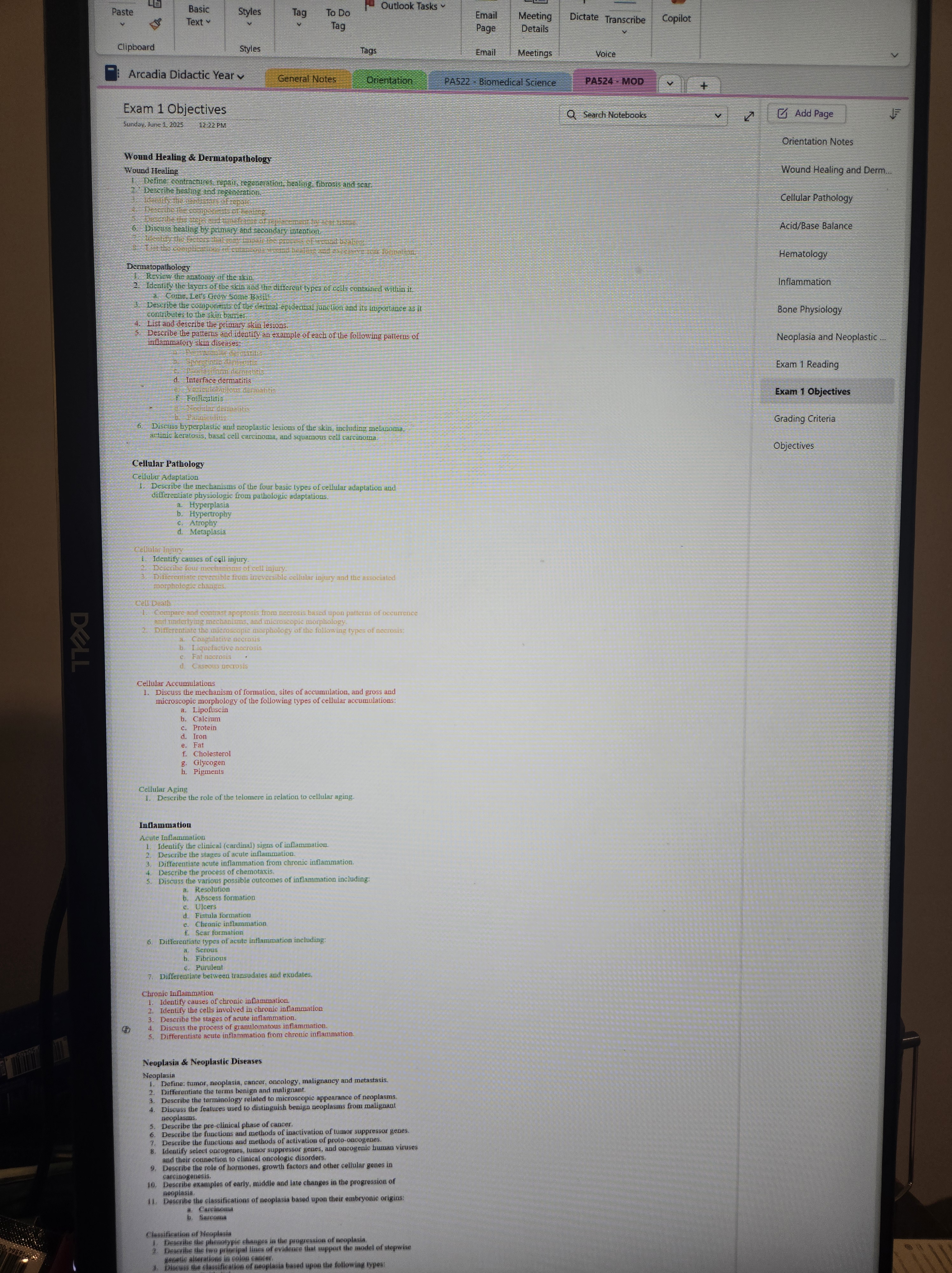
Since I started taking my prereqs, I’ve gotten quite adept at using Microsoft’s OneNote for taking notes and outlining things. Here I’ve taken all the objectives from various lectures that are covered in this first exam and put them in one place. I’m slowly going through and color coding what I feel very comfortable with (green), only moderately comfortable with (orange, or not at all comfortable with (red). Black is for stuff I haven’t reviewed yet. This images is from Tuesday night.

Using this will hopefully allow me to decide where over the next few days I need to focus my limited time. If it’s already green, I’ll spend very little time on it. If it’s red, I’ll definitely spend time on it, and if it’s orange, I’ll have to determine how much time to allocate to it.

You’ll note that I don’t have any actual comments within the objectives. That’s generally elsewhere in my notes on other tabs.

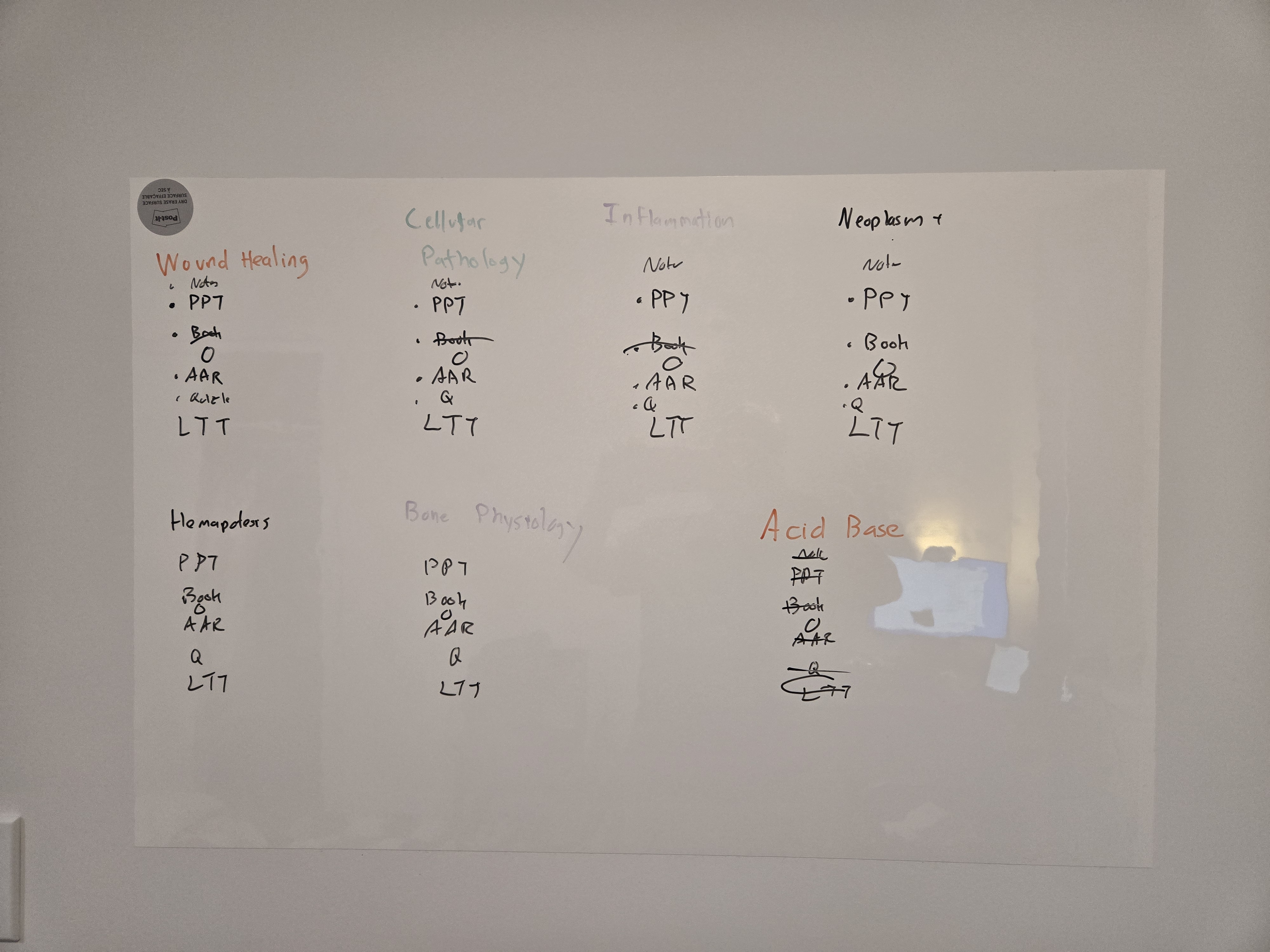
But I also have a second thing I’m looking at. That’s the whiteboard shown in the following photograph. This is definitely something I’m going to be changing over time as I find out what works and doesn’t work.

I’ve broken out each lecture that will be covered on this exam. Then below it I’ve put several items (and this is the area most subject to change). Here, the colors mean nothing. They’re simply the markers I had available.

But to decode it:

  • Notes – Have I reviewed my notes (or in a few cases, even made them!)
  • PPT – Have I reviewed the PowerPoint slides. I’ll be honest here without naming names, but some professors make better PowerPoints than others. For example some will include notes with the slide. This can be very useful so that I can put the contents of the slide in context.
  • Book – Have I read the assigned chapters in the book? If not, I need to go back to it. Sometimes the book will explain things the lecture didn’t cover or explain it differently which will help.
  • O – Outline – have I outlined notes and organized them in a readable fashion.
  • AAR – Alternative Academic Resources – did they provide a link to a video. Are there videos I need to read.
  • Quiz – Have I made or looked for a Quizlet? To be honest, I find this hit or miss because if someone else is making them, they put in topics I don’t need to know or alternatively not put in stuff I do need to know.
  • LTT – This is the critical one and ultimately the only one I’m going to care about at the end.
    • Learn – Do I feel like I’ve learned the material? This will be true when I have all, or perhaps mostly green in my OneNote outline.
    • Teach – Do I feel like I can teach the material to someone else, or even better, have I. If I feel comfortable teaching it, then I’m going to be comfortable that I’m ready for the final T
    • Test – How did I do on the test? This of course is the ultimate metric.

For the whiteboard, I don’t necessarily plan on or hitting every single mark there. They’re more of reminders. “Hey, you’re having trouble with this topic, have you tried all these ways of learning it?” The only one I really care about is being confident in the LT portion of LTT.

The combination of these two resources will hopefully help me make sure I don’t go down a rabbit hole of a particular lecture and forget to study for another. For example, if I wake up Sunday morning finding I’m green on almost everything, but perhaps orange on two things and red on one, I’ll focus on the red topics first, so I can at least get them to what I consider an orange level.

What’s this translate to in the end? I can’t put hard numbers on it, but my thinking is something like:

  • Everything green – I feel like I should walk into the exam expecting something solidly in the 90s.
  • A majority of green with a few oranges – ok now I’m talking solidly the 80s, perhaps approaching 90.
  • Mostly oranges but no reds – I’ll start to worry. I’ll probably pass, but not solidly in the 80s.
  • Mostly oranges with some reds – I’ll be in panic mode. I’ll have to spend more time.

But, this is a feedback. If I think I’m green at that amount of effort and I’m getting a much lower grade on tests than I expect, that means in the future I’m going to have to increase my study time, or change how I study.

Alternatively, if I find myself in the orange a lot because I ran out of time, but doing really well on tests, then perhaps it means I’m overestimating how much I don’t know and need to revise.

I started this blog Tuesday night and am posting Sunday night. At this point, I’m green on most items and I think I’m ready to go. But we won’t know for sure until tomorrow!

PA School: First Impressions and Grades

“It’s like drinking from a fire house.” Before classes even started, I heard that expression a lot and frankly, used it a lot. It’s true.

The first week started off a bit easy. The first day was orientation. That was easy. And we had two classes postponed to the following week. That made that week easy. Of course it meant that much more work last week! By my count we had 16 class lectures, plus a lab and four other scheduled events. It was quite the firehose. I still haven’t caught up on my note taking!

But this week is in some ways where the rubber hits the road.

For one thing, our first “student led lab” was today. In these, we are broken down into three groups, and each group has two student instructors that we rotate through over the next 7-8 weeks. This means everyone at some point will lead a lab. You can guess who, by sheer coincidence get assigned not only to lead a section for the first student lead lab, but the first session of the day. Ayup, myself and a fellow student. So since there are three sections each week, each having two student leaders, that meant that six of us got together on Sunday to setup what are called “presets” on the Anatomage tables and work out our presentations. That took at least six hours. Then on Monday, I spent at least two to three hours doing additional prep and run through. Tuesday, I had to lead my section. I wasn’t quite as well prepared as I would have liked, but I got good feedback, and my fellow students seemed to appreciate my efforts. The TA that graded the section gave me my grade a bit later the same day. 100%. I’m of course happy with that. BUT… that ends up being like just a few percentage of my entire grade. There’s a lot more grades to come.

Speaking of which, Wednesday was one of the bigger tests for another class. It’s big in two ways. For the class it’s in, it represents 20% of the grade for that class! For another, it’s sort of a make or break exam. If you fail it, you actually have a chance to remediate it before the end of the semester. This is great, but if you fail that, you’re dismissed from the program! Reportedly no one, at least in recent memory, has ever failed it twice. So that was reassuring.

The exam itself is “Medical Terminology”. I’ve been studying for it off and on over the past few weeks and 3 of my fellow classmates did a study session for it late Tuesday afternoon. In addition, my Council of Moore has reassured me that I’ll do great given my background (but of course they weren’t the ones actually taking it now, were they?)

So I’ll admit I was not OVERLY nervous but I’d by lying if I didn’t admit that I had been a bit trepidatious about it. Turns out I did “well enough.”

Around here, they reassure us that any grade over an 80% is good enough

Monday morning, I have my next exam. That one honestly, is MUCH harder than the Medical Terminology one, but as long as I pass, I don’t have to worry about being kicked out of the program!

So, wish me luck. I’m confident, but will always take a bit of luck!

PA School – Update

I’m going to start with the fact that I absolutely should be studying right now. But I’m consciously choosing not to. I’ll get into why in a moment.

So it’s been an interesting week. Tougher in a few areas than expected, perhaps easier in some than expected. And note, this post will be a long one.

When I got down here, my housing situation was still in flux. I was torn between two places and had basically settled on a place in downtown Wilmington, but still needed to figure out the paperwork. That took until Thursday before I could move in. So for three nights I slept in hotels. Not great, but doable. Thursday I was finally able to move in and unpack the car.

First the good:

  • It’s a beautiful building. Marble floors downstairs, etc.
  • It has a great gym, though I haven’t gotten there yet.
  • It has a great balcony on the 12th floor for cooking out and the like.
  • It’s small, but perhaps better described as cozy.
  • I was able to get a great deal on it given the location and quality.
  • The commute isn’t nearly as bad as one might expect.
  • For a small fee, it has a great co-working space in the building with free beer on tap!
  • It has a concierge service and wonderful package receiving room.

Now the issues

  • I had looked at a 1 bedroom at this place on a previous trip and that’s what made me interested in the place. But I couldn’t afford it. Then I realized they had some studios. I decided, given the other facilities in the building, that would be workable. So, I agreed to take one, without actually actually seeing it until I started to move in. A bit of a mistake. Turns out the studios overlook the central area, not the streets, so I’m looking out at a wall. Granted, it’s probably 50′ away, but well, to a country boy used to seeing the sky all the time, it’s quite depressing. But I could probably get over that in time.
  • I mentioned I’m a country boy at heart. I’m definitely not a city person. I got thinking perhaps being in a walkable neighborhood and all would be great. But I’ve realized, I’m probably NOT going to have the time! This will be a reoccurring theme.
  • Bicycling: simply the logistics of hopping on my bike and going for a ride is far more complicated than I expected it to be. And takes more time (between getting the elevator, etc.)
  • Time: given the workload I have, I realize, I’m probably not going to have the time to make use of the facilities, including the co-working space
  • Socialization: I may be a country boy at heart, but that doesn’t mean I don’t like having folks over. Between this place being a bit smaller than I expected and the logistics of parking and all for guests and letting folks in, I can’t see myself organizing successful study group meetings here. That’s grating on me. It’s definitely not an issue I thought would be a problem until after I thought about it this weekend.
  • So, overall, I’ve come to the conclusion that I should have taken the other space. I’m currently exploring options to see what I can do. Worst case, I suck it up, bike less, and make this work. I mean in many ways, it really is a nice place and if it was a different situation, I’d probably love the space.
  • But if you know anyone looking for a great studio space in downtown Wilmington, reach out to me.

The other issues

Simply settling in. I mean this would be true anywhere. But I’m lacking some basic necessities. Amazon for the most part is taking care of this. But the thing that nearly sent me over the edge today was that UPS failed to deliver my bed from Amazon! I’ve been sleeping on hotel beds and now a leaking air mattress for a week. Between that and stressing about my apartment choices, I have NOT been getting good sleep! All weekend I was looking forward to my bed being delivered so tonight I could sleep well. Alas, UPS failed and claimed “no one available to receive package”. Did I mention the building has a concierge service? Not only that, but if that person stepped away from the desk, there’s two glass-walled offices right next to the doors that overlook the concierge desk. I received packages over the weekend, including Sunday. I have NO idea how UPS could mess this up. Two calls and numerous attempts to contact them resulted in “A regional manager will reach out to you within the hour.” That was 3 hours ago. So much for that.

So, as a result, I’m completely off my game. I’m in no mood to study. So right now I’m writing to get my brain back where it needs to be.

Speaking of studying

That is the main reason I’m here. I mentioned last week I have 16 credits. This is spread across 6 classes right now.

  • Professional Practice I – 1 credit – This will be an “easy” course. No real tests, just a few projects. I think some of my classmates may think it’s a “trivial” class and it probably is in terms of getting a good grade, but honestly, in some ways it’s one of our most important.
  • Medical Interview Counseling Skills – 2 credits – We had our first lecture in this today, partly covering billing and coding.
  • Human Gross Anatomy – 5 credits – Both an easy class and a hard class. I’m finding some of it simply review from my prereqs. But it’s vitally important and we’re still covering what I consider the basics. It’ll get harder as the semester goes on. A lot of stress though and where I’ll be spending a lot of my study time in the coming weeks.
  • Biomedical Science – 3 credits – We have not had this yet
  • Mechanisms of Disease – 6 credits – Due to two different professors being sick two lectures got moved from last week t o tomorrow. So we didn’t even have a full week last week! Tomorrow will be a busy day. Right now this is causing the most stress among our cohort because next week we have a “must pass” exam on medical terminology. I say “must pass” because if you fail, you have to sign up for an online course and take the test again by the end of the semester and if you fail that, you’re out of the program totally. I’m not overly stressing, in part because of the studying I’ve done so far reinforces what I picked up over the years and working as a tech and my background in Latin has given me a leg-up. I’m still working on learning more though. Just to be sure.
  • Pharmacology & Therapeutics I – 1 credit – We haven’t had a lecture here yet.

Today the Director of Didactic Studies met with our cohort to give advice on how to study and what to study. He also went in depth on how they grade and validate the tests. It’s far more complex than simply “ok, you got these questions wrong”. They look into how many students got them right versus wrong, and when they got them wrong, which wrong answers did they pick. This gives them some insight into if they’re teaching the right things or perhaps something got missed in a lecture.

After every test, the system eventually generates a Strengths and Opportunities report. Strengths are things you did well on. Opportunities are areas you need to work on. For example, if it’s a test in Anatomy and you get most of the questions on the skeleton correct, but got most of the ones on the nervous system wrong, you’d be advised not only to study more on the nervous system, but possibly what areas specifically (perhaps you understand where they go, but not what they do.) I really like this because I think it’s a key part of what will help me do well.

He also emphasized they’ll do different types of questions:

1st Order – basic and absolute knowledge. For example it might be a diagram with “identify this muscle?” Or a multiple choice for “what is the definition of hypoglycemia?”

2nd order – a question about something related to what is shown. So the diagram might point to a muscle but instead of identifying it, it could be more like “what type of motion does this muscle help with?” Or a multiple choice for “Which of the following numbers might be indicative of hypoglycemia?” So you have to know the definition of hypoglycemia and what numbers are associated with it.

3rd order – to be honest, I’m still trying to come up with a good example.

But the point here is to NOT just remember facts, but causes and effects, and to have a deeper understanding of the subject matter.

80%

One thing they keep stressing is, 80%. If you’re getting over that, don’t worry about it. Their own reporting shows that as long as you’re doing that, you’re very likely to pass the PANCE on the first try. Of course I hope to do better, but it also means I won’t stress to much either. As they point out, at this point, the competition is over. We’re in. As long as we all pass, we’ll graduate. We’re not really competing for spots for anything. This is reassuring.

That said, let’s say I got a 70% or below. That simply triggers a meeting to go over what concepts I missed and perhaps learn why and how to do better the next time. 75% or below you can ask for one, but it’s not mandatory.

He also went into Bloom’s Taxonomy a bit which was useful in understanding how to learn and achieve that 80% or better.

One thing I’m really like about this program is that they feel compelled to go beyond simply “we’re teaching you stuff” to ensure we’re actually learning stuff and able to pass the PANCE. I think it’s one reason their PANCE pass rates are consistently well above the national standard. (for example in 2024, the Christiana Campus had 95% of their students pass the PANCE on their 1st try, compared to 93% nationally. The Glenside Campus had 98% pass on their first try. 100% eventually passed.)

I had one classmate rejected from a program much closer to home for her, but she didn’t feel bad because their PANCE pass rates were in the 60%-80% range.

So in Closing

The bed situation will resolve.

The apartment situation I can live with.

But most importantly, the school situation will be VERY difficult, but I have a school that I feel like is really backing me. I actually feel very confident that no matter how hard I find the academics at times, I’ll make it. That’s reassuring.