Hiking into the Grand Canyon is Easy

You simply point yourself downhill and put one foot in front of another.

It’s hiking out that’s hard.

Except, that’s not really true. Believe it or not, I often prefer hiking uphill over downhill, especially if the trail is a bit sandy or muddy.

When you hike downhill, you’re actually putting more force on your landing foot than when you’re walking on flat ground or walking uphill. This can be tiring and sore. And if the trail is sandy or muddy, you have to take extra care not to slide and lose your footing. The only real advantage of hiking downhill is aerobically it tends to be easier and you burn fewer calories per mile.

Hiking uphill is often more tiring, but I find it easier on the body. Especially if you’re carrying enough snacks and water and can avoid the hottest part of the day.

In the Grand Canyon, a mistake many novice hikers make is forgetting that hiking in is optional, hiking out is mandatory. So they set off on what they think is a good day hike. “Oh look, Tipoff is only 4.5 miles away. If we get an early start we can finish by mid-afternoon and have time for dinner.”

So they start, perhaps close to sunrise or soon after. Given the path of the trail, they’re not in the bright sunlight for the first mile or so. The hiking is easy going. Things are feeling good. Then they come around the corner and are now on the eastern, more open side of the O’Neill Butte. Now it’s starting to get to be closer to say 10:00 AM. The Canyon is heating up. But they’re feeling good. They continue hiking. Now they’re starting to sweat, but that’s ok, they’ve got plenty of water that they’ve barely touched. And finally they can see the shelter at Tipoff. So they proceed. They get there around 11:00 AM. They’re feeling good. They’re sitting in the only shady spot for miles.
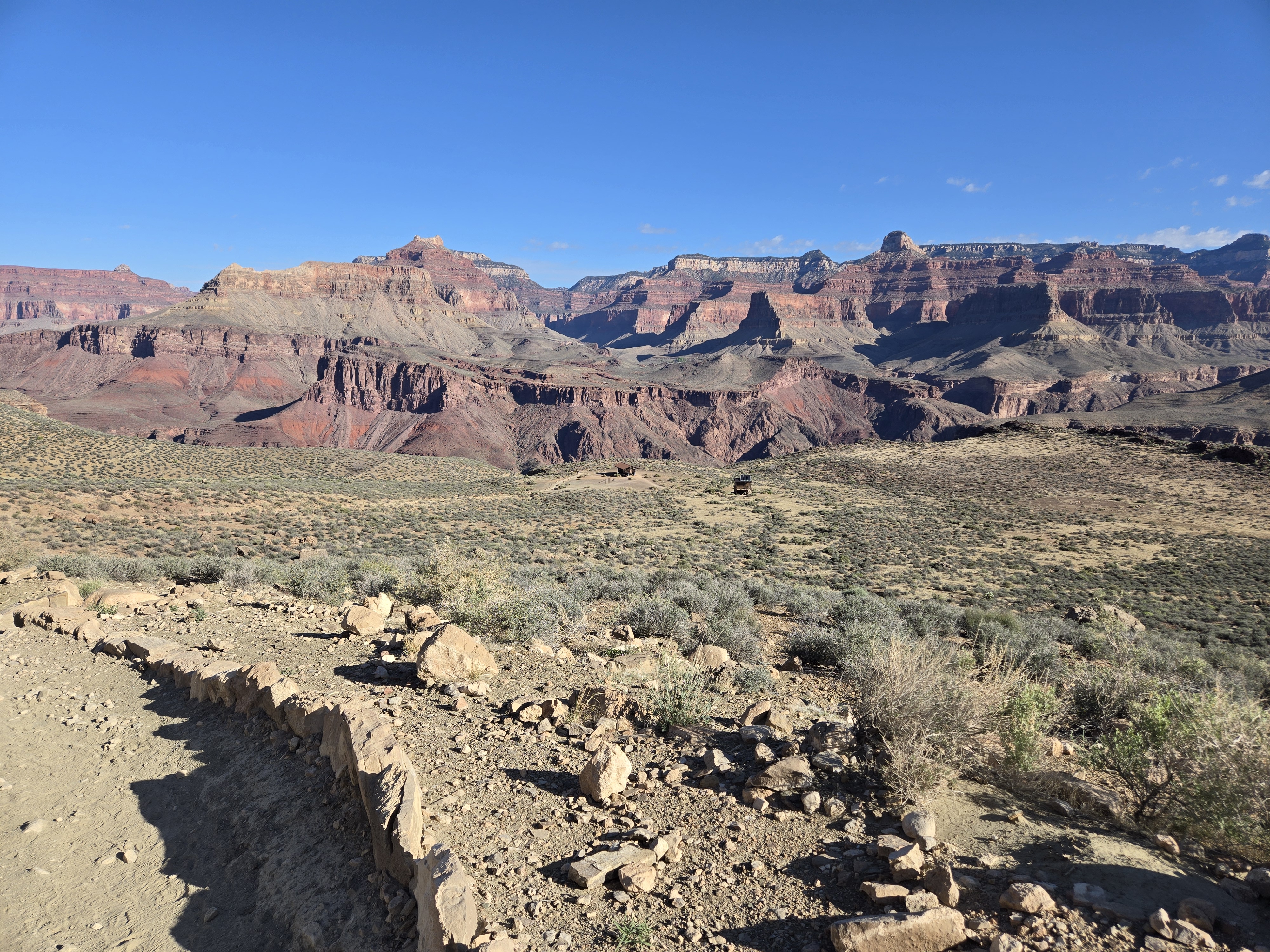
A few if the Tipoff shelter from about a 1/2 mile away.
Tipoff Shelter

Finally they start back in high hopes. After all, how bad can it be. But now they realize it’s high noon in the Canyon. What started out as a cool, dry hike in he 70s when they started, is now a hike in the lower 90s with no shade. But at least it’s a dry heat, so they don’t feel gross and sweaty.

But now it’s uphill. And their legs are aching. Their snacks are running out. And their water, the surplus they thought they had when they got to Tipoff because they hadn’t even drunk half of it disappearing fast. It dawns on them that they’re now consuming three to four times as much water on the ascent as they did on the descent.

They get back upon the Butte and find a hint of shade here or there as the Sun moves westward, but eventually they realize that the shady last mile or so from the morning is now in the full view of the Sun. They start to panic when they take the last sip of water and realize the Rim is still a mile away and at their current pace, an hour more of brutally hot hiking.

Fortunately, like most hikers, they actually make it to the Rim safely. They stand in line refilling their water bottles and drinking down as much as they can. They’re a bit nauseous, but elated. They’ve seen one of the Wonders of the World. They’ve tested their limits more than they had expected But they’re here. They lived to talk about it. And hopefully they’ve learned a lesson: hiking in is easy and optional, hiking out is harder and mandatory.
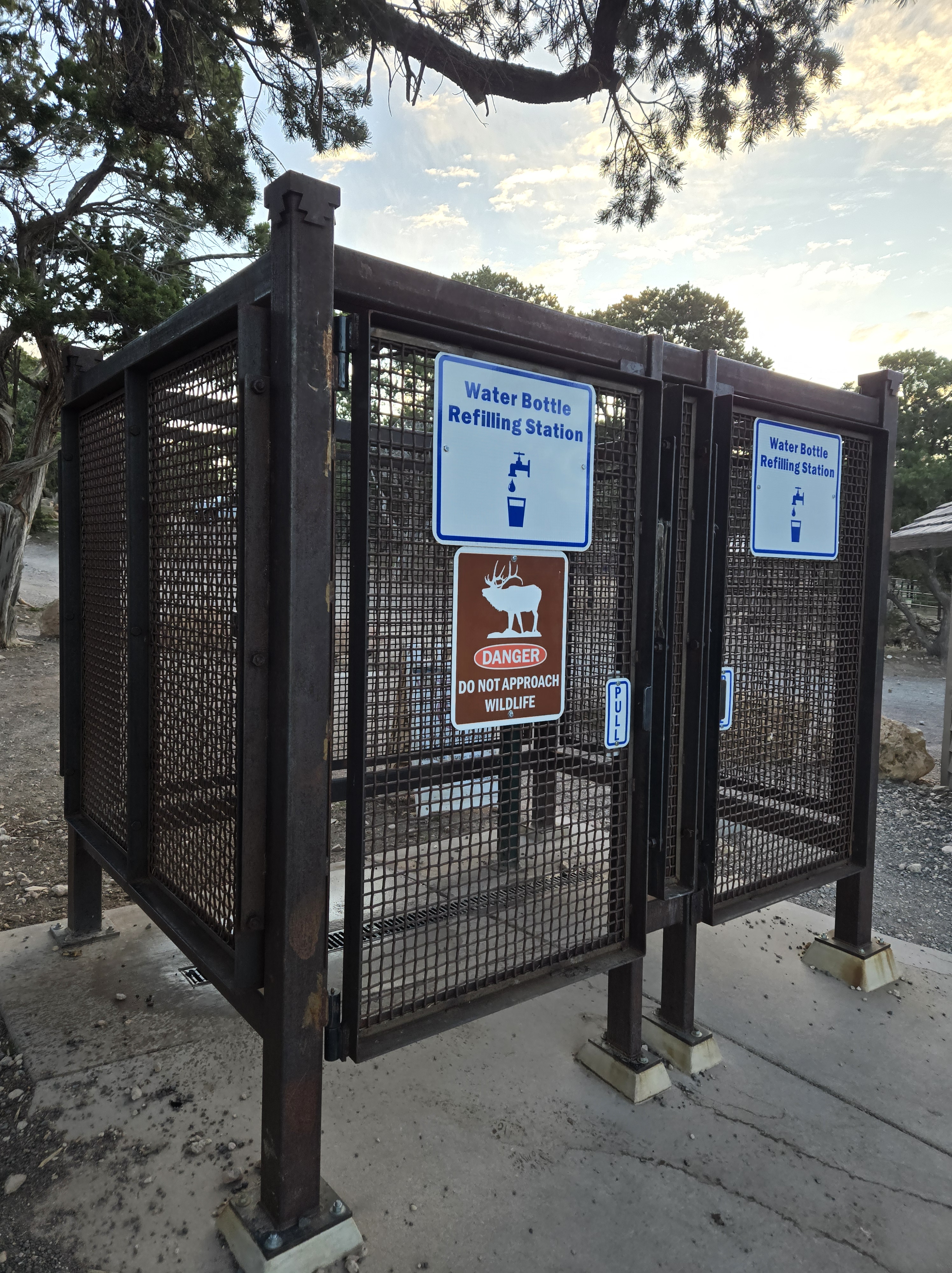
Water Station at the South Kaibab trailhead. It's in a cage to prevent wildlife from getting to it.
Water Station at the South Kaibab Trailhead

Why these thoughts? Honestly, I started this post with a different thread in mind, about how I’m approaching the end of the first year of PA school. But, my thoughts ended up taking a different path, and that has made all the difference. At least as far as this post goes.
Medical Teamwork

I’m currently watching a series of videos to prepare for taking my ACLS (Advanced Cardiac Life Support) and PALS (Pediatric Advanced Life Support) certification classes in one and half weeks. The most recent video was about teamwork when running a cardiac code.

I realized, this is one of the parts of my ED Tech job I really appreciated, not the medical side per se, but how, when you’ve got a well-oiled team that has worked together, you can make things run very smoothly.

During a cardiac code, there’s not much techs can do other than compressions or “bag” the patient (provide O2 through a BVM (Bag-Valve Mask). We can’t put in IV lines or push drugs, we can’t intubate the patient and we can’t shock them. But, those compressions are a key part of a code. We’re basically keeping the patient’s brain and heart (and other organs) perfused while the rest of the team can work their magic.

I’ve honestly lost track of how many patients I’ve done compressions on, but a fair number do stand out.

In one case, the patient was in our primary trauma bay when his heart suddenly stopped. We called a code blue and the nurse and I jumped in. She started to use a BVM to provide oxygen while I jumped up and started doing compressions. I recall thinking how natural it felt for us to be doing this. There wasn’t an unnecessary chatter or discussion. We just started doing what was necessary and once we started I counted compressions, would stop, she’d bag the patient, and I’d resume. Meanwhile like The Avengers, the rest of the team assembled. It was quick and efficient.

Another thing I appreciate, at least where I work is that they value everyone on the team. This was never more evident when I was precepting a new tech. In this case, I was basically showing him how we did things in the ED. I wasn’t really teaching him anything medical since he had a couple decades of experience as a paramedic and EMT, so his medical knowledge exceeded mine.

During this period, we had a patient go into cardiac arrest. He and I both did compressions while the rest of the team worked on him. Sadly, this patient didn’t make it. However, one thing that a good team leader does during an arrest is ask for ideas. They realize they’re human and they might have missed something. So, the attending here, one of my favorite attendings by the way, ran over what we had done to confirm we had done everything expected and then asked, “Any other suggestions?” My orient spoke up, “Is it possible he OD?”

The attending gave it a quick thought and replied, “no” and then explained why he had ruled that out as a correctable factor. It wasn’t a “who are you?” or “I don’t know you, you’re just a new tech”. He took the question seriously and gave a serious answer.

At the end of the day, we can’t save everyone. Hearts stop for a variety of reasons. But I’m proud of the team I’m member of and proud to know that we work well together and give it our best.

And that’s part of the reason I love my job as a tech.

Olympic Memories

The 2026 Winter Olympic Games of the XXXIII Olympiad are officially closed. I’ve always enjoyed the Olympic games. So I thought I’d take a bit of time to reflect on my memories of the Olympics over the years.

My first Olympic memories would be the 1972 Olympics in Munich. Fortunately, my memories of those particular Olympics are very limited but good ones. I remember going with my parents to visit some of their friends, I want to say in New Haven, CT. Their friends had kids, a bit older than me. We ended up watching Mark Spitz race. Of course the joke then and for a few years later was how did they fill the Olympic swimming pools?

I honestly don’t recall the 1976 Olympics. I was probably more caught up in the country’s Bicentennial.

But then, there were the 1980 Winter Olympics. If you are old enough and an American (and I suppose Russian, though for opposite reasons) you know where you were when you heard those immortal words, “Do you believe in Miracles?” For the record, I was in a hotel in Washington DC with some then in-laws, coming back from Florida. (We had taken the then private Auto-Train back from Florida and spent a few days in DC). This was a positive highlight during the Cold War. What I find most interesting is if you asked most Americans, they’d think that was when we won the Gold, but in reality it was a round-robin playoff game and we had to defeat Finland two days later to claim the Gold. This was of course in Lake Placid New York, and while I haven’t been on the rink, my wife has played hockey there.

I recall the 1984 Summer Games because a friend from back home went to them. She promised me a postcard which I never received. But that’s another story.

By 1988, I was in college. I watched some of the Winter Games events on TV and recall hearing how they weren’t sold out. A friend and I seriously thought about a road trip to Calgary, but decided it wouldn’t be a great idea. While the time off from school probably wouldn’t have helped our grades, I think the bigger worry was whether his car would make it and we decided being caught somewhere in the American or Canadian plains states in the middle of winter was not a wise idea. That said, I have a few regrets about not taking that road trip.

The 1996 Summer Games of course were marred by the bombing. But the highlight to me was Mohammed Ali lighting the torch.

The 2004 Summer Games stood out because of the return to Greece, though some argued it should have happened in 1996 on the 100th anniversary of the Modern Games. Being a fan of Vangelis, his music being front and center was a pleasure.

Beijing, 2008 – I’ve got to say, the opening ceremony was one of the most impressive I’ve seen. I can’t say it was my favorite, but it was huge and spectacular, exactly what I’d expect from the Chinese.

James Bond and the Queen, opening the 2012 games. This has got to be one of the best opening ceremony stunts of all times.

The 2022 Winter games were heartbreaking. Watching Mikaela Shiffrin fail to medal, not once but more than once tore at my heart. It was obvious that the death of her father was still hard on her mind. As a father I so much just wanted to tell her, “it was ok, he’s here, he’s proud of you.” I obviously have no connection to her so I know it wouldn’t do any good, but as a father, I know one is always proud of their kids.

And so, watching her finally medal in her final run in 2026 was amazing. I jumped for joy.

These entire Olympics were a joy to watch. The story of Alysa Liu was inspiring. To know that she had come back on her own terms and with joy in her heart. Man, that was just incredible. It was clear that she was having fun. That she was finally doing the sport because she wanted to and how she wanted to, not because of being goaded on by her coaches.

And I do think there was some bias in scoring for Madison Chock and Evan Bates. That said, I think the most fun program to watch in the ice dancing was Lilah Fear & Lewis Gibson from the UK.

I have other memories, but these are the ones that pop up.

Thinking Like a Programmer

It’s a bit cliche to say that the hardest thing about PA school is how much we have to learn. I mean it’s true, but doesn’t say much.

I’ve mentioned in the past how one of the biggest obstacles I had to overcome to simply even be considered to admissions, let alone be admitted, was my undergrad GPA of over 35 years ago. And I get it. If you’re attending a grad program, really any grad program, right after your undergraduate degree, your undergraduate GPA is fairly indicative of how you’ll perform in grad school. And the truth is, 35 years ago, I would have failed out of grad school. But I’m not the person I was 35 years ago.

One of the things I’ve had to do a lot of over the past 8 months or so is adapt my learning style as I go. I have to figure out what has been working and what hasn’t been working. I spoke in my previous post about how tough I find pharm. The first piece of good news is that I passed that exam. Not by much. But I passed. However, I did something I probably would not have done in my undergrad days: I set up a meeting with the course coordinator for pharm to discuss how I should approach things. So I’m already a better student than I was 35 years ago.

For me, the hardest part about pharmacology is that it’s really mostly rote memorization. There are times where the suffix portion of a drug name can help clue you in (e.g. -olol is what we call a betablocker and used for HTN) but not always. Propranolol is a betablocker we use for HTN, but also for Essential Tremors! In any case, rote memorization doesn’t come as easily as it did to me 35 years ago.

My professor gave me some advice, which honestly we had been told before, but this time in a more concrete fashion. See, I tend to make a lot of flashcards on 3″x5″ flashcards. I’ve made a few thousand by now. And they help. But she suggested I keep them briefer and more succinct and make more. She also suggested I keep them simpler. I had been making them far too complex. It sounds like a simple change, but I think it’ll make a difference (we’ll see in a few weeks after my next pharm exam).

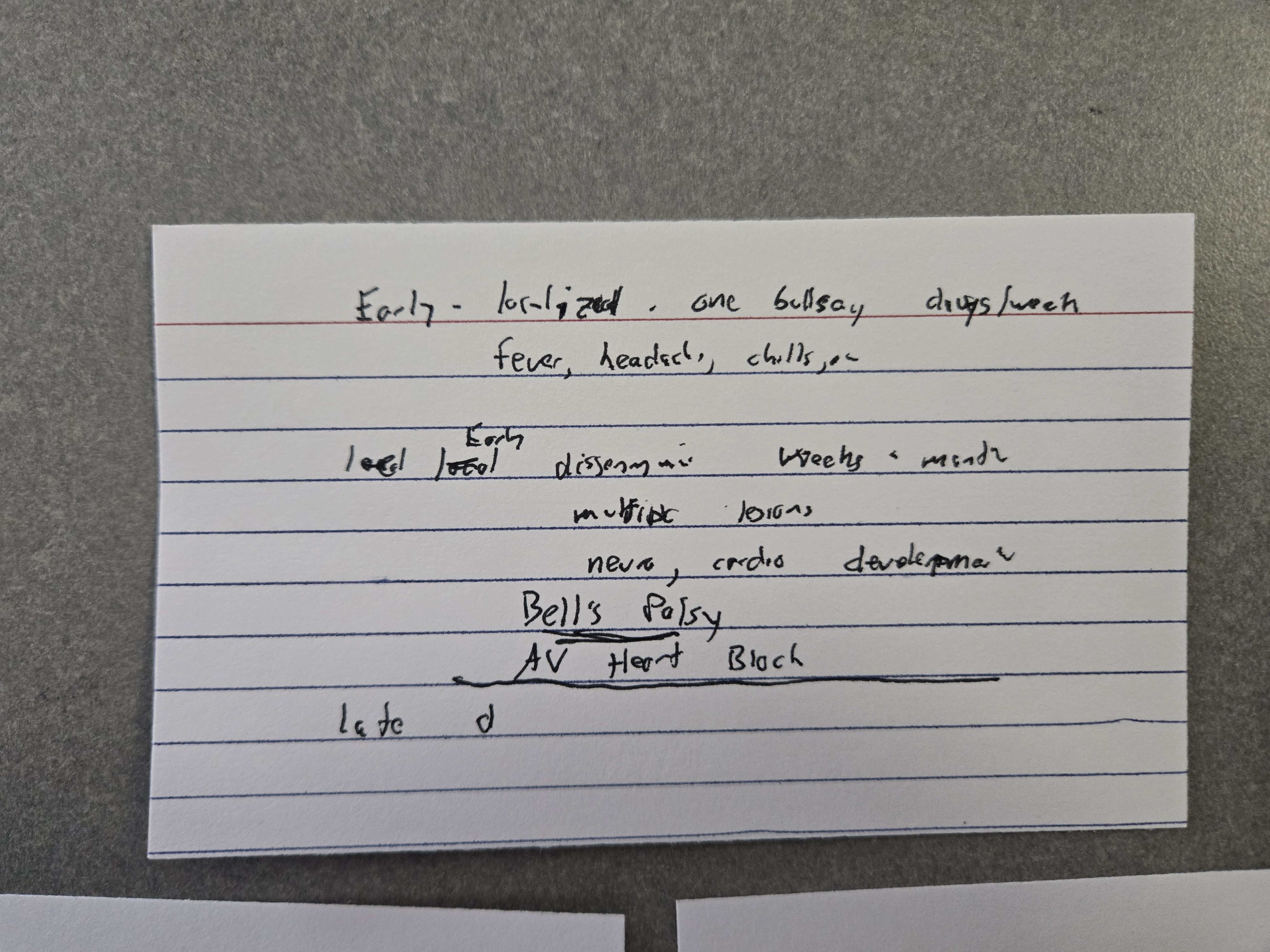
That said, I caught myself today making a flashcard on Lyme Disease stages and I realized I was cramming more and more details onto it. I stopped. I realized I was falling back on my old ways. So how does this related to programming?

Index card with detailed notes about three stages of Lyme Disease
Overly Complex Card

I was suddenly reminded of when I was hired for a programming job to work on a project using Visual Basic and Visual C#. Both are what programmers call “object-oriented” languages. I had grown up on more procedural languages. I really had very little experience programming in an object-oriented language. In fact I told them that during my interview. Their response was “we want you anyway. So I quickly came up to speed and started to think like an object-oriented programmer. And for this project, this was actually a great paradigm. The program helped engineers design and specify the parts for a particular type of physical object.

But every once in awhile I’d find myself facing particular programming challenge and finding the code hard to write and very complex when trying to solve the problem. And then it would suddenly dawn on me, I had stopped thinking in terms of objects and was trying to think like a procedural programmer. Once I went back and approached the problem from an object-oriented paradigm, often the solution would pop out very quickly and the code would be shorter and clearer.

It took a paradigm shift. So I simplified the first card greatly.

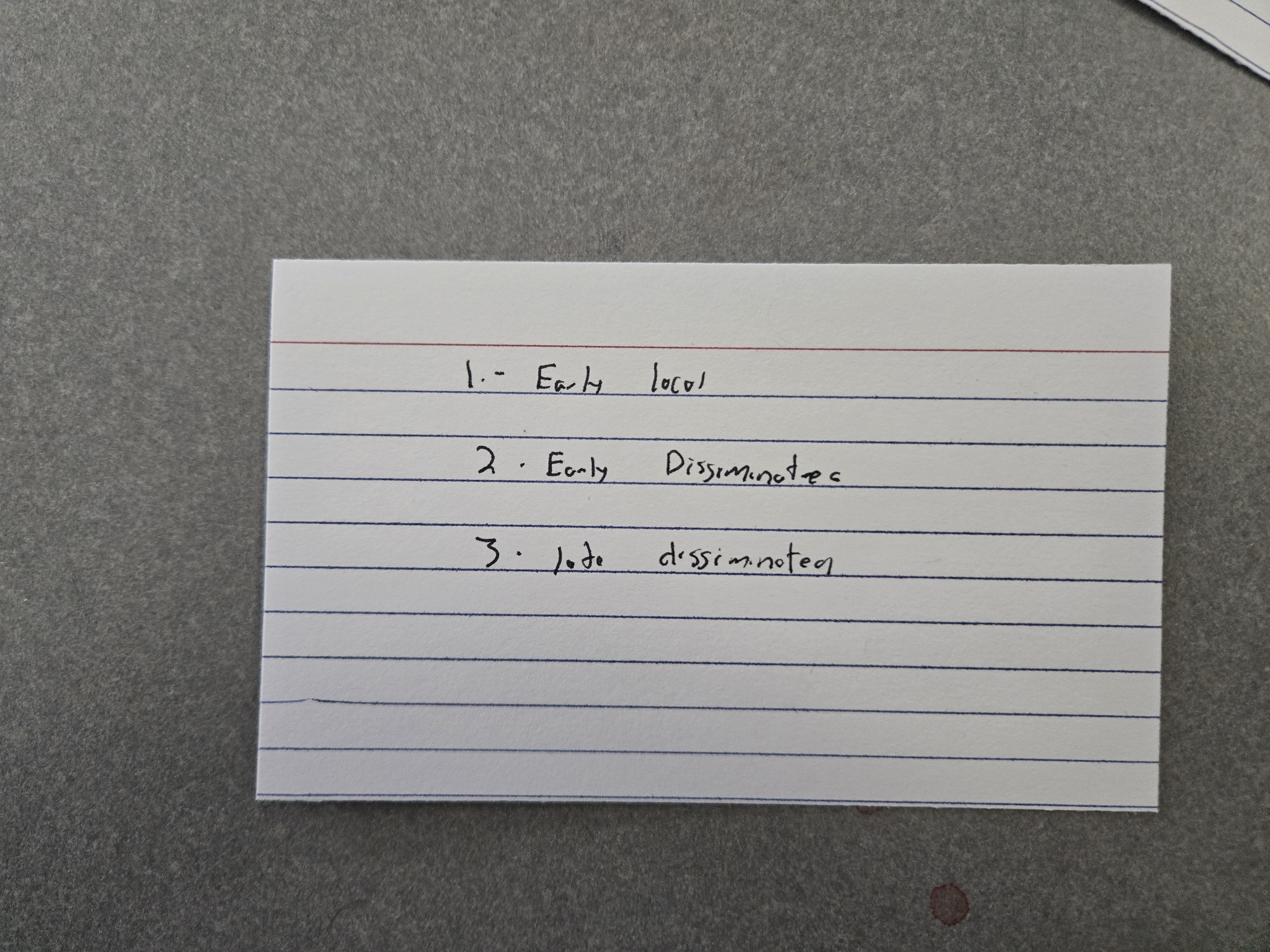
Simplified index card listing just the 3 stages of Lyme Disease
Simplified Card

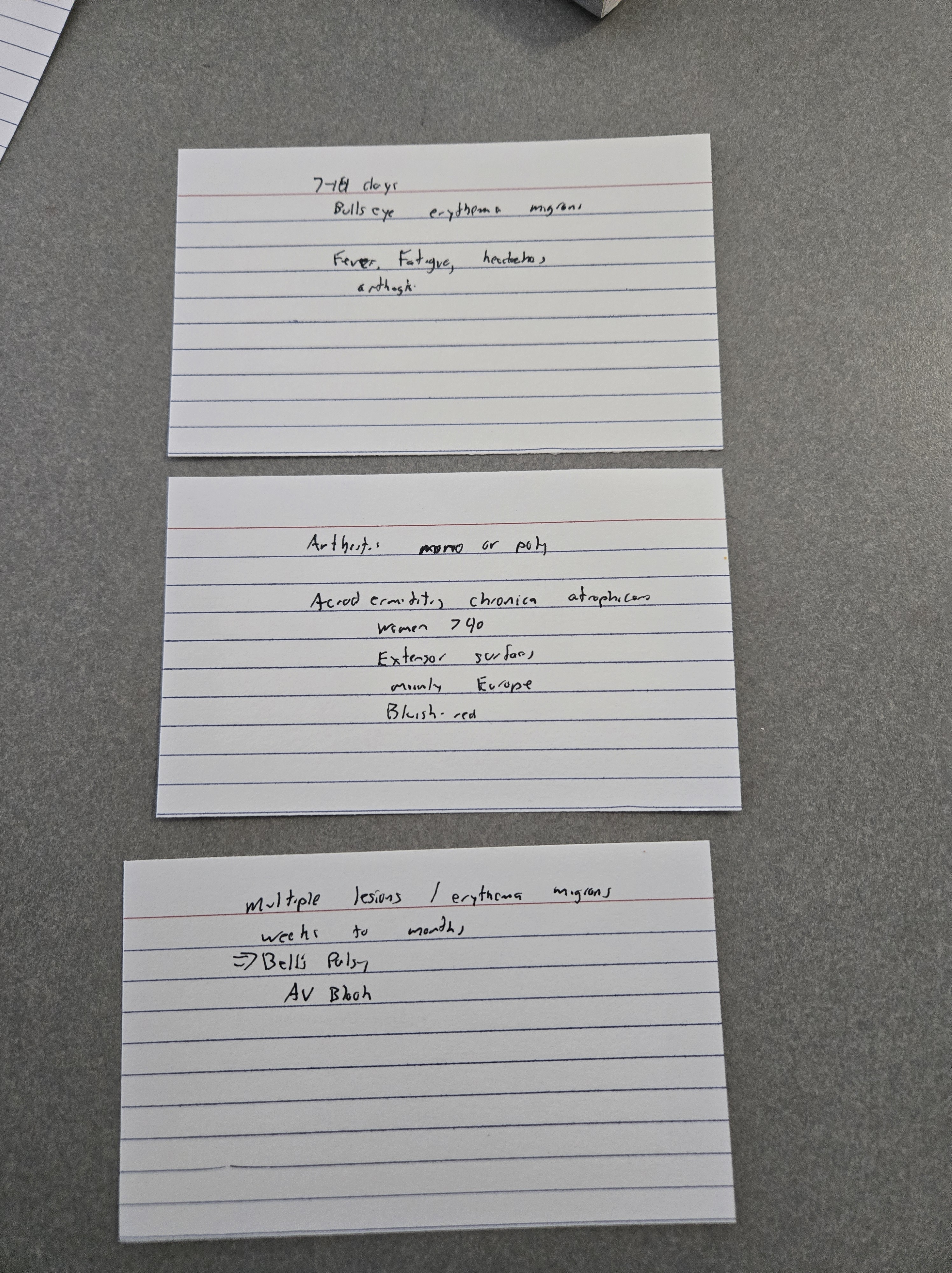
And then made three separate cards

Three index cards, one for each stage of Lyme Disease
The Additional Cards

This helps in two ways. For example, rather than have to remember every detail on the overly complex card and perhaps confuse them, I can focus on the individual stages of Lyme. If I forget one, I’m only impacted in that area at test time.

But also, I can use the cards “forwards and backwards”. i.e. I can look at the front (which states the stage) and work on recalling the signs and symptoms for that stage. Or, I can look at the back and try to recall what stage it is. It reinforces the memorization process AND means that if they ask a question in either direction, I’m more likely to get the right answer.

Does this work for everything? No. But I’m already liking it for some things.

Will it work? We’ll see.

But the point is, for me to get better at pharm (though ironically this is for a medicine lecture) I need to make a paradigm shift in how I study. Wish me luck.