“It’s Just a Simple Change”

How often have we heard those words? Or used them ourselves?

“Oh this is just a simple change, it won’t break a thing.” And then all hell breaks lose.

Yet, we also hear the reverse at times. “This is pretty complex, I’ll be surprised if it works the first time, or if it doesn’t break something.” And yet then nothing bad seems to happen.

We may observe this, but we don’t necessarily stop to think about the why. I’ve seen this happen a lot in IT, but honestly, I’ve seen this happen elsewhere and often when we read about accidents in areas such as caving, this also holds true.

I argue that in this case the perception is often true. Let me put in one caveat. There’s definitely a bias in our memory where we don’t recall all the times where simple things don’t break things, but the times it does, it really stands out.

The truth is, whenever we deal with complex systems, even simple changes aren’t so simple. But we assume they are and then are surprised when they have side effects. “Oh updating that path here won’t break anything. I only call it one place, and I’ll update that.” And you’re good. But what you didn’t realize was another developer liked your script, so made a copy and is using it for their own purposes and now their code breaks because of the new path. So your simple change isn’t so simple.

Contrast that to the complex change. I’m in the middle up refactoring a stored procedure. It’s complex. I suspect it’ll break something in production. But, honestly, it probably won’t. Not because I’m am awesome T-SQL developer, but, because of our paranoia, we’ll be testing this in UAT quite a bit. In other words, our paranoia drives our testing to a higher level.

I think it behooves us to treat even simple changes with more respect than we do and test them.

In the world of caving we use something called SRT – Single Rope Technique. This is the method we use for ascending and descending a rope. When ascending, if you put your gear on wrong at the bottom, generally there’s no real risk other than possible embarrassment. After all, you’re standing on the ground. But obviously a the top, it’s critical to put your equipment on correctly, lest your first step be your last. Similarly, we practice something known as a change-over; changing from ascending to descending, or descending to ascending while on rope. When changing from climbing to descending you want to make sure you do it correctly lest you find yourself descending at 9.8m/s^2. To prevent accidents, we ingrain in students “load and test your descent device before removing your other attachment point.” Basically, while you’re still secured to something at the top, or to your ascending devices if you’re partway up the rope, put your entire weight on your descent device and lower yourself 1-2″. If you succeed, great, then you can detach yourself from whatever you are attached to at the top, or remove your ascending devices. If somehow you’ve screwed something up and the descent device comes off the top or otherwise fails, you’ve got a backup.

Now, I will interject, getting on rope at the top of a pit, or a changeover is something an experienced caver will have done possibly 100s if not 1000s of times. It’s “a simple change”. Yet we still do the test because a single failure can be fatal. And I have in fact seen a person fail to properly test their descent device. And moreover, this wasn’t in a cave, or other dark or cramped space. It was in broad daylight on the edge of the RPI Student Union! This was about as simple as it could get! Fortunately he heard it start to fail and grabbed the concrete railing for dear life. In this particular case a failure most likely would not have been fatal, but would have caused serious injury.

So, despite having gotten on rope 100s of times myself, I ALWAYS test. It’s a simple change. But the test is also simple and there’s no reason to skip it.

The morale of the story, even your simple changes should be tested, lest you find they’re not so simple, or their failures aren’t so minor.

This Post is Free!

Yes, seriously, other than a bit of your time, it will cost you nothing to read this post. And you might gain something from it. That can be a good value.

As I’ve mentioned in the past, one of things I do when I’m not doing SQL Server is perform training for those interested in Cave Rescue. I also sometimes blog about it. I have also mentioned that this year I’m organizing the National Cave Rescue Commission‘s national weeklong training class. In addition, since apparently I’m not enough of a masochist I’m also organizing a regional Level 1 only weeklong training class.

Due to generous contributions the NCRC is able to offer scholarships. For the regional weeklong, we are able to offer 4 scholarships of a value of up to $375 each. This covers 1/2 the cost of training. Applications were due Saturday. Now, we’re hoping for 12-20 students, so this means if everyone applied, they’d have between a 1/3-1/5 chance of getting scholarship. Can you guess how many had applied as of Saturday?

Before I answer that, I’ll note my wife used to work as a financial aid director at a local nursing school. They too sometimes offered scholarships. There was one worth I believe $500 that often went unclaimed. Yes, it required a one page essay to be judged to apply. That one page apparently was too high of a barrier for many folks and as a result sometimes it was never awarded. Quite literally a person could have written. “I would like to apply for the scholarship” as their essay and gotten it.

The same thing happened with our regional scholarships. Out of 11 students so far, none applied. This was literally free money sitting on the table. We have decided to extend the scholarship application process until April 23rd and reminded folks they could apply.

Now, some of the students probably can NOT apply, because they are employees of government agencies that sometimes have rules on what outside funds or gifts can be accepted. This actually increases the odds for the other students. And some may feel that their economic status is good enough that they don’t need to and fear they’d take a scholarship away from someone who has more of a need for it. And that’s a position I can definitely appreciate. But my advice to them, “let the scholarship committee make that decision.” If they determine someone is more needing the money, or your need is not enough, they will let you know. And if they do give you a scholarship and you feel guilty, pay it forward. Donate to the fund later on, or give the money you saved to other causes.

Besides essentially free money at the NCRC, I got thinking about the amount of free training I’ve received in the SQL Server community. Yes, I’ve paid for PASS Summit a few times, but even if I had never gone to that, the amount of knowledge I’ve gained for free over the past several years has been amazing. Between SQL Saturdays and User Group meetings, the body of knowledge I’ve been exposed to has been absolutely amazing.

And yet, I know folks who shun such activities. I’m not talking about folks who say, “I can’t make it this month because it’s my kid’s birthday”. I’m talking about folks who claim they never learn anything. I don’t understand how that’s possible given the HUGE range of topics I’ve seen at SQL Saturdays and oh so many other free events. Some folks seem to think only the paid events are worth it. And while PASS Summit had certain unique advantages, the truth is, you can listen to almost all the presenters at various free events too.

Yes, time is not free, and I recognize that. But overall, it still amazes me at the number of folks who overlook the value of free events, or easy to gain scholarships to events. Don’t turn your nose up at free. It can be valuable.

P.S. – for the parents of college bound kids out there, one thing I did in college which netted me a bit of free money. A few days after the semester began, I’d stop by the financial aid office and ask if there was any unclaimed scholarship money I was eligible for. I never netted much, but I did net a few hundred dollars over the years. For 15 minutes of my time, that’s a pretty decent ROI.

Stop! Basic vs Deep Understanding

As an NCRC instructor, it turns out I’m eligible for steep discounts on equipment from a company called Petzl. I decided to take advantage of this a few weeks ago to get some new equipment for caving and just for practicing in general. One of the pieces, a new helmet was a no-brainer (in order to protect my brain). And I must say it’s so much more comfortable than my old helmet that I’m quite happy with it and has become my new default helmet. Well worth it.

Background (cavers (or anyone really) can skip this!)

But one of the other pieces I bought is a bit different. It’s called a Stop. For those who aren’t familiar with caving, first some background. Excluding cave-diving, which is a very specialized activity, caving is pretty much divided into horizontal and vertical. Horizontal caving doesn’t mean it’s perfectly flat, but does mean you can basically move through the cave using just your hands and feet and maybe a piece of webbing or short rope as a handhold.

That said, at some point, many cavers want to start to explore more caves that have more vertical relief and that require ropes to descend into. Unlike rock-climbers, cavers don’t actually climb the rocks (as a general rule) but the rope itself.

The general techniques used by cavers fall into a category known as Single Rope Technique (SRT). The emphasis here is that a single rope is used to ascend and descend. This article won’t go into all the different ways of ascending the said rope, but among the systems are what are known as Frog, Texas, Mitchell, Rope-Walker and homegrown ones. Cavers will argue infinitely over which one is better, but at the end of the day, much of it comes down to personal preference. (That said, the Frog system is by far the most common one used in Europe and the US tends to be far more varied.)

Generally the most common way of descending is to use a device that generates friction with the rope. Here is perhaps the biggest difference between European Frog users and American Frog users.

In the US, most Frog users (in my experience, I’m not sure I’ve seen a great poll) use what’s known as a micro-rack. (And yes, this does mean there’s a non-micro-rack. These are still used in some cases, but far less common).

Image shows a micro-rack on 10mm rope on the left and on the right, the fore-arm/palm of a left hand for scale,
Micro-Rack (left on rope in position of use, on right to show scale)

These are fairly simple devices that are durable and given the design, generally can provide a wide range of friction. Generally in American SRT work, once you start descending, you stay on a single rope and don’t need to move to another rope. I love my micro-rack and can, while hanging on the rope (from my climbing devices) change over safely to be able to rappel in well under a minute and I can do it blindfolded (that’s not an exaggeration, I’ve tested myself.) It’s a great device and it works.

But as I mentioned, this is in the US. In Europe, most cavers would look at me twice and wonder what the heck I was thinking. Over there a different device, generically known as a bobbin is used. In my case what I bought was a version from Petzl known as a Stop (among other things, it has a handle to help move one of the internal “pulleys” to vary friction)

Open Petzl stop on left, attached to rope on right

Stop! This is the part to read!

And now after all the long-windedness I’m finally getting to the meat of this post.

As I mentioned above, both devices rely on friction. Both require some device specific knowledge to use. For example, with the micro-rack you need to know which way to thread the rope. With the Stop, you need to be aware of the requirement of what’s known as a braking carabiner in addition to the Stop itself. In this case I’m using a specific carabiner Petzl sells called a Freino Z. Each device also has a specific way of doing what’s known as a hard tie-off. This is essentially a method of tying the rope around the device such that if you release both hands from the device and rope you will not descend. This is a critical skill to have.

So, after playing with the Stop on the ground a bit, I decided I had to try it as I would use it, i.e. 10′ in the air off the floor of my office while attached to a rope. I struggled a bit, but changed over from my ascent to descent safely and made it back down.

I mention this because I didn’t have anyone there to teach me or show me. I was reminded again that there’s a difference between what I’d call rote or a basic understanding and a deep understanding. I teach a lot of beginners how to change over from their climbing system to their descent devices. And it’s obvious at first that they are simply replicating the motions taught to them. I know I did when I started. Put this here, put that there. It works, they technically pass the requirements needed to take the class I’m teaching. But, if suddenly in the middle of a trip their equipment failed or they lost it (it’s not entirely unheard of for someone to drop their rappel device down the shaft) and had to change to a different piece of equipment, they quite honestly would be lost.

Their basic understanding is limited to the original device. They don’t fully understand how it operates as much as “how to do these steps to make it work”. Only with time and lots of practice does the basic understanding become deep understanding. This is to me, the fun and interesting part. I’m not saying you could hand me any device and I’d automatically understand how to use it. For example, unless someone tells you a braking carabiner is a required part of a bobbin setup, you wouldn’t know that just from looking at it. But if someone said, here’s the basic operations and here’s some details you’d need to know, then yes, you feel confident I could use a new device.

In the case of SRT, proper knowledge is literally a life safety issue. But what about databases. (Yes, I almost always find a way to tie my caving activities to databases!)

I saw a question on Quora the other night asking “How do I do a backup/restore in SQL Server.” The basic answer is readily apparent, even from a casual reading of the documentation. BUT, the deeper understanding should be to the point, where among other things in my opinion, when doing a restore with NO RECOVERY automatically flows from your fingertips. Sure, you might find that you’ve recovered exactly what you need with the first file and no additional logs are necessary, but how many of us have finished a multi-hour restore only to realize we forgot the NO RECOVERY and now can’t apply our logs and have to start over? This may seem annoying, but if it’s the production database, you’ve just more than doubled your recovery time and hence your outage. That’s not a good thing to happen.

Similarly, many of us have seen things like NOLOCK used in queries. We almost always cringe. Sure, the syntax may be correct, but 99 times out of 100, the usage shows the person didn’t have a deeper understanding of the implications.

So it’s about more than simply knowing the syntax (which I’d argue is similar to the rote or basic memorization on how to put a micro-rack or bobbin on a rope) as much as knowing implications of the syntax and why certain things are done.

I’m still working on getting as good with the Stop as I am with the micro-rack, but honestly, if you stuck me in a dark cave tomorrow, I think I’d do just fine.

And next time I restore a database, I think I’d do fine. Will you?

The Value of Paper vs Convenience of Digital

About 35 years ago in the fall, a housemate of mine got a phone call, “hey, I’m a caver who’s passing through your area this weekend and found your name in the NSS Members’ Manual, I was hoping maybe you could hook me up with a caving trip.” Well it just so turns out that the RPI Outing Club traditionally does Friday night caving. (Why night you might ask? Well it’s always dark in the caves, so going at night leaves time on Saturday and Sunday to hike, rock-climbing, canoe, etc.) My housemate invited the guy along and he joined us caving (I think in Knox Cave).

I mention this story because it’s an example of how the NSS Members’ Manual has often been used over the years. Talk to enough old-time caves (especially those who recognize the smell of carbide in the morning) and many will mention how they’ve been in a strange area and looked up a fellow caver. Usually the lookup was to find someone to go caving with, but it might also be help with a broken vehicle, looking for crash space for a night or even more esoteric reasons. Many cavers kept a copy in their vehicles so they’d always have it with them.

Well, this past weekend (March 13th to be precise) the Board of Governors of the NSS voted to stop publishing the Members’ Manual. There was a lot of debate on the topic during the meeting and later online on Facebook (and I assume other spaces) and I wanted to discuss a bit of it here.

There were several rationales for this decision and I don’t think any specific one can be pointed at and said, “this is the reason.”

Conservation was certainly mentioned. The NSS is after all a group who has a primary charge of conservation and while this primarily pertains to underground resources, I think arguably not wasting trees falls into this purview. I’ll leave the debate about the size of the actual impact to others.

Convenience was another one mentioned. Many argued the online members manual which allows for searching to be more convenient than flipping through pages. I’d agree there’s some merit to this argument, but as others countered, that doesn’t mean much if you’re outside cell range and that many caves just happen to be outside cell range. A printed manual is always available, never runs out of batteries and never goes offline. I think there’s merit to both sides of the argument and a lot depends on one’s use case.

But there was an argument I had not given much thought to before and as it continued I started to notice that it was perhaps more demographically split than the others. This argument was about data privacy.

While the argument about the convenience of a printed manual did tend to skew towards the older cavers, that wasn’t strictly true. Even many of the older cavers admitted they hadn’t opened the printed manual in years and preferred to use the online manual.

But the argument about data privacy definitely appeared (in a very non-scientific look) to have two skews: younger and by gender.

At least one, and I believe two of the younger folks advocating for dropping the printed manual expressed shock when they first received their copy of the Members’ Manual and found what they considered personal information, including their home address printed therein. And pretty much all the objections to such easily available information came from women. This gave me cause to think. There’s been a lot of discussion among some NSS members about Diversity, Equity, and Inclusion. Many (and it’s almost always older white men by the way) will argue, “oh anyone is welcome caving!” And while that’s true, I will argue many are ignorant of some of the barriers that might exist. I’ll admit, I had always looked at the Manual as a great way to get in touch with a fellow caver. I mean after all, why not? I’m a good, decent guy. Pretty much most of the cavers I know are. Why would it be a big deal if some random caver wanted to get in touch with me? This discussion about privacy has made me rethink that. My assumptions do not necessarily hold true for those who don’t look like me.

Now, two notes: First, I’m fairly positive, but I can’t be sure and will admit I haven’t looked closely, one has always been able to opt-out of what info went into the printed Manual. I could be wrong. Second, the online method I know positively has that option. And here’s one area where the online manual is superior. It can be constantly updated. This means not only is address info potentially more current, but a member can at any point go in and add, or more importantly, REMOVE their personal information if they so wish. Once the printed Manual goes out, such information is there forever. This presents a risk some members don’t want to have.

Now, I’m going to make a slightly contradictory argument before I come to my final words. As a data professional, on one hand I’m a fan of “make all things digital!” There are definitely benefits, many of which are outlined above. The ability to dynamically update information and access it in many different ways is arguably a huge plus.

BUT, I’m also well aware that while we say, “once it’s on the Internet, it’s there forever” the reality is far more complex and nuanced. Anyone seen their Geocities pages lately? And while it’s not true that NASA has lost the Saturn V plans, the reality is, there are computer tapes, especially from the earlier planetary missions that are either hard or even impossible to read. This is partly due to the fact that the magnetic media has decayed but also due to the fact that the hardware has disappeared. This happens in our own lives. How many of my readers have games or other items on floppy disk and no way to read it with a computer in their house?

I mention this because among other things, the NSS is a research organization. This means it’s quite possible that 10, 20 or 50 years from now, someone may come along and want to do research on the membership of the organization. They might want to explore where cavers are from, the type of members, how long folks were members, or for other goals we can’t imagine at this time. While inconvenient to do such research from printed form, I can guarantee that the printed manuals will be readable 50 years from now. And each one will be an annual snapshot. I’m not so sure that the current membership database will be readable 50 years from now (how many folks for example can read a dBase III database?) and I’m even less convinced that annual snapshots will be easily available (that said I’m not privy to how the membership is stored and if it’s always dynamic or if there’s annual snapshots or what).

So in my final words I’d say “there’s no perfect answers” here. I think the arguments for and against a printed manual have merit and both sides need consideration. My preference is a compromise:

  1. Charge members who want the printed Manual an upcharge to help cover costs. Make this opt-IN (i.e you don’t automatically get a manual unless you ask)
  2. In addition, a certain number of Manuals should be archived at research libraries around the country. While all this data is stored at the headquarters, disasters such as fires, water leaks, etc can happen. I think the NSS needs to ensure that data, such as a history of its membership needs to be preserved.
  3. When members join or renew, other than their name and membership number, make all PII data opt-IN for printing and for on-line. Nothing will show in either place unless they specifically allow it. This is the modern world and all members should have the right and ability to control what information of theirs is made public. This is among other things a DEI issue.
  4. Drop any form of on-line PDF (I can’t find one, but several people mentioned they had found one). Ironically this is perhaps the biggest risk in my mind of breach of privacy data; PDFs are easily scraped for data. In addition, do NOT allow a “global” search of the on-line Members’ Manual where all members can be looked up at once. Both this and if there’s an inline PDF make scraping far too easy.
  5. Take into account current data privacy laws (such as in the EU and California) that have a direct impact on the retention of online data.

Basically I’d prefer, if not the best of both worlds, the best we can get: the convenience and permanency of a printed manual as well as the convenience and dynamism of an online manual. Both I feel have their place. But as far as either goes, I think the growing awareness of data privacy practices and the fact that the NSS needs to be aware that for some, this IS a DEI issue, means that the status quo has to change. I’ve said before, “the times they are a changing” and this is an example of that.

What’s for Dinner?

“Food!” is my usual answer. Yes it’s my dad joke answer. I can’t help it.

The truth is, I generally don’t have a well planned menu in advance and sometimes what I plan on making for dinner will change after I step in the supermarket and something catches my eye. Sometimes I won’t even have an idea until I go into the supermarket. That said, I still have sort of a routine, one my family is familiar with and perhaps at times tired of. (That said, they still eat what I make, so I guess they’re not that tired of it).

  • Monday – Usually a chicken dish. Last night was Pad Thai (but I’ll let you in on a secret, the noodles were woefully underdone. I was afraid they’d turn to mush and took them out too early!)
  • Tuesday – Usually something centered around ground beef/turkey, tacos, sloppy joes or shaved steak for Philly Cheese steaks. I’m not sure about tonight’s dinner, but since I did tacos last week, I can guarantee it won’t be Taco Tuesday tonight. I don’t like repeats. 🙂
  • Wednesday – Up in the air. Sometimes a grilled sausage, onion and pepper on a bun.
  • Thursday – Often store bought ravioli or tortellini. They’re simple and quick.
  • Friday – I get more creative, often some crab cakes, maybe scallops, or something good.
  • Saturday – At least once a month, pizza with homemade crust (and occasionally homemade mozzarella).
  • Sunday – Take out. Previously 90%+ of the time it was Lee Lin, a Chinese food place I’ve been ordering from for decades (literally since college) but now we vary it up with other take out places.

So yeah If you happen to show up at my house (post-pandemic please) you’ve got an idea of what you’ll end up with depending on what night you show up. Maybe. I might change my mind.

I really enjoy cooking. I love the idea of creation and the idea of nourishing body and soul. I like the fact that food can bring joy to people.

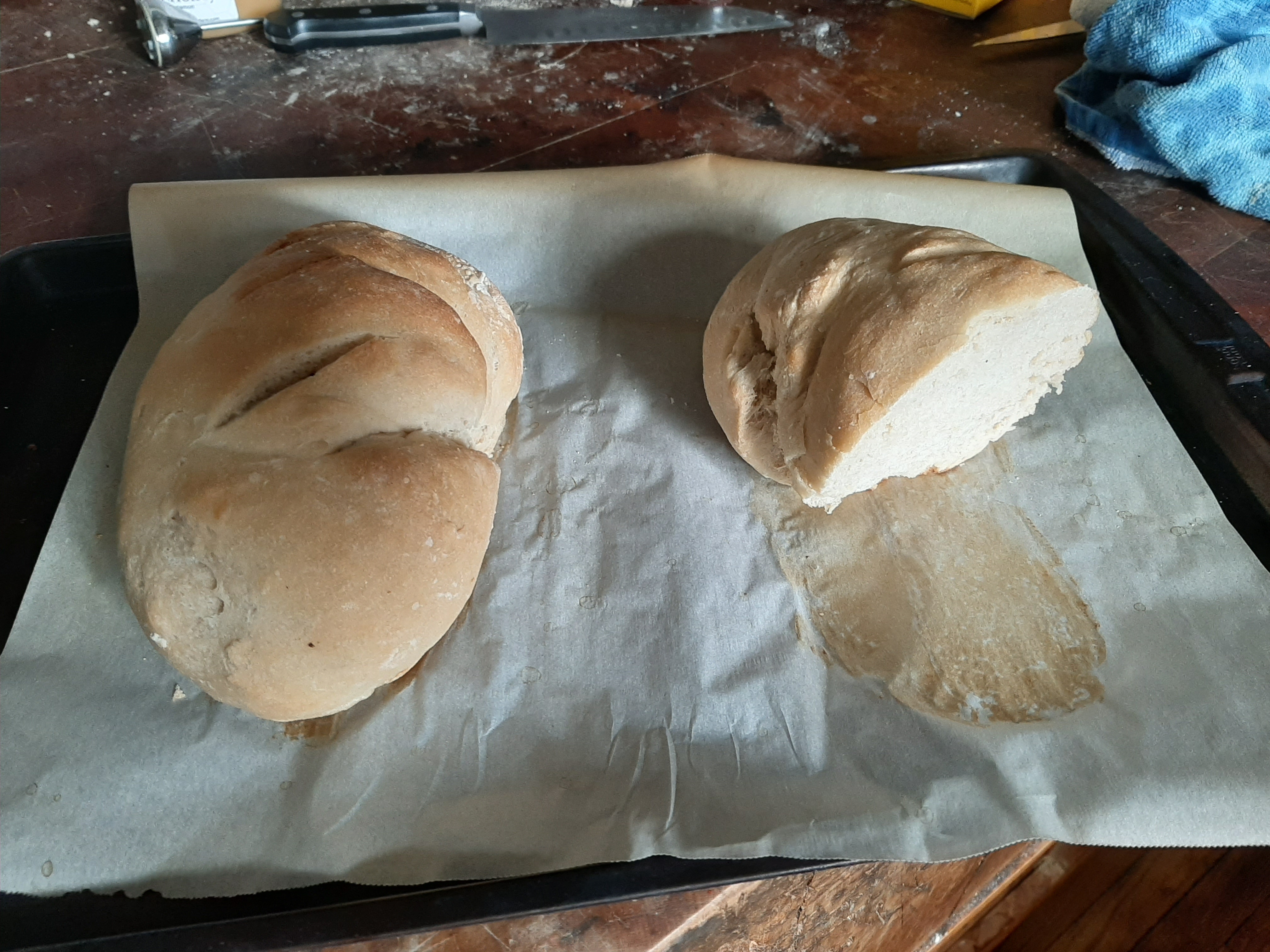
During the time of Covid, there have been times when cooking has been a real drudgery, but other times I’ve really enjoyed it or had the chance to try new things. For example, like many Americans I’ve dabbled with making Sourdough.

Image is of  full loaf (on the left) and a half loaf of homemade sourdough bread.
Fresh Sourdough, an early attempt.
A roast beef sandwich with lettuce and tomato and mayo on a plate. In the background is a keyboard.
Roast Beef Sandwich with homemade sourdough bread!

Of course I mentioned pizzas?

An image of two pizzas from above, resting on a butcher block.
The one on the left is a pepperoni pizza. The one on the right is a white pizza with sundried tomatoes. 
Both have fresh basil from my garden on them.
Two sourdough pizzas with home grown herbs.
Image of two pizzas looking from above. On top of a butcher block.
Top one has fried onions, Granny Smith apple, bacon, sundried tomatoes.

Bottom one is white pizza with home made pesto.
Two more: the top is bacon, sundried tomato, Granny Smith Apple, fried onions! The bottom a white pizza with homemade pesto and some sundried tomatoes
“Breakfast Pizza” with cheddar cheese, bacon, black pepper and a pair of eggs cracked on top near the end.

For Thanksgiving I tried something new:

An experiment for Thanksgiving dessert - apple sharlotka. It was a success!
An experiment for Thanksgiving dessert – apple sharlotka. It was a success!

And of course one has to have sweets!

Gingersnap cookies
LOTS of sugar and carbs!
Bags of Christmas Cheer
A smattering of gingerbread men!

But of course, the question is “what’s for dinner?

My French-Canadian grandmother’s recipe for baked kibbeh taught to her by her Lebanese mother-in-law. BTW, this is 1/2 the amount she’d normally make for family gatherings! This is over 3 lbs of meat plus bulgur wheat and onions! It’s a LOT of food and oh so delicious.
I actually bought my air fryer BEFORE the pandemic, but love it and use it a lot and find it makes great wings. (And the cinnamon cap has nothing to do with the wings.)
Air fried General Tso’s Chicken, finished in the pan. Thanks to #SQLFamily fellow DBA Rie Shewbart Merritt for the recipe!
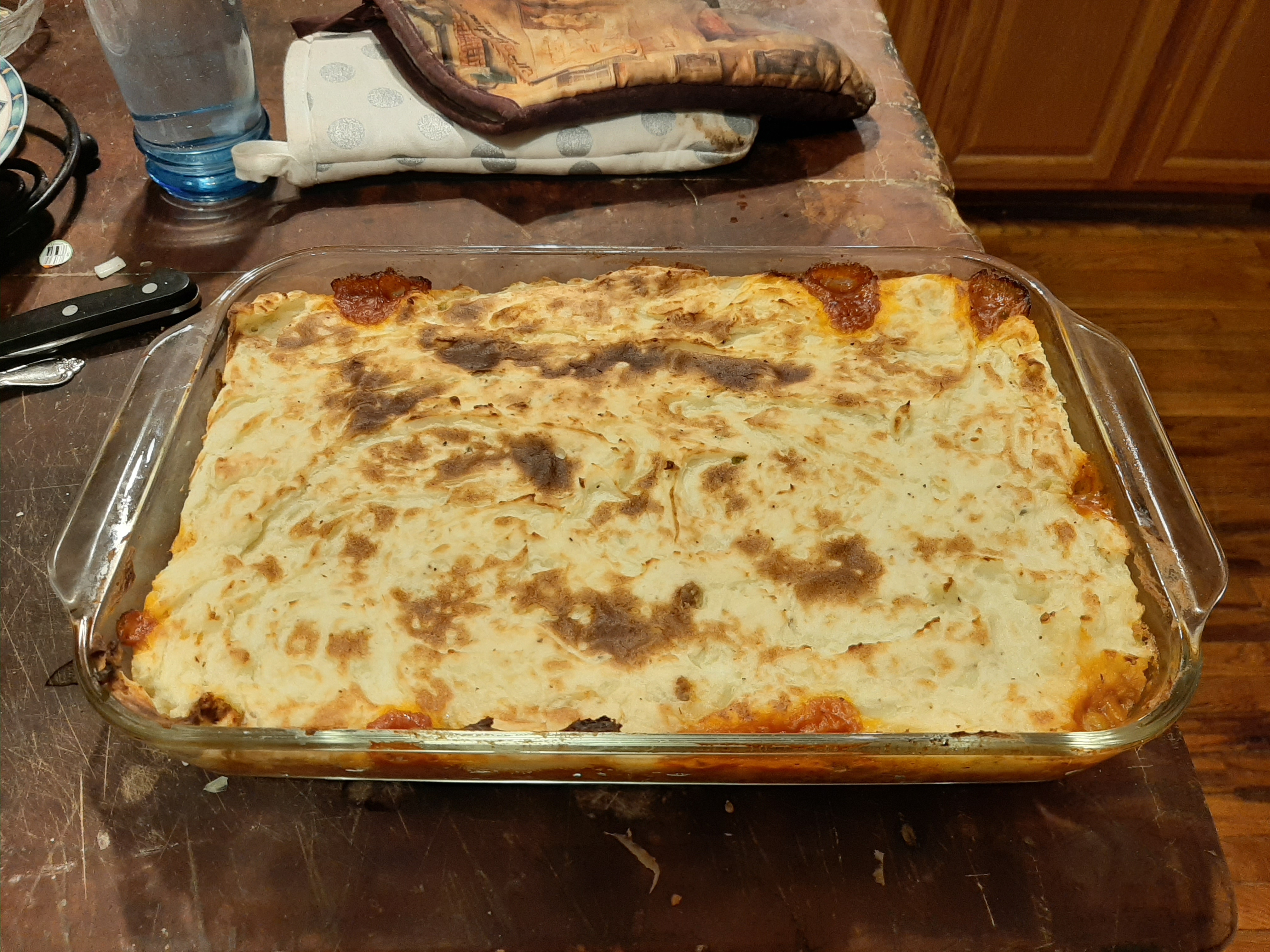
Technically “Cottage Pie” because it’s made with beef instead of lamb, but still delicious, and one of Randi’s favorites!
A Friday dinner with steak and potato (and yes, I’m a heathen who likes a bit of ketchup with my steak, but that sauce is delicious too!)
Perogies that close family friend Christine Dzakowic Walsh had made, but fresh herbs from my garden.
Another Friday dinner. That’s my burger on the right, with the works, grilled onions, bacon, bleu cheese, lettuce, tomato, garlic-parm fries!
Can I interesting you in mini-beef wraps with mashed potatoes with a wine-sauce reduction? I think I got this one from close friend Sarah Lawrence.
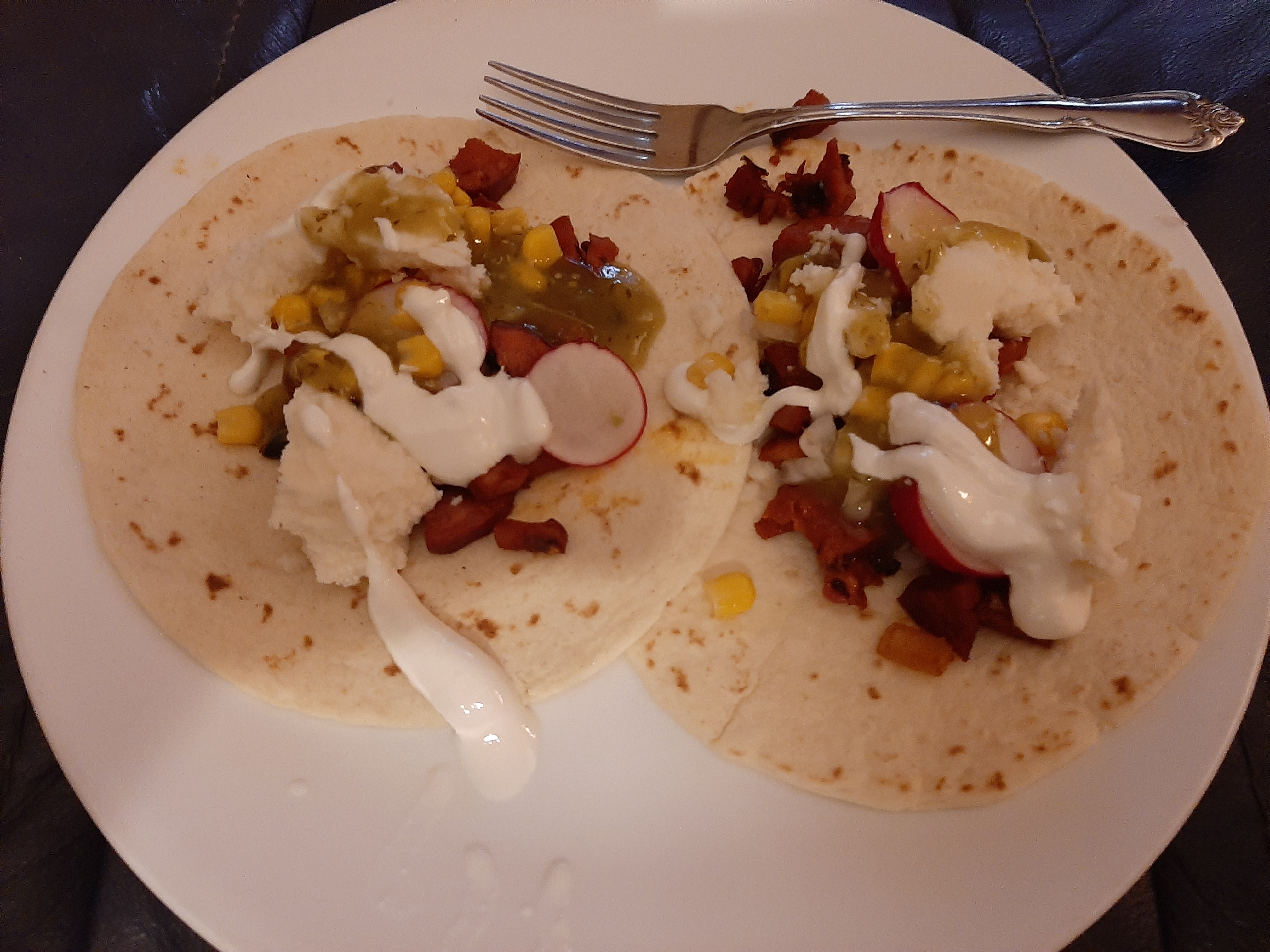
Chorizo street tacos anyone?
Homemade Falafel and homemade hummus with a peanut sauce and veggies and homemade pita. I need to make this again soon I think.
Of course latkes are a must in this house come Hanukkah! (toss in some curry powder, trust me on that one!)
Homemade pasta with homemade pesto and Presto… delicious dinner!
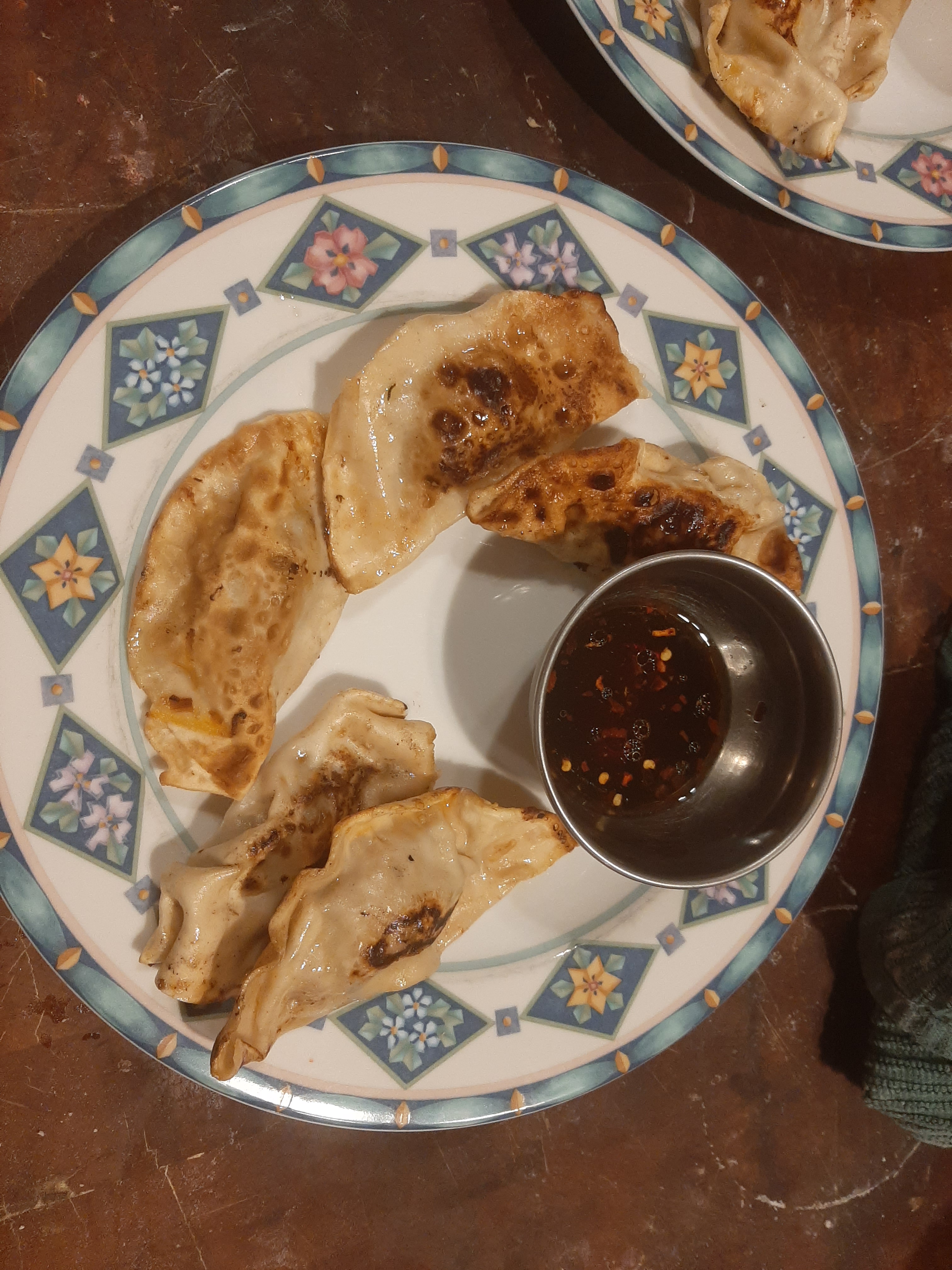
My most recent experiment, homemade dumplings! Delicious but need some work!
Some homemade chili with yes.. sourdough bread!
Coquille St Jacques – delicious! My mom introduced me to this dish when I was about 10.

And besides dinner, there’s breakfast

French toast with lots of cinnamon!
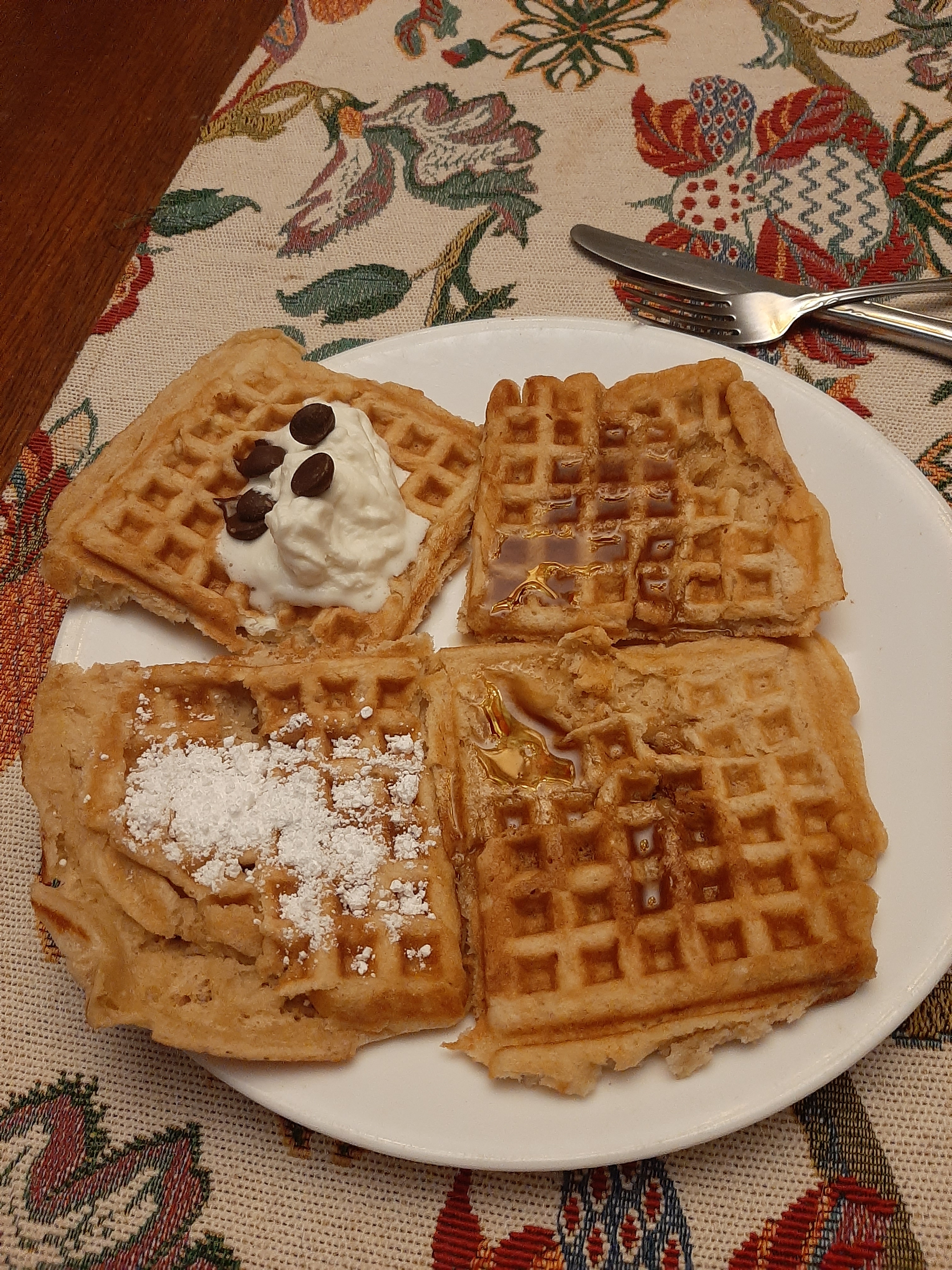
Sourdough waffles with a variety of toppings (including homemade whipped cream!)
Sourdough pancakes!
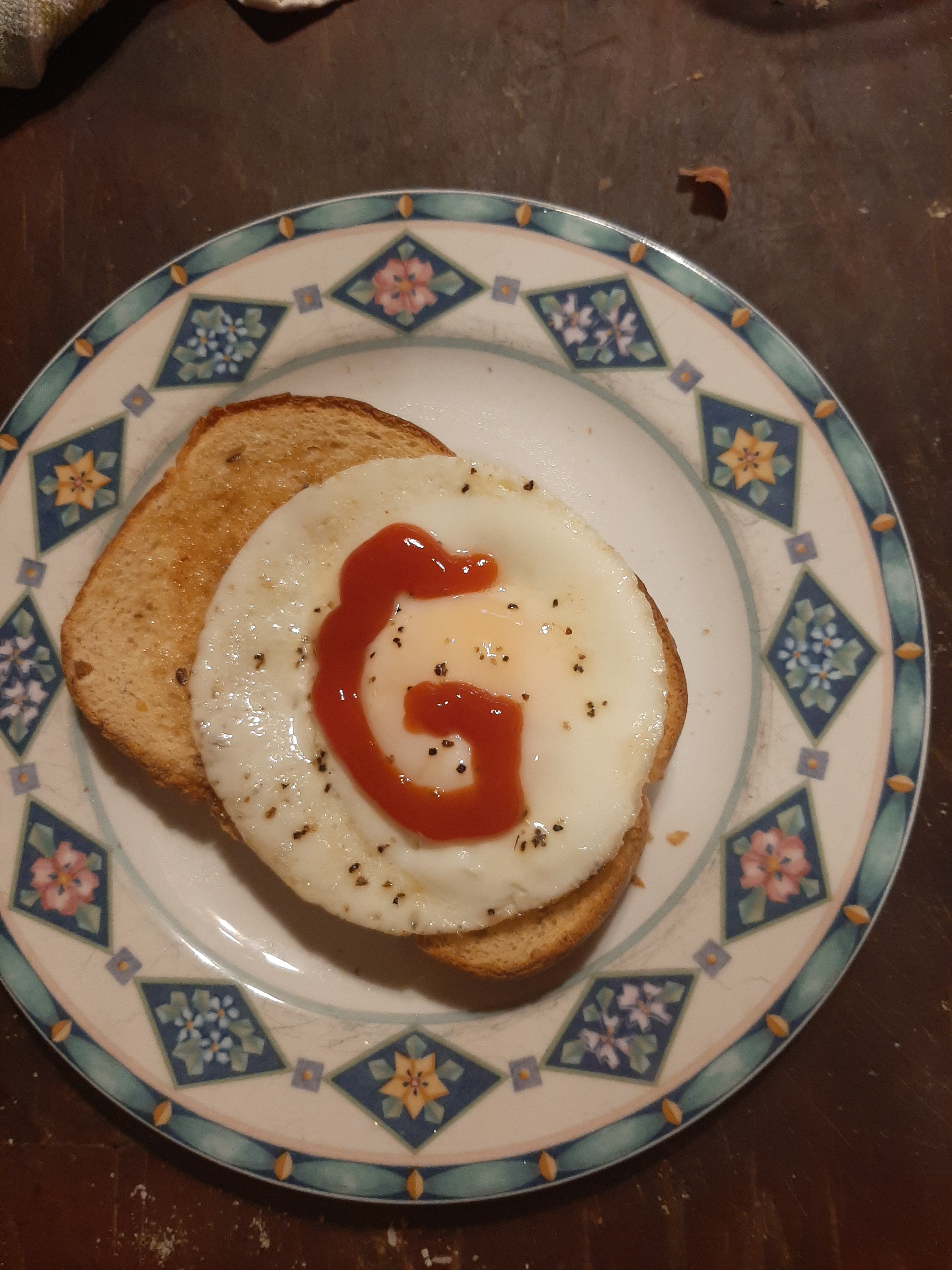
Yes, I put ketchup on my eggs. Deal with it. And yes, that’s my initial. It’s my egg. I can do that!
My latest attempt at homemade bagels. I think I nailed it this time. More in the future!

Snacking is important too!

Homemade Pita (roll it very thing and place in a very hot oven!) with homemade Hummus!

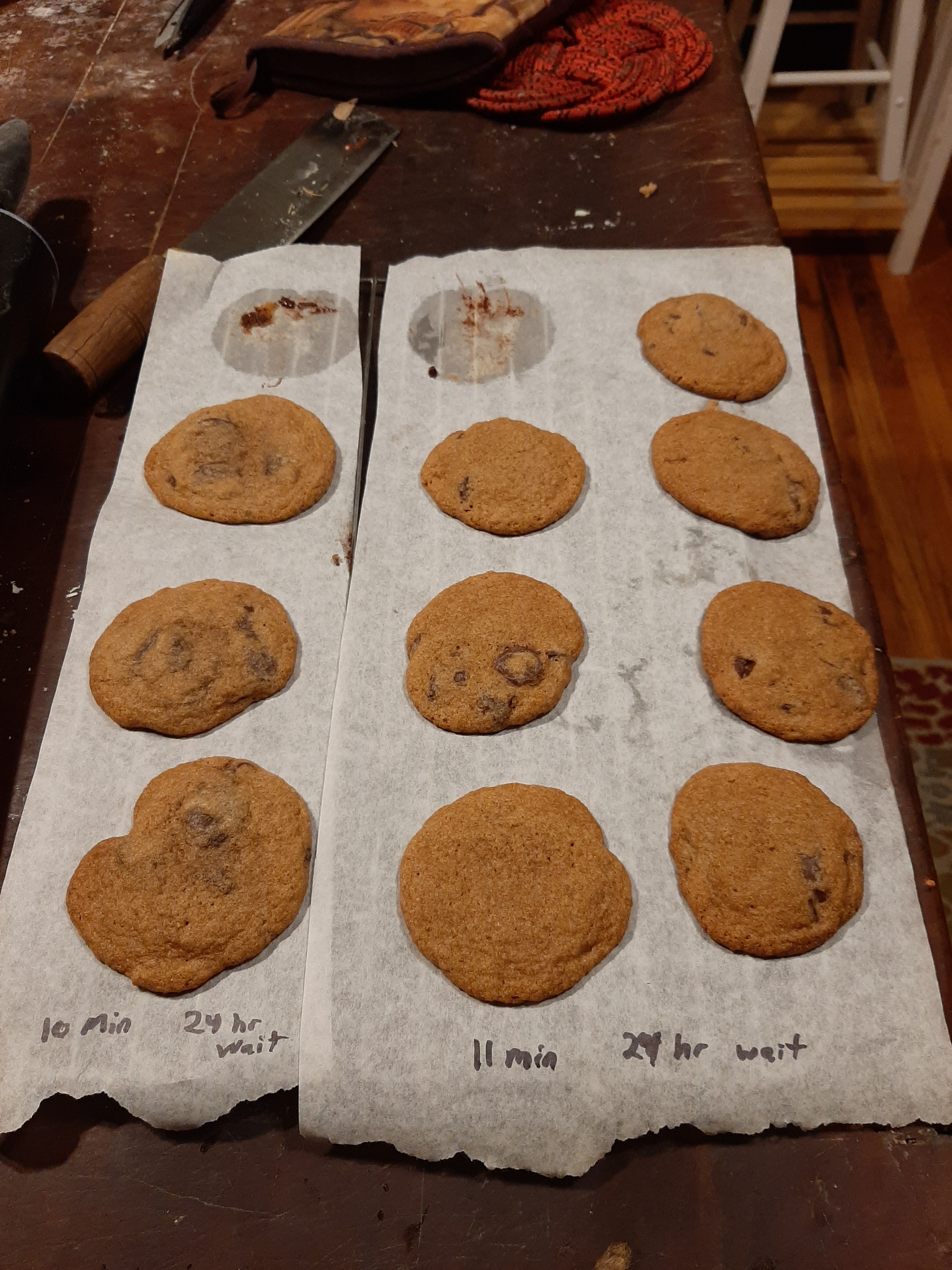
Now, that’s not to say it’s all fun and games. Sometimes one does have to collect data on how to make things better. Recently I had been reading up on chocolate chip cookies (research of course) and learned that the original recipe called for letting the dough sit for 36 hours before baking. Now, I’m never one to take a detail like that at face value, so I had to of course experiment. I also decided to test the baking time for my white whole wheat chocolate chip cookies to see if 10 or 11 minutes was better.

Baked right after mixing
Baked after being chilled 24 hours
After being chilled 38 hours (I slept in that morning).

So, I think more research is necessary, but I would say that chilling does appear to help the flavor and I think initially 11 minute baking is better, but the next day, it’s hard to tell if it or the 10 minutes is better.

I probably have a dozen or so more pictures of various meals, but I think I’ll stop here. I’m getting hungry and it’s not even lunch time yet!

Seriously though, besides the biking and caving and other things to keep me busy, I’ve enjoyed cooking (most of the time) in the last year. I hope you enjoyed my trip through my kitchen in the last year. I’d love to see what you’ve been making or baking!

Another Case for Diversity

I’ve spoken in the past about why I think diversity is important. For example, understanding genders helps us design better databases and interfaces. But this past weekend another argument for diversity was presented to me. I was reminded that experiences many of us take for granted are often experienced differently by other people.

I’ve spoken in the past that I’m a caver and I teach cave rescue. As a caver I’m a member of the National Speleological Society. This is a great group and it’s dedicated to cavers and those who have a personal or professional interest in caves. It recently added a section for diversity. Some of the discussion behind this occurred on Facebook and it was quite telling in the reaction.

Let me start with saying that cavers are some of the friendliest people I know. It’s far from unheard of for a caver to look in the NSS Members Manual or online and say “Hey, you don’t know me, but I’m passing through your area, can you hook me up with a local cave to visit and maybe some crash space” and it happens. So yes, cavers are quite open and hospitable.

That said the Facebook discussion was an example of many of my fellow cavers missing the mark. The one that stood out in my mind was “Of course people of color can come caving with us. They just need to ask. We never turn anyone away.” And that’s most likely true. But, there are problems there, including people of color knowing they can ask and who to ask and where.

One response I found particularly telling, was a person of color pointing out that in parts of the South, simply walking across a field to a cave was potentially unsafe to them. This was a concept the white cavers couldn’t wrap their mind around and even actively told the person his experience was wrong.

So in this area I do think it’s important for us to reach out to members of groups who might not traditionally cave and invite them to join us.

But, as I said, another reason was presented to me on the past Thursday night. The NSS Education and Diversity Committees had joined together to present a webinar by Beau D. Carroll on Cherokee Syllabary in caves in the Alabama area (the main focus was on Manitou Cave).

Now, I go caving because I think it’s cool, both literally and figuratively. Seeing how the rock changes as you move to different parts of the cave, or seeing formations, and all that is just really interesting. My experiences are shaped by that. I also enjoy taking beginners of all ages caving and seeing their reactions and their often growing enthusiasm. I can quite safely say I’ve literally taken 100s of people on their first caving trip and am proud to know that several have gone on to become great cavers, far outpacing my own experiences.

That’s my experience.

Beau talked a lot about the experiences he, as a member of the Eastern band of Cherokees experienced while exploring in Manitou Cave and other caves. For him, it was both a learning experience (he is working on a PhD in archeology) as he found and translated the Cherokee Syllabary writings in the cave and as a way to connect to his ancestors. To me, this was particularly fascinating for two reasons. The first is the history of the syllabary itself is fascinating. It was developed over a 12 year period by Sequoyah and within 5 years, it’s estimated over 90% of the tribe could read. It’s one of the few writing systems that was developed within recent memory and for which we have somewhat decent records of its development. The second reason is that the writing very much is recording the history of a people whose entire way of live was disrupted by the Trail of Tears. He’s unlocking history and we’re learning from it.

It’s also a very different way of experiencing the dark zone of a cave. It’s not just a matter of “oh this is cool” but “this is someone’s history and culture.” One example stands out to me.

At one point during the Q&A Beau talks about leaving offerings of tobacco for his ancestors inside a cave. I have to admit, initially this offended my sensibilities, especially in light of the NSS motto.

Take Nothing but Pictures, Leave Nothing but Footprints, Kill Nothing but Time

But it forced me to stop and think about my own prejudices. While it’s clear from other comments Beau makes that he and his Cherokee agree on much of the concept of cave preservation, am I right to be offended? Is my concept of “leave nothing but footprints” truly correct? For me, caving is not a spiritual experience, but for him it is. His experience is arguably as valid as mine and I think should be respected also.

In the end it made me realize that a strong reason for a diversity committee isn’t just to “bring others into the caving” but for us to realize how others experience caving. This is equally and perhaps in some ways more important. I don’t think we can truly understand caving until we understand how others experience it also.

I want to thank Bree Jameson for bringing the webinar to my attention and Devra Heyer, NSS Education Committee Chair and Leah Hill, NSS Outreach Chair and Ambassador for the Diversity Committee for putting this all together. It’s a great presentation.

Please, take an hour out of your day and listen and watch. It’s worth it!

Also, please not my latest Redgate Simple-Talk article is now online: PowerShell editors and environments part 1 is now online.

Learning and Teaching

This past weekend was the first of 3 weekends I’ll be spending in teaching a cave rescue class. As I’ve written before, I usually spend at least 1 week a year teaching students how to help rescue folks out of caves. I don’t get paid money, and in fact have to pay for my own travel and sometimes other expenses. But, I love it. Unfortunately, the large event we had planned for NY this year had to be postponed due to Covid-19.

A Little Background

Fortunately, New York is one state where folks have been very good about social distancing and wearing masks, so that gave me the opportunity to try something new: teaching what we call a “Modular Level 1” class. Instead of taking an entire week off to teach, we spread the teaching out over three weekends and several nights. This can often better accommodate peoples schedules. After a lot of planning and discussions I finally decided to go ahead and see if I could host a class. Through a series of fortunate events4, by the time I was ready to close registration, I actually had more than enough students. What makes this class different from other classes I’ve taught is that more than 1/2 the students have never been in a cave. However, most of those are in medical school and a goal of mine has been to get more highly trained medical folks into cave rescue. So, we greenlighted the class.

Teaching

The first day of class is really mostly about “check-ins”. Each student must demonstrate a certain set of skills. When I teach the Level 2 class, this generally goes quickly because the students have already gone through Level 1 and the students tend to be more serious in general about their caving skills. But for Level 1, we get a broader range of students with a broader range of skills. And in this case, some folks who were just entering the community of being knot tying and SRT (Single Rope Technique).

There’s a mantra, I first heard among the medical education community, but is hardly unique to them, “See one, do one, teach one.” There’s a logic to this. Obviously you have to see or learn a skill first. Then obviously you need to be able to do it. However, the purpose and goal of that last one eludes some people.

Without getting too technical, let me give an example: in SRT, cavers and rescuers need the ability to climb the rope and, while attached to the rope, successfully change-over to be able to descend the rope. I’ve literally done this 100s of times in my life. I obviously have the first two parts of that mantra down I’ve seen it, and and done it. But teaching it is a whole other ball game. Being able to DO something, doesn’t mean you can successfully teach it. We do many things based strictly on experience and muscle memory. If you think about walking, you may realize you do it naturally without any real thought. But imagine trying to teach someone how to do it. You probably can’t, unless you’re a trained physical therapist.

Much is the same with the aforementioned change-over. Just because I could do it, didn’t mean I could successfully teach it. However, over the years, as I’ve taught it more and more I’ve come to recognize certain mistakes and certain areas I need to focus on. I’ve gotten better at teaching it. So by teaching more, I’m learning to become a better teacher. By being able to teach it, I also understand it and know it better. The “teach one” part of the mantra is important because it means you can give forward the skills you’ve learned, but also means you have a better understanding of them in the first place. You can’t effectively teach what you don’t understand.

In addition to learning how to teach better, I’ve also realized that some approaches work better than others for people. There’s a common knot we tie in the rope community called an “alpine butterfly”. There are at least four ways I’m aware of to teach it. One method involves looping the rope over your hand 3 times in a certain pattern and then pulling on the right loop in the right way through the others, the knot “magically” appears.  I’ll admit I’ve never been able to master this and as a result, obviously don’t teach this way. The method I use is a bit more off-color in its description. Writing it down it comes down to:

  1. Take a bight of the rope
  2. Put two twists in it
  3. Take the loop, aka head, pass it between the legs of the rope
  4. Shove the head through the asshole formed between the two twists
  5. Pull tight and dress

At the end of that, you have a beautiful alpine butterfly. On Saturday night I was helping a student perfect her butterfly. She was having trouble with the 3 loops over the hand method. I showed her the asshole method. She almost instantly got it. Now, that’s NOT to say the asshole way is the better way, it’s simply the way that worked better for her.

Learning

Besides learning how to teach better, I actually learn a lot from my students. For example, one of the students who does have extensive alpine rescue experience was asking about our use of what are known as Prusik loops to tie Prusik Knots. In her training and experience she uses something similar called a VT Prusik. I had seen these before in previous training, but had not had a chance to see them in action or play with them. She did a quick demonstration and then on Monday sent me a link with more information. Needless to say, by the end I was ordering a pair so I could start to play with them myself. I can already see where I might use them in certain cases.

Another example of learning is that I’m starting to adopt a different way of tying what’s known as a Münter hitch. I’ve been tying these successfully for decades, but started noticing another method that’s fairly common and in my mind, if not more intuitive, it is at least a bit more of a visual mnemonic. I think it’ll reduce my chances of tying one poorly so I’ve started using it more and more. And this is because I saw how quickly students would pick it up.

Gelling

By Saturday night most of the students had passed their check-offs, but not in what I’d call a solid fashion. They were still at the stage where they were simply reproducing what they saw. This is common in the early stages of learning. As a result, I decided to adjust the Sunday morning schedule and spend a bit more time on simply practicing and honing their skills. What we really want at some point is for the skills to “gel” (i.e. go from a liquid state where their ability is in flux to a state where there abilities are more solid). What can be interesting about this is for some folks, this can be a fairly quick process and in fact I noticed by lunchtime for a number of students, their abilities had gone from simple rote reproduction to an actual more gelled state. After lunch we put in some more time and with some of the students I’d simply walk up, call out a knot for them to tie, walk away, give them a minute or so and come back to see what they had done. In most cases, they were successful. The night before that would not have worked. They’re still a long way to go from being as good as I or they might like, but they were no ready to go out in the field and safely put a patient over the edge.

Level 1 students pull a patient up over a cliff

Safely getting a patient over the edge

Concluding

So we have two more weekends to go before they can call themselves trained as Level 1 students and hopefully they’ll keep learning and improving beyond that. For me, as long and tiring as the weekend was (I think I got about 5-6 hours of sleep each night, at most) it was rewarding because I got to see students learn skills we taught AND because I got to learn stuff too. It was a great weekend and I look forward to the next two.20200829_134511


Caving and SQL

Longtime readers know that I spend a lot of my time talking about and teaching caving, more specifically cave rescue, and SQL Server, more specifically the operations side. While in some ways they are very different, there are areas where they overlap. In fact I wrote a book taking lessons from both, and airplane crashes to talk about IT Disaster Management.

Last week is a week where both had an overlap. One of the grottoes in the NSS (think like a SQL User Group) sponsored a talk on Diversity and Inclusion in the caving community. The next day, SQL Pass had a virtual panel on the exact same subject.

Welcoming

Let me start with saying that one thing I appreciate about both communities is that they will welcome pretty much anyone. You show up and ask to be involved and someone will generally point you in the right direction.  In fact several years ago, I heard an Oracle DBA mention how different the SQL community was from his Oracle experience, and how welcoming and sharing we could be.

This is true in the caving community. I recall an incident decades ago where someone from out of town called up a caving friend he found in the NSS memberhsip manual and said, “hey, I hear you go caving every Friday, can I join you?” The answer was of course yes.  I know I can go many places in this country, look up a caver and instantly be pointed to a great restaurant, some great caves and even possibly some crash space to sleep.

So let’s be clear, BOTH communities are very welcoming.

And I hear that a lot when the topic of diversity and inclusion comes along. “Oh we welcome anyone. They just have to ask.”

But…

Well, there’s two issues there and they’re similar in both communities. The less obvious one is that often anyone is welcome, but after that, there’s barriers, some obvious, some less so. Newcomers start to hear the subtle comments, the subtle behaviors. For example, in caving, modesty is often not a big deal. After crawling out of a wet muddy hole, you may think nothing of tearing off your clothes in the parking lot and changing. Perhaps you’re standing behind a car door but that’s about it. It’s second nature, it’s not big deal. But imagine now that you’re the only woman in that group. Sure, you were welcomed into the fold and had a blast caving, how comfortable are you with this sudden lack of modesty? Or you’re a man, but come from a cultural or religious background where modesty is a high premium?

In the SQL world, no one is getting naked in the datacenters (I hope). But, it can be subtle things there too. “Hey dudes, you all want to go out for drinks?” Now many folks will argue, “dudes is gender neutral”. And I think in most cases it’s INTENDED to be. But, turn around and ask them, “are you attracted to dudes?” and suddenly you see there is still a gender attached.  There’s other behaviors to. There’s the classic case of when a manager switched email signatures with one of his reports and how the attitudes of the customers changed, simply based on whose signature was on the email.

So yes, both groups definitely can WELCOME new folks and folks outside of the majority, but do the folks they welcome remain welcomed? From talking to people who aren’t in the majority, the answer I often get is “not much.”

An Interlude

“But Greg, I know….” insert BIPOC or woman or other member of a minority.  “They’re a great DBA” or “They’re a great caver! Really active in the community.”  And you’re right. But you’re also seeing the survivorship bias. In some cases, they did find themselves in a more welcoming space that continued to be welcoming. In some cases you’re seeing the ones who forged on anyway. But think about it, half our population is made up of women. Why aren’t 1/2 our DBAs?  In fact, the number of women in IT is declining! And if you consider the number of women in high school or college who express an interest in IT and compare it to those in in their 30s, you’ll find the number drops. Women are welcome, until they’re not.

In the caving community during an on-line discussion where people of color were speaking up about the barriers they faced, one person, a white male basically said, “there’s no racism in caving, we’ll welcome anyone.”  A POC pointed out that “as a black man in the South, trust me, I do NOT feel safe walking through a field to a cave.”  The white man continued to say, “sure, but there’s no racism in caving” completely dismissing the other responder’s concerns.

There’s Still More…

The final point I want to make however is that “we welcome people” is a necessary, but not sufficient step. Yes, I will say pretty much every caver I know will welcome anyone who shows an interest. But that’s not enough. For one thing, for many communities, simply enjoying the outdoors is something that’s not a large part of their cultural.  This may mean that they’re not even aware that caving is a possibility. Or that even if it is, they may not know how to reach out and find someone to take them caving.

Even if they overcome that hurdle, while caving can be done on the cheap, there is still the matter of getting some clothing, a helmet, some lights. There’s the matter of getting TO the cave.

In the SQL world, yes anyone is welcome to a SQL Saturday, but what if they don’t have a car? Is mass transit an option? What if they are hearing impaired? (I’ve tried unsuccessfully 2 years in a row to try to provide an ASL interpreter for our local SQL Saturday. I’m going to keep trying). What if they’re a single parent? During the work week they may have school and daycare options, but that may not be possible for a SQL Saturday or even an afterhours event. I even had something pointed out to me, during my talk on how to present, that someone in the audience had not realized up until I mentioned it, that I was using a laser pointer. Why? Because they were colorblind and never saw the red dot. It was something that I, a non-colorblind person had never even considered. And now I wonder, how many other colorblind folks had the same issue, but never said anything?

In Conclusion

It’s easy and honestly tempting to say, “hey, we welcome anyone” and think that’s all there is to it. The truth is, it takes a LOT more than that. If nothing else, if you’re like me, an older, cis-het white male, take the time to sit in on various diversity panels and LISTEN. If you’re invited to ask questions or participate, do so, but in a way that acknowledges your position. Try not to project your experiences on to another. Only once have I avoided a field to get to a cave, because the farmer kept his bull there. But I should not project MY lack of fear about crossing a field onto members of the community who HAVE experienced that.

Listen for barriers and work to remove them. Believe others when they mention a barrier. They may not be barriers for you, but they are for others. When you can, try to remove them BEFORE others bring them up. Don’t assume a barrier doesn’t exist because no one mentions it. Don’t say, “is it ok if I use a red laser pointer?” because you’re now putting a colorblind person on the spot and singling them out. That will discourage them. For example find a “software” pointer (on my list of things to do) that will highlight items directly on the screen. This also works great for large rooms where there may be multiple projection screens in use.

If caving, don’t just assume, “oh folks know how to find us” reach out to community groups and ask them if they’re interested and offer to help. (note I did try this this year, but never heard back and because of the impact of Covid, am waiting until next year to try again.)

Don’t take offense. Unless someone says, “hey, Greg, you know you do…” they’re not talking about you specifically, but about an entire system. And no one is expecting you to personally fix the entire system, but simply to work to improve it where you can. It’s a team effort. That said, maybe you do get called out. I had a friend call me out on a tweet I made. She did so privately. And she did so because, she knew I’d listen. I appreciated that. She recognized I was human and I make mistakes and that given the chance, I’ll listen and learn. How can one take offense at that? I saw it has a sign of caring.

Finally realize, none of us are perfect, but we can always strive to do better.

So, today give some thought about how you can not only claim your community, whatever it may be, is welcoming, but what efforts you can make to ensure it is.


On a separate note, check out my latest writing for Red-Gate, part II on Parameters in PowerShell.

“We want information…information… information!!!”

For anyone who has ever watched the classic British mini-series “The Prisoner” this is a very recognizable line. But it applies to many parts of our lives.

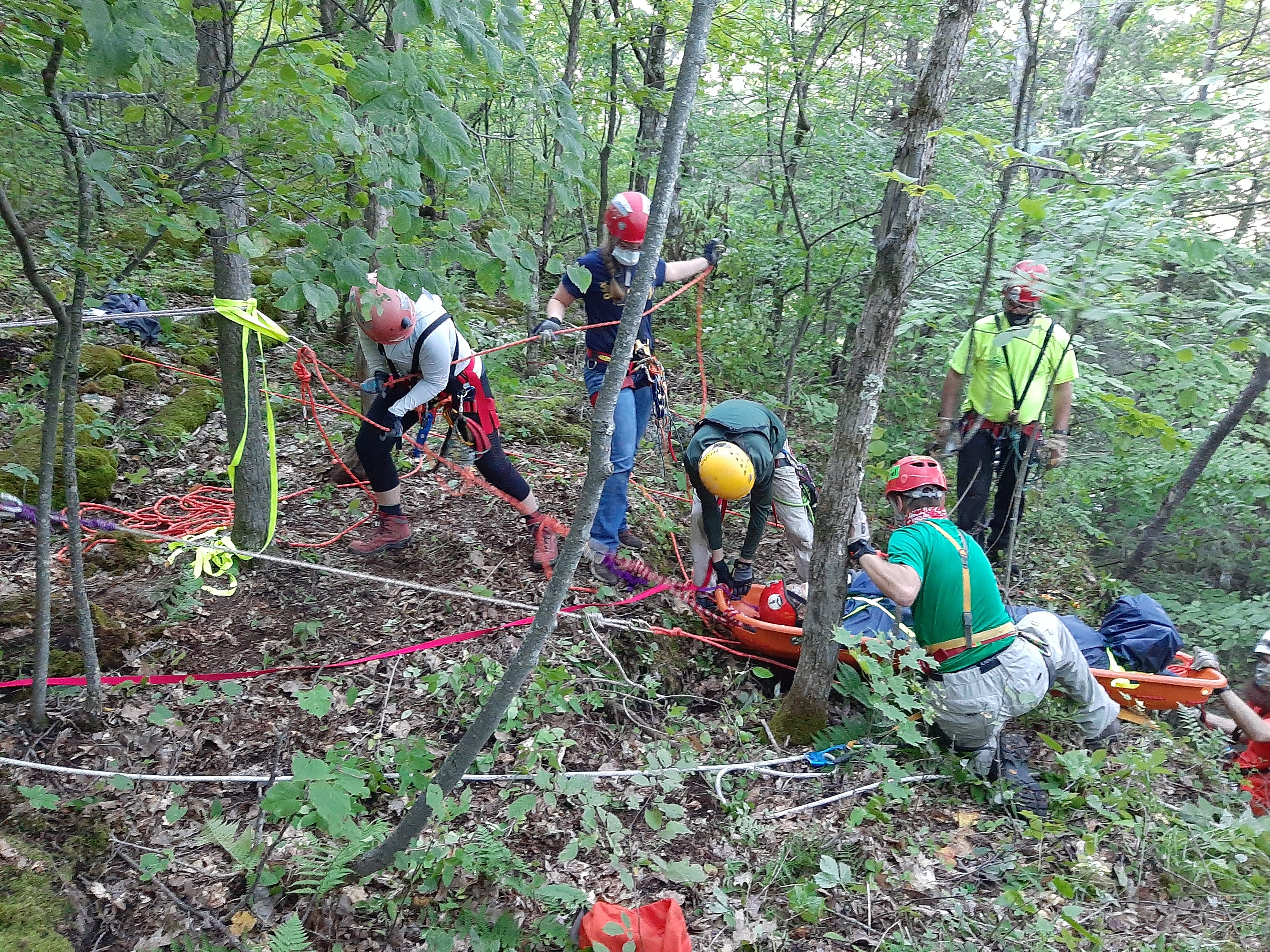
This is a tale of hiking, a non-cave rescue, and yes, eventually Extended Events.

“I went to the woods…”

This past weekend I spent some time in the woods hiking and getting away from it all. This is the first time in literally decades I had done an overnight hike on the Appalachian Trail. My goal was to get in an overnight and work on closing a gap of it that I had not yet hiked.

The last time I hiked the trail, cell phones were a very rare item, carried by business people only and often weighing several pounds, they certainly weren’t something the average hiker could afford, and even if they could, they would be too heavy to carry.

I mention this because I had fully intended to carry mine with me, so that I could take pictures, and perhaps even, I’ll admit it, if I had connectivity when I camped that night, catch up on some Wikipedia reading, or send a picture or two to friends and family. But alas, about 2 miles into the hike, at a gorgeous viewpoint (see older photo above), I stopped, tried to pull out my phone and realized that unsettled feeling I had at my car before locking it wasn’t “Am I sure I have my keys” but really should have been “am I sure I have my phone!”

It turns out, other than my inability to document my trip with some photos, and not being able to call my wife to let her know I’d be at the pick-up point much earlier than we had planned, not having access to information of the outside world was a refreshing change of pace. I’m almost glad I didn’t have my phone.

A Missed Call

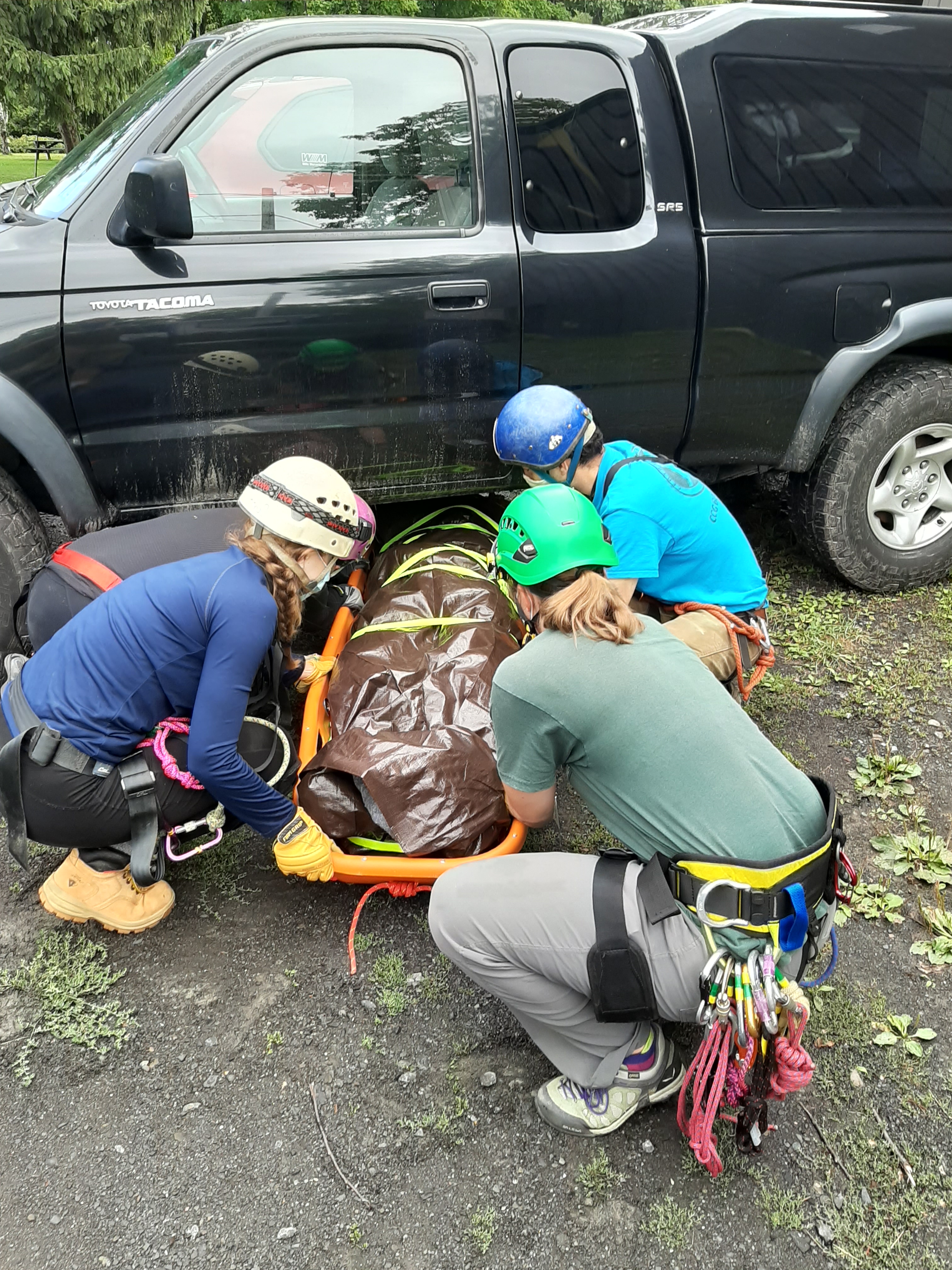
As some of my readers know, besides being a DBA, I also teach and at times perform cave rescues. As I tell folks once they get past the “That’s so cool” phase, it’s not really all that glamorous. If I get called out to one actual rescue a year here in the Northeast, it’s a busy year. But, on warm weekends in the summer, the odds are higher than say the middle of the week in the winter (though that has happened too).

So a concern I had in regards to not having my phone was that I would miss a call for a potential rescue.

It turns out I was partially correct in my concern.  On the way home, I saw my phone buzz. I didn’t answer it, but a few minutes later did glance down to see “Missed Call”. It was from my team co-captain. (To be transparent here, the terms team and co-captain are used loosely, it’s not a very formal setup). She rarely calls, especially if it’s a weekend, except in an emergency. I waited until I got home to call her back. And it wasn’t an actual call-out, yet. It was at this point a “potential missing caver.” What this meant in this case was a vehicle had been spotted outside a popular cave, and it had been there for at least 18 hours. That is unusual for this cave, most trips are 2-3 hours in length. So, this was concerning. But, we didn’t have enough information. Was someone in the cave? If so, where? Were they in need of assistance? We needed information, and by hook or by crook we were going to get it. Or at least some of it.

In general, one of the biggest issues we have when starting a cave rescue is the lack of information. In this case case it was even, “are they in the cave?” Had we determined they most likely were, the next question would have been, “where?”. That shapes our search. “How long?” That might shape what equipment we bring on our initial search. “What injuries?” That would also shape our response. In any cave rescue we eventually get the information, but it can be frustrating to have to wait. Caves don’t have cell service inside. (We often do literally put our own phone system into caves during a rescue however!) When we train folks, they often find it hard to believe at first that a patient could be 300 feet into a cave, and it would take a skilled, fresh caver 45 minutes to simply get to them, and another 45 minutes to get back. So as simple a request as “can you get me information about the patient” could easily take 90 minutes or more. And yes, that’s a real life incident.

In this case, eventually the authorities ran the plates and it appears the plates had expired before 1990, the VIN that could be found on the insurance card sitting on the dashboard was made up (or belonged to a vehicle decades older) and the address on the card was fake. We stood down. There wasn’t going to be a search that day. It was entirely a police matter.

#TeamExEvents

I said I’d get to Extended Events and here we are.  I’ve written about them before and I’m a huge fan of them. Simply put, if you’re not using them, you’re probably missing information that you can very useful. I started in the days of SQL Server 4.21a, but really started to cut my teeth on SQL Server with 6.5 came out. Back then our problem sets were probably easier and smaller, but we still dealt with similar issues, the biggest has often been performance related. In the early days there were some decent tricks and ways of diagnosing where your performance bottlenecks were, but to be honest, sometimes it was hit or mess. Over the years, Microsoft has added a lot of functionality to SQL Server including DMVs and Extended Events. I now routinely use Extended Events to track down performance issues or other problems. Last night at our local User Group Meeting, Grant Fritchey did a lightning round where he highlighted one of the features of Extended Events that honestly, I know about, but don’t use enough: Causality Tracking

Causality Tracking Checked

Causality Tracking extends the power of Extended Events to a new Level!

Let’s just say this is a feature that makes picking out the specific events you want to follow much easier. The example Grant gave showed a ton of detail, more than you’d normally need, but extremely useful if you did in fact need it. In other words a simple checkbox can now give us a great deal of useful information.

With the right information, you can often identify bottlenecks and make huge performance gains.

At times I feel like I’m Number Six, trying to get information about a database problem or a potential cave rescue

Number Six: Where am I?

Number Two: In the village.

Six: What do you want?

Two: Information.

Six: Whose side are you on?

Two: That would be telling. We want information…information… information!!!

Six: You won’t get it!

Two: By hook or by crook, we will.

In conclusion, there are times when disconnecting from the information around us can make a weekend in the woods more enjoyable, but a dearth of it is standard at the start of a cave rescue, while having ready access to it can make solving a problem far easier.

Where do you stand on the information spectrum today? Do you have a lack of it, the right amount, or too much?


“Houston, We Have an Opportunity”

This is not quite the famous quote from the movie Apollo 13, one of my favorite movies. And, well we have a problem. But also an opportunity.  I’ll get to the opportunity in a bit, but first, the problem.

My Event and Disappointment

The problem of course is COVID-19. As the end of the week in which I’m writing this, I was scheduled to help host the National Weeklong Cave Rescue training seminar for the NCRC. For years, I and others had been working on the planning of this event. It’s our seminal event and can attract 100 or more people from across the country and occasionally from other countries. Every year we have it in a different state in order to allow our students to train in different cave environments across the country (New York caves are different from Georgia caves which are different from Oregon caves and more) as well as to make it easier for attendees to attend a more local event.

Traditionally, the events held in NY (This would have been the fourth National Seminar) have attracted fewer people than our events in Alabama which is famous for its caves. But this year was different, with lots of marketing and finding a great base camp, we were on track for not only for the largest seminar yet in New York, but for one on par with our largest seminars anywhere.

Then, in February I started to get nervous. I had been following the news and seeing that unlike previous outbreaks of various flus and other diseases, COVID-19 looked like it would be something different. This wasn’t going to pass quite as quickly. This was going to have an impact. As a result, I started to make contingency plans with the rest of my planning staff. I consulted with our Medical Coordinator. I talked to the camp. By March I started to regain some optimism, but I still wasn’t 100% confident we could pull this off. And then, the questions from attendees started to come in. “Are we still having it?” “What are the plans?” etc.  Another week or two later, “I need to cancel. My agency/school/etc won’t cover the cost this year.”  Finally by the start of April, after talking to several of my planning staff and my fellow regional coordinators it became obvious, we could not, in good conscience host a seminar in June. Yes, here in upstate New York the incidence of COVID-19 is dropping quickly. We’re starting the re-opening process. Honestly, if folks came here, I would NOT be worried about them getting infected from a local source.

However, we would have nearly 100 people coming from across the country, including states where the infection rates are climbing. Many would be crammed into planes for hours, or making transfers at airports with other travelers. So, while locally we might be safe; if we held this event, where folks are in classrooms for 3-4 hours a day, then in cars to/from cave and cliff sites and then often in caves for hours, it’s likely we would have become ground zero for a spike in infections. That would not have been a wise nor ethical thing to do. So, we postponed until next year.

I mention all that because of what happened to me about three weeks ago and then the news from last week: 2020 PASS Summit is going Virtual. About three weeks ago I was asked to participate in a meeting with some of the folks who help to run PASS as well as other User Group leaders. The goal was to discuss how to make a Virtual Summit a great experience if it went virtual. This was one of several such meetings and I know a lot of ideas we brought up and discussed. NONE of us were looking forward to PASS 2020 being virtual, but we all agreed that it was better than nothing. And of course, as you’re well aware, last week PASS made the decision, I suspect due in large part for the very same reasons we postponed our cave rescue training event.

Sadness and Disappointment

Mostly I’ve heard, if not happy feedback, at least resigned feedback. People have accepted the reality that PASS will be virtual. I wrote above about my experience with having to postpone our cave rescue training (because it’s so hand’s on, it’s impossible to host it virtually). It was not an easy decision. I’ll admit I was frustrated, hurt, disappointed and more. I and others had put in a LOT of hard work only to have it all delayed. I know the organizers of Summit must be feeling the same way. And I know many of us attendees must feel the same. Sure, Houston is not Seattle and I’ve come to have a particular fondness for Seattle, in part because of an opportunity to see friends there, but I was looking forward to going to Houston this year (as was my wife) and checking out a new city.

One thing that has helped buoy my emotions in regards to our weeklong cave rescue class is that over 1/2 the attendees said, “roll my registration over to next year. I’m still planning on coming!” That was refreshing and unexpected. Honestly, I was hoping for maybe 1/4 of them at best to say so. This gave me hope and the warm fuzzies.

Opportunity

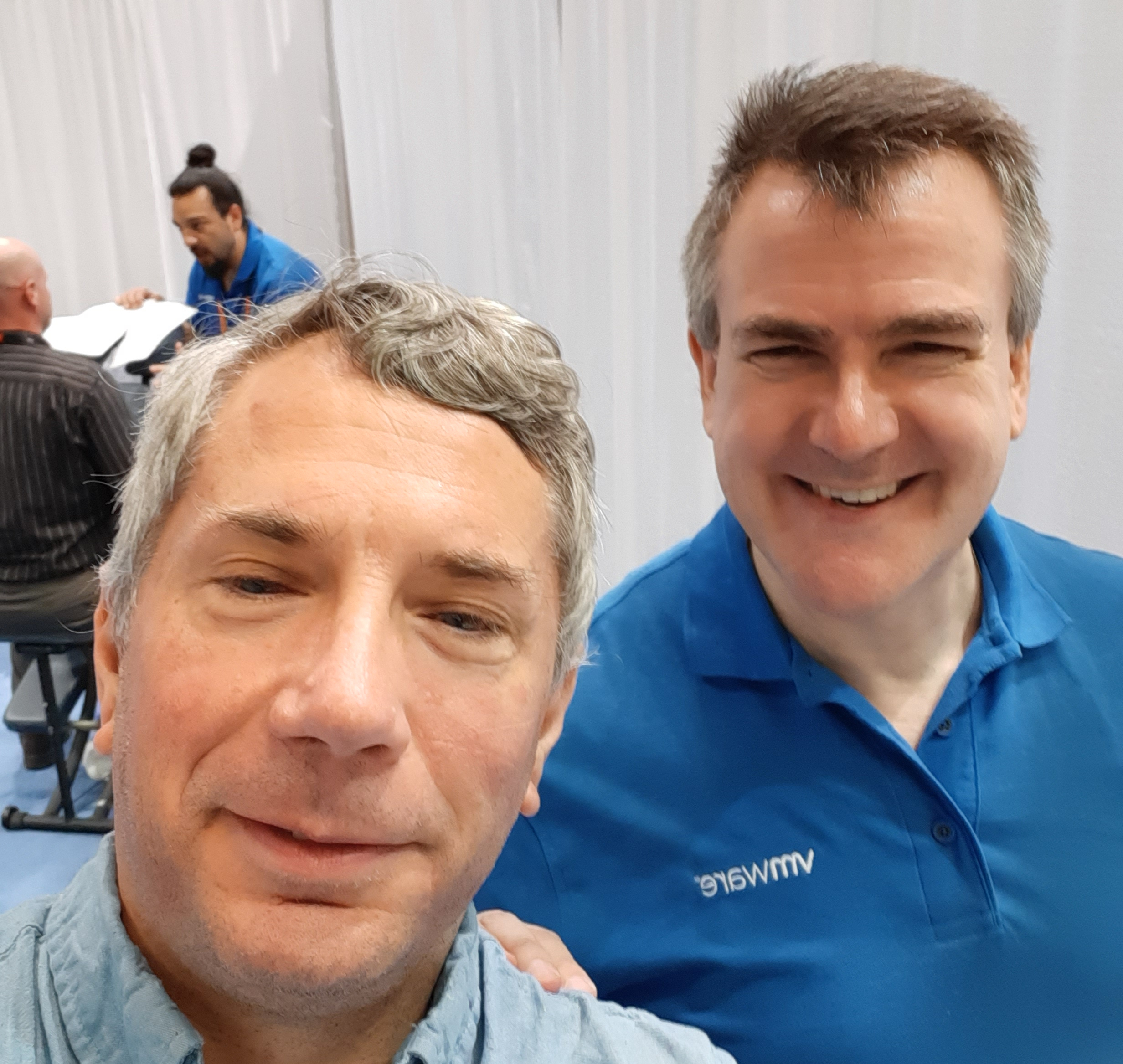
Let me start with stating the obvious: a virtual event will NOT be the same as in-person event. There will most definitely be things missing. Even with attempts that PASS will be making to try to recreate the so-called “Hallway track” of impromptu discussions and hosting other virtual events to mimic the real thing, it won’t be the same. You won’t get to check out the Redgate Booth in person, hang out on the sofa at Minionware, or get your free massage courtesy of VMWare.

20191106_123733

After a great massage courtesy VMWare.

And we’ll miss out on:

20191105_143514

Achievement unlocked: PASS Summit 2019 Selfie with Angela Tidwell!

But, we’ll still have a LOT of great training and vendors will have virtual rooms and more.

So what’s the opportunity? Accessibility!

Here’s the thing, I LOVE PASS Summit. I think it’s a great training and learning opportunity. But let’s face it. It can get expensive, especially when you figure in travel costs, hotel costs and food costs. This year though, most of those costs disappear. This means that when you go to your boss, they have even less of an excuse to say, “sorry it’s not in the budget”.  And honestly, if they DO say that, I would seriously suggest that you consider paying for it out of your own budget. Yes, I realize money might be tight, but after all the wonderful training you can then update your resume and start submitting it to companies that actually invest in training their employees.

I would also add, from my understanding, while convention centers by law ADA accessible, this doesn’t necessarily mean everyone with a disability can attend. There can be non-physical barriers that interfere. Hosting virtually gives more people the ability to “attend” in a way that works for them. It might be in a quiet, darkened room if they’re sensitive to noise and lights. It might be replaying sessions over and over again if they need to hear things in that fashion. It very well could be taking advantage of recorded sessions and the like in ways that I, an able-bodied person isn’t even aware of. So that’s a second way in which it’s accessible.

Now, I know folks are questioning “well if its virtual, why should we pay anything, especially if vendors are still paying a sponsorship fee?” There’s several answers to that and none of them by themselves are complete, but I’ll list some. For one, I haven’t confirmed, but I’m fairly confident that vendors are paying a lot less for sponsorship, because they won’t get the same face to face contact. For another, PASS takes money to run. While we often think of it as a single big weeklong event, there’s planning and effort that goes on throughout the year. This is done by an outside organization that specializes in running organizations like PASS. (Note the PASS Board is still responsible for the decision making that goes on and the direction of PASS as a whole, but day to day operations are generally outsourced. This is far from uncommon. Those costs don’t disappear. There’s other costs that don’t automatically disappear because the event is no longer physical. And of course there are costs that a virtual event has that the physical event doesn’t. Now EVERY single session will be available as a live-stream (as well as recorded for later download) and this requires enough bandwidth and tools to manage them. And it requires people to help coordinate.  Making an event virtual doesn’t automatically make it free to run.

The Future

Now, I know right now I’m on track for hosting the NCRC Weeklong Cave Rescue training event next year at the location we planned on for this year. Our hope of course is that by then COVID-19 will be a manageable problem. But in the meantime, I’ll keep practicing my skills and sharing my knowledge and when and where I can, caving safely. And as always willing to take new folks caving. If you’re interested, just ask!

I don’t know what PASS 2021 Summit will bring or even where it will be. But I know this year we can make the most of the current situation and turn this into an opportunity to turn PASS into something new and more affordable. Yes, it will be different. But we can deal with that. So, register today and let’s have a great PASS 2020 Summit in the meantime!  I look forward to seeing you there. Virtually of course!