Awkwardness Made Comfortable

Let’s get straight to the topic of this post: pelvic and genitourinary exams. It’s a critical skill for people in medicine to learn. And like most skills, you learn by doing. At some point, you’re going to have to do your first one. For me, that first one was today.

Would you believe me, if I said that I actually enjoyed today’s practical and left it smiling? Before you jump to assumptions, let me be clear, I enjoyed it and was left smiling because the people we practiced with made is easy and comfortable. I have permission from two of them to use their names. The other three people I met, I did not get a chance to ask for permission and while I’m fairly confident they’d have given their permission, because of the subject matter, I won’t use their names.

Mary Conway PA-C is the owner of a company called META – Medical Education Teaching Associates. She setup META close to 37 years ago. META’s goal is to train people, such as PA students on how to do a proper pelvic and genital exam and how to make it comfortable for both the provider and the patient. And I want to say she does a great job. Earlier this week, she did a Zoom session with the students from both campuses. During this one hour session, she walked us through what META did, how, and what we would do today.

We were broken into two groups before today. Half were scheduled for the morning, and my half for the afternoon. I think we were all nervous to different degrees. I’ll admit I wasn’t super nervous, but I’d be lying if I said I wasn’t nervous at all.

First, for the afternoon, the entire group was taken into one of the larger classrooms where one of the instructors, a nurse, showed us the proper technique of a genitourinary exam on a man. It was a bit surreal to stand there in a group of twenty-two as he showed us what to do. But it was also instructional and strangely, not very awkward. We then broke into two groups of eleven. My group went with Mary and Nicole into one of our exam rooms. There Mary walked us through the steps on how to do a pelvic and breast exam on Nicole. Again, you might think this would be extremely awkward, and while there was a bit of awkwardness to it, less than one might expect. It was a thorough demonstration and explanation and they both answered any questions we had.

All the instructors and models have their reasons for doing what they do here. Often it’s for personal reasons. Nicole said she had 5 daughters, so for her, women’s health was very important. She’s been doing this for years and it’s clear she wants students to learn not only the right way physically do perform such exams, but also language used to make things more comfortable for the patient and honestly for the provider.

Once Mary had demonstrated what we were expected to do, we further broke our group of eleven into a group of six and a group of five. The five went off to practice the male genitourinary exam. Once the door closed Nicole asked, “Ok who wants to go first?”

After a moment of awkward silence, it should surprise no one who knows me, that I volunteered. While I honestly felt comfortable with the required techniques, I was still very grateful as Nicole basically walked me through each step. I’d like to think I did a fairly decent job on my first pelvic exam on a real human being.

And here’s why the whole experience left me smiling and was enjoyable. In some places, your first pelvic exam might be as a student, while you’re on a rotation and your preceptor is walking you through it. This puts you on the spot. The patient is most likely nervous since such an exam is already awkward and that is compounded with your inexperience. I can’t imagine it’s good for anyone, or that you learn much from it.

Here though, Nicole (and the other models who I didn’t meet) are there explicitly to help you learn. They’ve been through this, literally 1000s of times. They know their bodies. They can tell you what to expect. They know their own bodies so well, they can even help explain what it is you’re feeling and not feeling, especially during the bimanual portion of the exam. They turn what might otherwise be an awkward experience into what’s honestly a very comfortable and routine feeling learning experience.

After my group finished the pelvic exam with Nicole, we went to another classroom to practice the genitourinary exam that we had seen earlier. Again, the process was made to be as comfortable and easy as possible.

And really in many ways, I think that’s what these sorts of exams should be: comfortable and routine feeling. We as a society often don’t like to talk about our genitals. We tend to have hang-ups when talking about our pelvic regions and possible medical issues. But really, at the end of the day, it’s part of our bodies and medically we need to be aware of and comfortable with examining that area.

At some point, I’ll end up doing my first such exams on actual patients, but after today, I’m already feeling more comfortable than I thought I could be.

Disclaimer: my views here do not represent those of my employer (AMC) or my PA program (Arcadia University) and are my own views. The people named gave permission for their names to be used.

My Journey So Far

While showering this morning (right after listening to a lecture on women’s health for pharm) I got thinking about my journey to becoming a PA and reflected on how far I had come. I thought I’d share some of those thoughts.

The official “start” date was I believe December 28th, 2021. I think that’s the day when I sprung upon my wife the idea of a dramatic career change. I’m grateful that she was supportive from the moment I suggested it, even if neither of us fully understood what was involved.

I didn’t really announce it until January 1st, 2022. Looking upon that post, I’ll have to admit I was a bit optimistic. I thought I might be able to finish it by 2025, 2026 at the latest. Well it’s going to be 2027. But, short of something traumatic happening, that date is pretty much set in stone. I know the date of graduation, but I will still have to pass the PANCE after that. So the exact date is still up in the air a bit.

Unofficially, I can’t say when I started. Was it in 2015 when my dad was sick and folks kept asking me if I was in healthcare, or when I met with a friend and now colleague to talk about medical school, which at the time we agreed wasn’t practical?

Was it earlier when I got involved in the NCRC or a bit later when I became an instructor, often helping teach the medical curriculum?

Perhaps it was when I first took SOLO at RPI. Or perhaps earlier? For example, I think my first aid class and CPR class was in elementary school at Lee H. Kellogg.

I think I’ll stick with the December 8th, 2021 goal. I do know that after graduating RPI, the thought of grad school wasn’t in my mind. My GPA was so low that I had ruled it out. But by 2021 I was ready for change.

So what have I done since then?

In January 2022, after jumping through some hoops, including getting vaccine titers, I started taking my prereqs. It quickly became clear that I wouldn’t be able to get all the prereqs in and get in the necessary patient contact hours in time to apply in 2022. So the goal of getting accepted in 2022, starting in 2023 and finishing by 2025 was quickly dropped.

It wasn’t even until October of 2022 that I could start acquiring my patient contact hours.

In the meantime I kept taking more classes. By December of 2023 I had ended up taking 41 credits for prereqs. In May of of 2023 I started submitting my first applications for PA school. And shortly after I started to receive my rejections. I had known my GPA would hurt me, but I was hoping the rest of my application and story would be get me a spot. The closest I came was being put on the waiting list for the school I currently attend, Arcadia. But there was no movement there.

So I went into 2024 already planning a second round of applications. By now, I had taken pretty much all the requirements I could, let alone needed. This did let me focus on working more in the ED, so that was nice. I slowly wound down my consulting. I was at this point very much committed to getting into PA school. Honestly, if I hadn’t, after dealing with a second round of defeat, I might have gone back and retaken some of the more basic classes from undergrad that I hadn’t done well in, but I was hoping to not have to do that.

I had a number of submissions in in May of 2024, basically as early as possible. And then I waited. And waited.

I finally heard back from one of my top choices. It was a no. I exchanged a few emails with the program director, but there was no change. The day after the last email from him, which honestly, I found a bit dismissive, I received an email about another decision. This is the one that changed my life. July 9th, 2024: It is our pleasure to offer you acceptance for admission to the Physician Assistant Program (the “Program”) at the Delaware campus for the class matriculating in May of 2025. It was from Arcadia. I don’t think my feet touched the floor for a week. The only hard part about this decision was whether to put down the required deposit and secure the spot, or wait and to hear from other schools which might tempt me. I didn’t want to risk the spot, so I put my money down. And it’s a good thing too, since it was my only acceptance. From then on, I could relax. At least until May of 2025.

As May 2025 approached, I started to make plans. One of them was forming my Council of Moore. Another big one was a road-trip. I’m so glad I did that. It really helped me clear my head. And then in May of 2025 I showed up and met my classmates.

May 2025 is less than a year ago. But honestly, it seems like it was both a decade ago and yesterday. I’ve often described PA school as like drinking from a firehose. And it has been. I’ve had my ups and downs. Since January though, things have generally be on the upswing.

We’re just over 10 weeks from starting our clinical rotations. I have a number of exams and quizzes between now and then (roughly 2 dozen quizzes, tests, other grades between now and my com). But I think I’ve got a handle on them. With the growing light of spring and the end of the didactic year so quickly approaching, things feel good. Yes, I’m realistic I still have a lot of exams and I could do poorly on any of them, but I’m at the point where clinical year is all in sight. And I can’t wait.

And now, back to studying for Pharm and my other 3 exams/quizzes this week.

Rolaids Spells Relief

Or more accurately, scoring high on my most recent pharm exam spells relief. I mentioned in a previous post how I walked out of the first pharm exam of the semester worried whether I had passed or not. I was right to worry. I did pass, but barely. And that honestly made me very nervous. With the way PA programs are setup, you can’t afford to fail a class. There’s no “make it up next semester”. Generally if you fail a class, you’re out. Some might allow a make-up exam or some form of remediation if you’re just on the cusp, but most don’t.

And I honestly find pharm the hardest of my classes. This is not because of how it’s taught or anything, but because it’s mostly rote memorization. Often in other classes, you can reason out the answer from first principals. But less so with pharm. It was my lowest grade last semester. So I was nervous if the trend continued I’d be in real trouble.

Now, back in my days at RPI I let my ego get in the way. I mean why not? I was one of the highest ranked students in my high school. Obviously I was smart. So if I had trouble in my classes at RPI, I didn’t need help. I could figure it out on my own. But the truth was, I couldn’t and didn’t. It wasn’t until I started asking for help more that I did better. When I started my journey to PA school, I vowed I’d ask for help when I needed it. And I have been. So, with hat in hand, I emailed the course director on my campus. As I mentioned in a post late last year, any time we fail a grade this is required. But if we pass, even if barely, it’s not required. So I could have let my ego get in the way and simply tried to tough it out. I’m glad I didn’t.

Now I’d like to say there was some breakthrough here and she gave me the key piece of advice. But it’s not quite that simple. We did talk about what I got wrong and why and how to approach the upcoming exam. She gave me a lot of reassurance. And yes, she did give me an idea or two to help with my study habits. We then met again last Friday which helped reinforce some of this. The one real study habit I changed was how I built my flashcards and studied. Instead of focusing so much on drug names and then things like indications, side effects, etc. I focused on certain keywords such as specific contraindications and side effects and then worked back to the drug name. I also for some drugs built up little mnemonics or memory palaces.

For example, one mnemonic I built was to remember that Benznidazole is for Chagas aka “kissing disease” and that Ben would kiss someone and get weak in the knees/bone (bone marrow depression is an adverse effect) and makes him all tingly in the fingers (peripheral neuropathy is another adverse effect) and that if Ben kisses too much he could get someone pregnant (one of the tests you want to give before prescribing it.)

And it worked. While taking the test there were a number of times while reading the stem, I felt confident of the answer even before looking at the possible choices. This is always a good sign. There were a few I definitely had to think about a lot. And honestly, one or two I simply guessed at. But, in the end, I ended up with my second highest exam grade so far this semester. It salvaged my Pharm grade enough to the point where even if I barely pass the final two exams in the class, I’d pass it. Technically I could just barely fail both and still pass. Not that I plan on that.

But the relief I feel, is very hard to describe. I’ve sort of been on a high from it for a few days.

I’ll take that.

Hiking into the Grand Canyon is Easy

You simply point yourself downhill and put one foot in front of another.

It’s hiking out that’s hard.

Except, that’s not really true. Believe it or not, I often prefer hiking uphill over downhill, especially if the trail is a bit sandy or muddy.

When you hike downhill, you’re actually putting more force on your landing foot than when you’re walking on flat ground or walking uphill. This can be tiring and sore. And if the trail is sandy or muddy, you have to take extra care not to slide and lose your footing. The only real advantage of hiking downhill is aerobically it tends to be easier and you burn fewer calories per mile.

Hiking uphill is often more tiring, but I find it easier on the body. Especially if you’re carrying enough snacks and water and can avoid the hottest part of the day.

In the Grand Canyon, a mistake many novice hikers make is forgetting that hiking in is optional, hiking out is mandatory. So they set off on what they think is a good day hike. “Oh look, Tipoff is only 4.5 miles away. If we get an early start we can finish by mid-afternoon and have time for dinner.”

So they start, perhaps close to sunrise or soon after. Given the path of the trail, they’re not in the bright sunlight for the first mile or so. The hiking is easy going. Things are feeling good. Then they come around the corner and are now on the eastern, more open side of the O’Neill Butte. Now it’s starting to get to be closer to say 10:00 AM. The Canyon is heating up. But they’re feeling good. They continue hiking. Now they’re starting to sweat, but that’s ok, they’ve got plenty of water that they’ve barely touched. And finally they can see the shelter at Tipoff. So they proceed. They get there around 11:00 AM. They’re feeling good. They’re sitting in the only shady spot for miles.

A few if the Tipoff shelter from about a 1/2 mile away.
Tipoff Shelter

Finally they start back in high hopes. After all, how bad can it be. But now they realize it’s high noon in the Canyon. What started out as a cool, dry hike in he 70s when they started, is now a hike in the lower 90s with no shade. But at least it’s a dry heat, so they don’t feel gross and sweaty.

But now it’s uphill. And their legs are aching. Their snacks are running out. And their water, the surplus they thought they had when they got to Tipoff because they hadn’t even drunk half of it disappearing fast. It dawns on them that they’re now consuming three to four times as much water on the ascent as they did on the descent.

They get back upon the Butte and find a hint of shade here or there as the Sun moves westward, but eventually they realize that the shady last mile or so from the morning is now in the full view of the Sun. They start to panic when they take the last sip of water and realize the Rim is still a mile away and at their current pace, an hour more of brutally hot hiking.

Fortunately, like most hikers, they actually make it to the Rim safely. They stand in line refilling their water bottles and drinking down as much as they can. They’re a bit nauseous, but elated. They’ve seen one of the Wonders of the World. They’ve tested their limits more than they had expected But they’re here. They lived to talk about it. And hopefully they’ve learned a lesson: hiking in is easy and optional, hiking out is harder and mandatory.

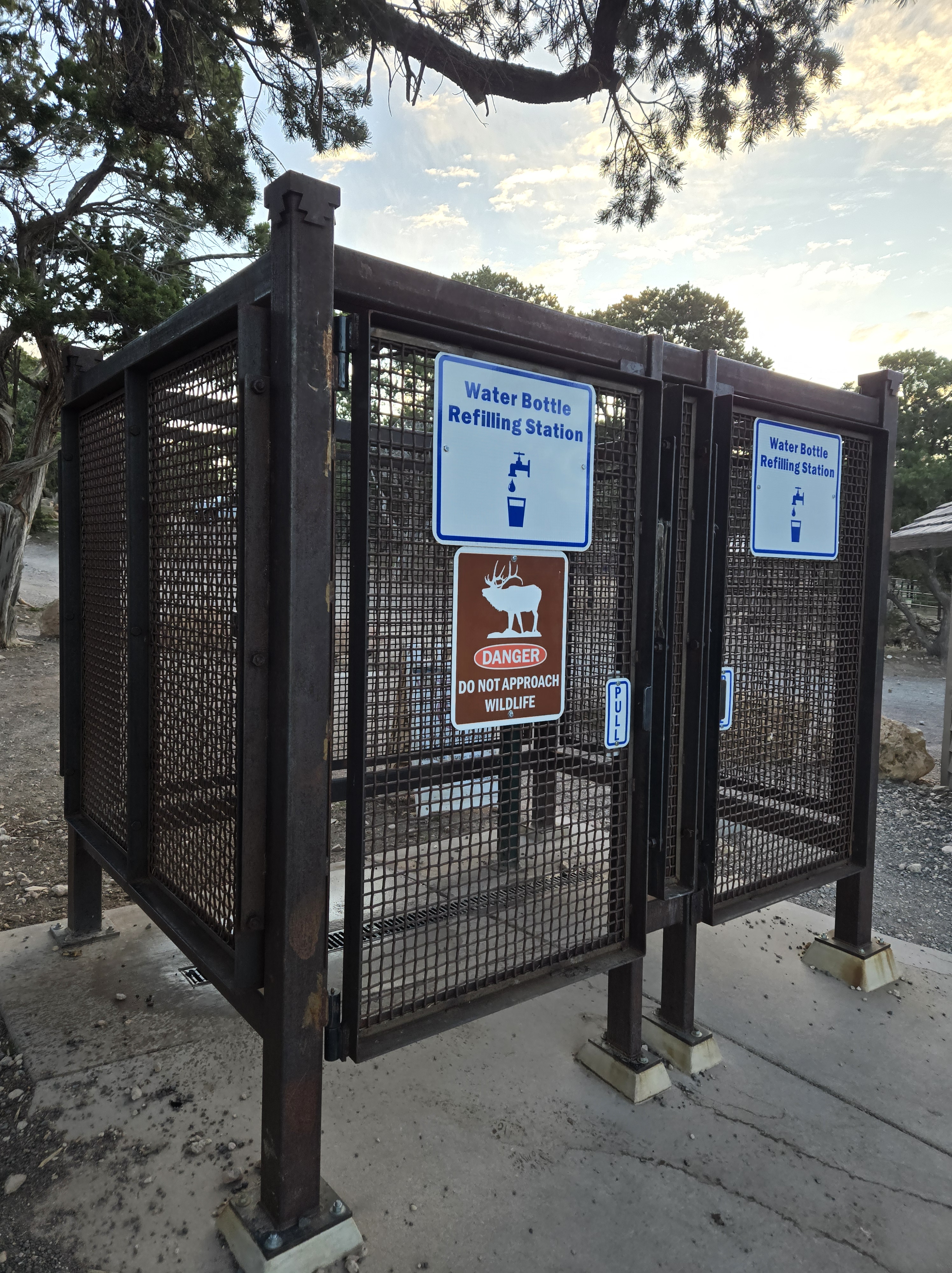
Water Station at the South Kaibab trailhead. It's in a cage to prevent wildlife from getting to it.
Water Station at the South Kaibab Trailhead

Why these thoughts? Honestly, I started this post with a different thread in mind, about how I’m approaching the end of the first year of PA school. But, my thoughts ended up taking a different path, and that has made all the difference. At least as far as this post goes.

Medical Teamwork

I’m currently watching a series of videos to prepare for taking my ACLS (Advanced Cardiac Life Support) and PALS (Pediatric Advanced Life Support) certification classes in one and half weeks. The most recent video was about teamwork when running a cardiac code.

I realized, this is one of the parts of my ED Tech job I really appreciated, not the medical side per se, but how, when you’ve got a well-oiled team that has worked together, you can make things run very smoothly.

During a cardiac code, there’s not much techs can do other than compressions or “bag” the patient (provide O2 through a BVM (Bag-Valve Mask). We can’t put in IV lines or push drugs, we can’t intubate the patient and we can’t shock them. But, those compressions are a key part of a code. We’re basically keeping the patient’s brain and heart (and other organs) perfused while the rest of the team can work their magic.

I’ve honestly lost track of how many patients I’ve done compressions on, but a fair number do stand out.

In one case, the patient was in our primary trauma bay when his heart suddenly stopped. We called a code blue and the nurse and I jumped in. She started to use a BVM to provide oxygen while I jumped up and started doing compressions. I recall thinking how natural it felt for us to be doing this. There wasn’t an unnecessary chatter or discussion. We just started doing what was necessary and once we started I counted compressions, would stop, she’d bag the patient, and I’d resume. Meanwhile like The Avengers, the rest of the team assembled. It was quick and efficient.

Another thing I appreciate, at least where I work is that they value everyone on the team. This was never more evident when I was precepting a new tech. In this case, I was basically showing him how we did things in the ED. I wasn’t really teaching him anything medical since he had a couple decades of experience as a paramedic and EMT, so his medical knowledge exceeded mine.

During this period, we had a patient go into cardiac arrest. He and I both did compressions while the rest of the team worked on him. Sadly, this patient didn’t make it. However, one thing that a good team leader does during an arrest is ask for ideas. They realize they’re human and they might have missed something. So, the attending here, one of my favorite attendings by the way, ran over what we had done to confirm we had done everything expected and then asked, “Any other suggestions?” My orient spoke up, “Is it possible he OD?”

The attending gave it a quick thought and replied, “no” and then explained why he had ruled that out as a correctable factor. It wasn’t a “who are you?” or “I don’t know you, you’re just a new tech”. He took the question seriously and gave a serious answer.

At the end of the day, we can’t save everyone. Hearts stop for a variety of reasons. But I’m proud of the team I’m member of and proud to know that we work well together and give it our best.

And that’s part of the reason I love my job as a tech.

Thinking Like a Programmer

It’s a bit cliche to say that the hardest thing about PA school is how much we have to learn. I mean it’s true, but doesn’t say much.

I’ve mentioned in the past how one of the biggest obstacles I had to overcome to simply even be considered to admissions, let alone be admitted, was my undergrad GPA of over 35 years ago. And I get it. If you’re attending a grad program, really any grad program, right after your undergraduate degree, your undergraduate GPA is fairly indicative of how you’ll perform in grad school. And the truth is, 35 years ago, I would have failed out of grad school. But I’m not the person I was 35 years ago.

One of the things I’ve had to do a lot of over the past 8 months or so is adapt my learning style as I go. I have to figure out what has been working and what hasn’t been working. I spoke in my previous post about how tough I find pharm. The first piece of good news is that I passed that exam. Not by much. But I passed. However, I did something I probably would not have done in my undergrad days: I set up a meeting with the course coordinator for pharm to discuss how I should approach things. So I’m already a better student than I was 35 years ago.

For me, the hardest part about pharmacology is that it’s really mostly rote memorization. There are times where the suffix portion of a drug name can help clue you in (e.g. -olol is what we call a betablocker and used for HTN) but not always. Propranolol is a betablocker we use for HTN, but also for Essential Tremors! In any case, rote memorization doesn’t come as easily as it did to me 35 years ago.

My professor gave me some advice, which honestly we had been told before, but this time in a more concrete fashion. See, I tend to make a lot of flashcards on 3″x5″ flashcards. I’ve made a few thousand by now. And they help. But she suggested I keep them briefer and more succinct and make more. She also suggested I keep them simpler. I had been making them far too complex. It sounds like a simple change, but I think it’ll make a difference (we’ll see in a few weeks after my next pharm exam).

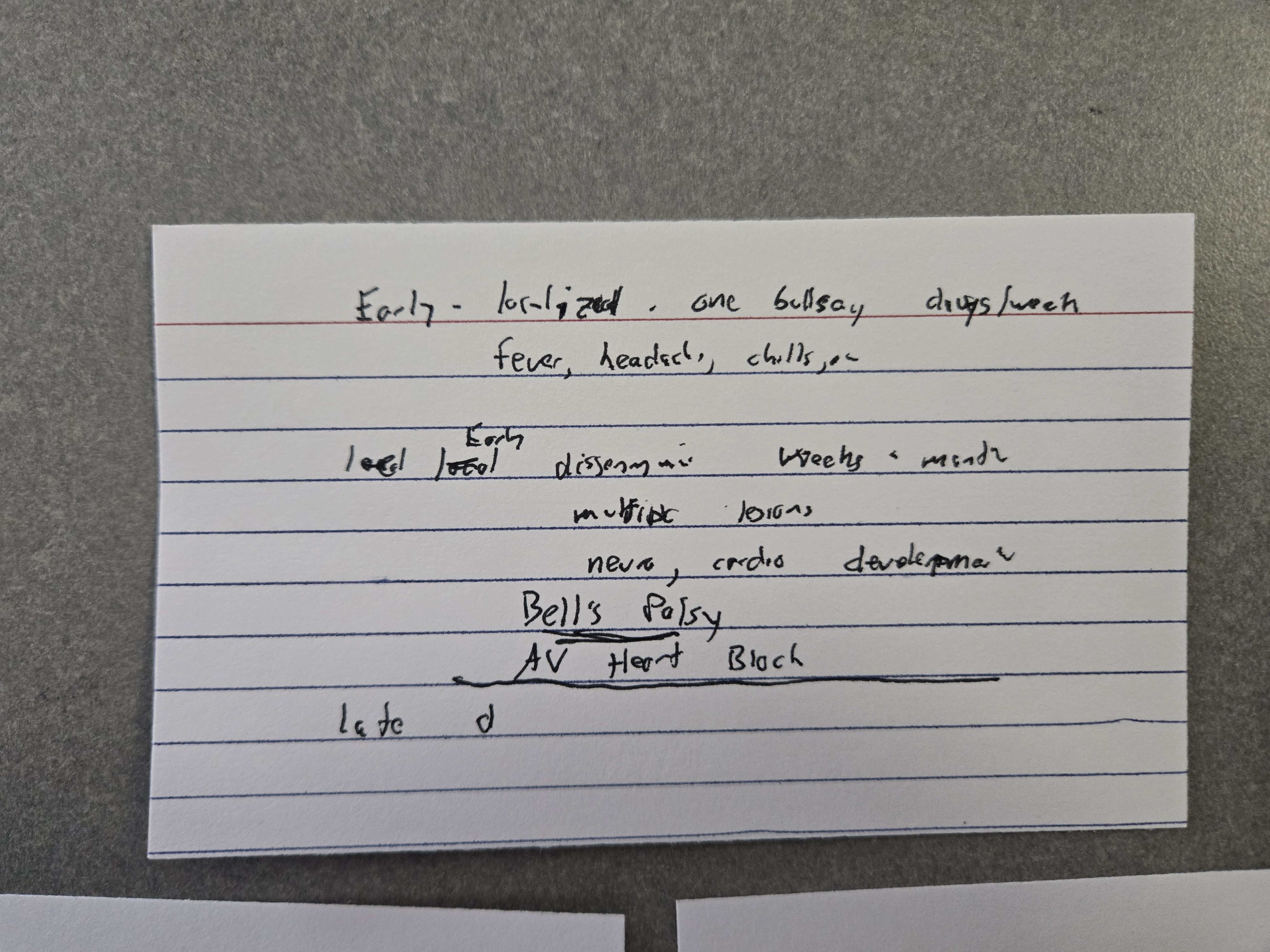
That said, I caught myself today making a flashcard on Lyme Disease stages and I realized I was cramming more and more details onto it. I stopped. I realized I was falling back on my old ways. So how does this related to programming?

Index card with detailed notes about three stages of Lyme Disease
Overly Complex Card

I was suddenly reminded of when I was hired for a programming job to work on a project using Visual Basic and Visual C#. Both are what programmers call “object-oriented” languages. I had grown up on more procedural languages. I really had very little experience programming in an object-oriented language. In fact I told them that during my interview. Their response was “we want you anyway. So I quickly came up to speed and started to think like an object-oriented programmer. And for this project, this was actually a great paradigm. The program helped engineers design and specify the parts for a particular type of physical object.

But every once in awhile I’d find myself facing particular programming challenge and finding the code hard to write and very complex when trying to solve the problem. And then it would suddenly dawn on me, I had stopped thinking in terms of objects and was trying to think like a procedural programmer. Once I went back and approached the problem from an object-oriented paradigm, often the solution would pop out very quickly and the code would be shorter and clearer.

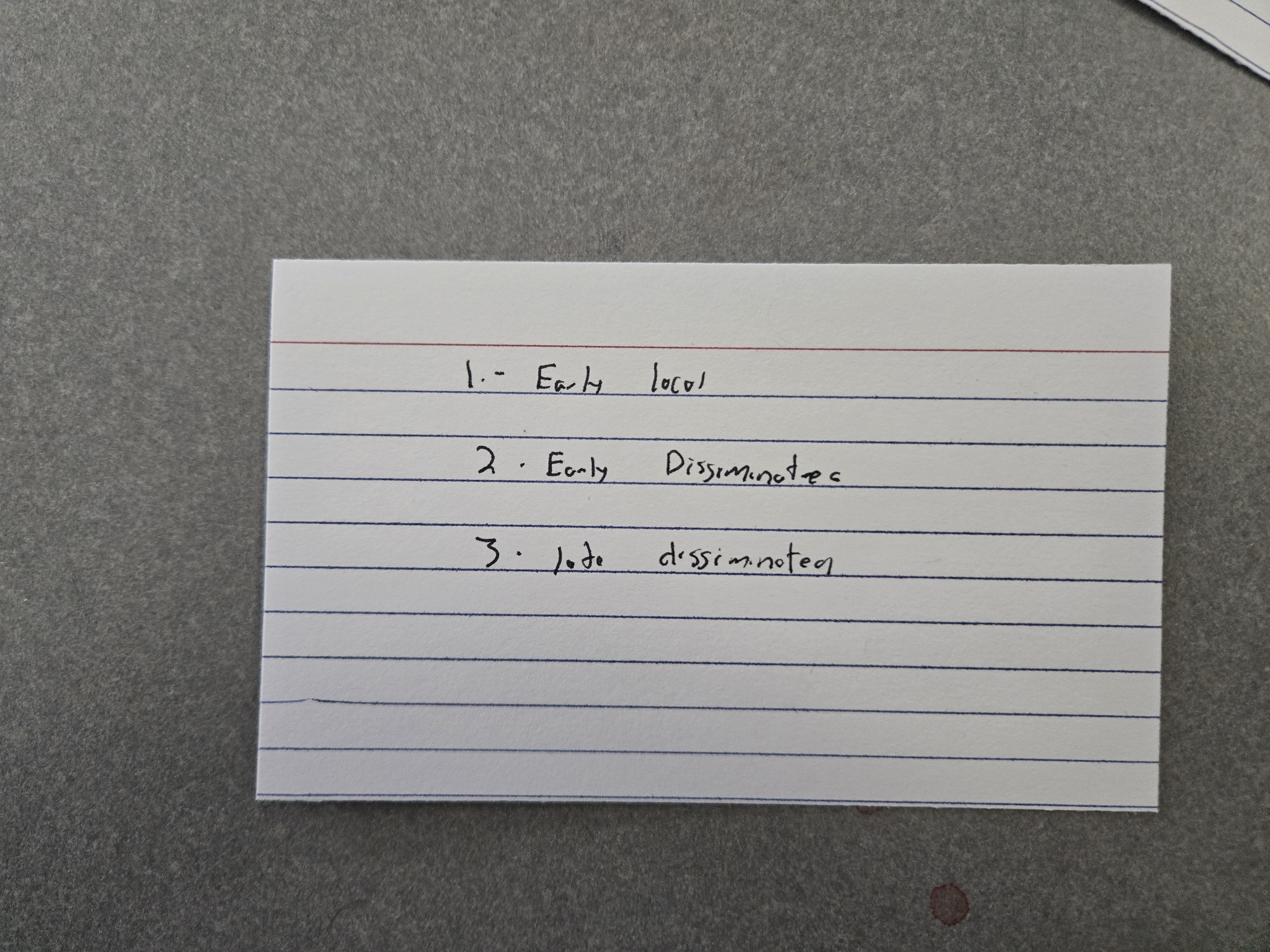
It took a paradigm shift. So I simplified the first card greatly.

Simplified index card listing just the 3 stages of Lyme Disease
Simplified Card

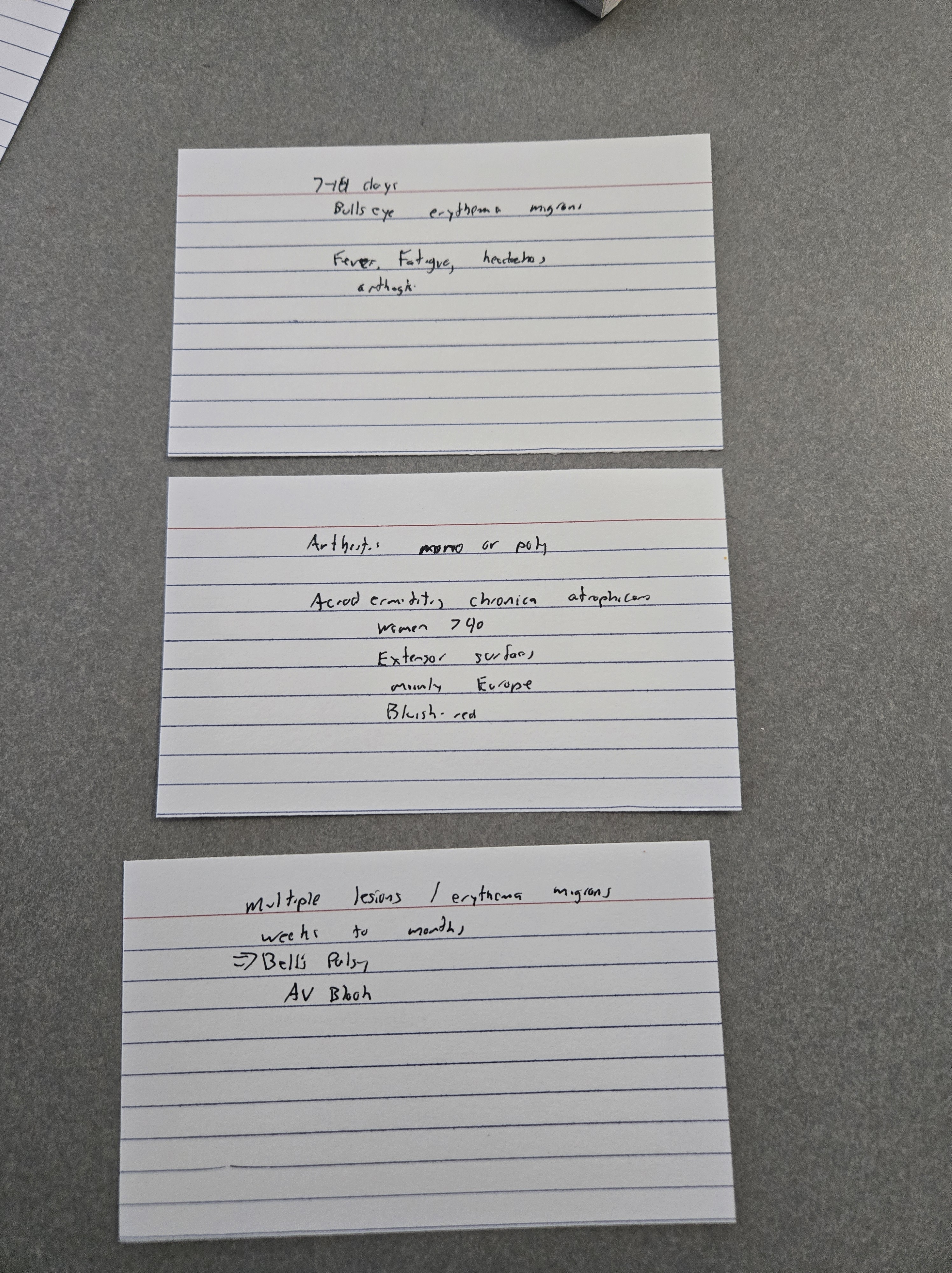
And then made three separate cards

Three index cards, one for each stage of Lyme Disease
The Additional Cards

This helps in two ways. For example, rather than have to remember every detail on the overly complex card and perhaps confuse them, I can focus on the individual stages of Lyme. If I forget one, I’m only impacted in that area at test time.

But also, I can use the cards “forwards and backwards”. i.e. I can look at the front (which states the stage) and work on recalling the signs and symptoms for that stage. Or, I can look at the back and try to recall what stage it is. It reinforces the memorization process AND means that if they ask a question in either direction, I’m more likely to get the right answer.

Does this work for everything? No. But I’m already liking it for some things.

Will it work? We’ll see.

But the point is, for me to get better at pharm (though ironically this is for a medicine lecture) I need to make a paradigm shift in how I study. Wish me luck.

Tough Times

There’s many reasons I maintain this blog. It started talking about my thoughts on design (both database and real word) and on metacognition and other topics. Often I spoke about caving and the NCRC. But sometimes I write, because I have to. This is one of those.

Let me start with two recent things shaping my current thought processes. My Pharm exam this morning. I won’t get a grade until Friday probably. And despite how hard I studied for it, I don’t expect it to be good. Pharmacology is my nemesis. It stresses me out. So, I’m completely stressed right now and to be honest, wondering if all the stress is worth it. But that’s a topic for another day. (Though you can read my thoughts from the end of last semester here.)

The second part was learning one of our cats has cancer that has metastasized. Many folks don’t believe us when we say we have two cats because they never see this one. Pisantar definitely is a bit skittish and tends to hide when company is around. But, of the two, he’s ultimately the more curious and probably more intelligent one. I have bonds with both cats, but sometimes I think I identify with Pi (as we call him) a bit more. So, that double whammy has me down.

But, what I really wanted to write about is something that finally gelled in my mind the other night. By now we’re all familiar with the shocking killing of Alex Pretti. When I saw the first video released I was shocked, upset, and sick to my stomach. Things haven’t gotten much better. If anything in some ways worse. And then the other night it hit me. He was an ICU nurse. He was one of us.

In over thirty-five years of IT, I’ve worked with teams large and small. And along the way, a few have passed, all from natural causes, including Covid. Honestly, one, given his health, didn’t surprise me at all. But, I’ll be honest, even though I’ve made friends, the closeness has never been as much as it has been with my coworkers in the ER. Even ones I might not consider close friends, I share a close, intimate bond with. I think it’s because in my IT jobs, the worst that could happen was a database might crash, some money might be lost, even jobs might be lost, but no life was saved or lost. Obviously in the ER it’s different. We have a common goal and a common enemy. We struggle to keep people alive for one more day. It doesn’t matter who they are or why they are there. They need help. We help.

In the ER I’ve encountered the best of the people and the worst. I’ve been punched. I’ve seen my coworkers be called the worst names (I once threatened to have a person ejected because of their behavior). I’ve seen threats be made. But I’ve also seen the family member cry on the shoulder of a nurse because we saved their mother. I’ve seen the wife smile, knowing her husband’s chest pains are just indigestion from her dinner, not a heart attack that could have made her a widow. I’ve seen the satisfaction on the team’s face when our compressions and meds were successful and we know the person was discharged, neurologically intact. We’re there. We’re making a difference, no matter who the patient is.

And, no matter who our coworkers are. There are coworkers whose political believes I disagree with. There are the coworkers who have rubbed me the wrong way. But, when push comes to shove, those are the very same coworkers I know will do everything in their power to try to save someone. We work as a team. We are a team.

No one I know goes into Emergency Medicine for the money. We do it because it’s who we are. Because we want to make a difference. We want to be part of something bigger and better than our individual contributions. We want to be part of a team.

Now in some ways, the ICU is a different place. It’s quieter. Far less chaotic. But at the end of the day, it’s the same thing. People doing their best to help their patients. People are there to make a difference. They’re a team.

And this extends beyond the ER. Many of my coworkers are also EMTs and paramedics. Or rescue animals. Or do other acts of service. It’s why I’ve done the NCRC for so long, it makes a difference. We’re one.

So, I realized, when Alex Pretti died, it was like a coworker died. It was someone I could have been close to. Someone I could have worked with to save a life.

I couldn’t imagine going into work knowing one of my coworkers had had their last shift. That one of my coworkers had run their last code. That one of my coworkers had pulled drugs from the Pyxis for the last time. We had lost one of our own. When I saw his flag draped coffin rolling out for the last time with his coworkers standing there, I realized, I was there too, in spirit.

It could have been any of the team I work with. And I realized, too, that knowing me and my spirit and desire to be out there, helping, it could have been me.

2026 A Year in Preview

For several years now I’ve set some goals for the upcoming year. These are not resolutions per se.

Last year I didn’t set too many goals because I knew I’d be starting PA school. This year my list is perhaps even shorter. But here goes.

  • Finish my didactic year of PA school. I’m two semesters down, one semester to go. It won’t be easy, but I think I’ve got it.
  • Start my clinical year. I have a total of 10 four-week clinicals I have to do. They’ll extend until April next year. This will be difficult and involve a lot of travel, but I think I’ve got it. But ideally at least one or two will be local to Albany.
    • Related to this one: Going to South Africa. I applied for both an international rotation in South Africa (with a focus on procedures) and a small scholarship. I received both. The scholarship doesn’t come close to covering the additional cost of the rotation, but it helps take some of the sting away.
  • Last year I mentioned seeing friends. While always a goal, I don’t think I’l have too much time for that.
  • Biking – I’ll definitely continue doing this because I need the physical activity and it helps my mental health.
  • Beyond that, not many goals this year. Only a few goals, but they’re big ones.

2025 A Year in Review

As I’ve done in the past, I like to take a look at the goals I set out at the start of the year and see how I did.

  • My primary goal of course was to succeed at PA school. My last two weeks were rough. But I’m doing well and my professors reassure me that I’m doing fine. There are parts I very much enjoy and did well in. And my professors reassure me that I’m doing well. So even though my GPA isn’t quite what I’d prefer, overall I’d call this a success.
  • I had a goal of a road trip. I accomplished that in spades. This was perhaps one of the best decisions I’ve made in a long time. I needed this trip in ways I didn’t realize and it refreshed my soul in many ways. Being able to visit a friend one last time was also a poignant part of the trip.
  • My goal of seeing/making friends has been mixed. I haven’t had a chance to catch up on old ones as much as I would like. As for making new ones, while I definitely like my classmates quite a bit, I can’t say I’ve made as deep personal connections as I might like. This is an area where the difference in ages is definitely a factor. Ironically, in some ways I’m perhaps have a closer connection to a couple of the professors, but because of our roles, there’s definitely a certain professional distance we maintain.
  • Biking has been a salvation for me. It also was a reason I decided to get out of my first lease and into one closer to campus. My initial apartment was in downtown Wilmington and while it was nice enough, I realized for many reasons it was far from ideal from me. One of those reasons was how impractical it would have been to bicycle at all. The last few weeks of the fall semester I didn’t get much biking in because of the weather. However, I now have a rowing machine and I’ve been using that. Once the weather gets warmer again, I expect to bike more.
  • New Septic – well, once again, we didn’t do this. But this time for a very good reason. We solved, at least for now. Even if the solution is only good for five years, that’s costs we aren’t spending money on now.
  • As for projects around the house, it’s hard to say. I got a few done. I put up a new section of fence around the pool. This one us more privacy and is in better shape. I also finished off putting a ceiling over our upper deck. I still have others I want to work on when I get the time.
  • That’s about it. I’d say for my goals, I did pretty well this year. Check in tomorrow to see the goals I’ll be setting for 2026.

Updating my Quarterly Calendar

The title photo for this post should show a shot of my 4-month whiteboard calendar that I used to use to plan out my months in advance. As you can see it still has May on it. I haven’t had an opportunity or even really a need to update it since May. In May I had a variety of events scheduled, but pretty much since then, as the calendar shows, it was all school, all the time. Though I was home over August break for a week, I didn’t bother updating the calendar.

To me it’s a symbol of how hyper-focused my life has been these last few months. Now it’s time to update it for the next few months. There still won’t be much on it, a couple of breaks and the scheduled “core competency exam” which is nothing more than simply a comprehensive test on everything we’ve learned over the previous 3 semesters.

The real interesting stuff starts in May, the second quarter of the year, so it doesn’t show up here. That’s when we get ready for our first clinical rotation and then head out for it.

In any event it’s sort of an interesting perspective on how I spent my last eight months and will spend my next four.

And what it looks like now. Basically, weekends… or classes.