Founder and owner of Green Mountain Software, a consulting firm based in the Capital District of New York focusing on SQL Server.
Formerly, a consulting DBA ("and other duties as assigned") by day, and sometimes night, and caver by night (and sometimes day).
Now, a PA student working to add PA-C after my name so I can work as a Physician Assistant.
When I'm not in front of a computer or with my family I'm often out hiking, biking, caving or teaching cave rescue skills.
It’s been awhile since I’ve focused exclusively on SQL Server or even T-SQL and perhaps this would make a great question for someone to ask on a T-SQL Tuesday, but for now I’ll ask.
An open question to any of my readers who work with T-SQL: “What command or construct do you find difficult?”
Let’s be honest, we all have something about T-SQL that trips us up. I’m hoping the basic SELECT statement doesn’t. Though, start to throw in stuff like an outer join and a correlated subquery, it can get complicated pretty quickly. But even those I can generally get written without too much effort.
The one construct I do encounter infrequently, but enough that I feel I should fully grok it by now is a DELETE with a join. It’s actually not all that complicated, but I often have to look up the syntax to remind myself.
But the one that gets me every single time: PIVOT. I’ve probably only written a half-dozen pivots in my life and that’s 6 too many in my opinion. I’m not sure what it is about them, but my mind still doesn’t just fully grasp the syntax in an easy way.
Thinking about it, I think one reason is because when I’ve had to use them, it has never been a trivial case.
Fortunately, since my primary focus is on the operations side of being a DBA, and most of the code I write is to support that, I don’t come across the need for a pivot very often. I suppose though if I were writing a lot more code, I’d use it more and understand it better.
I like when the day I blog lines up with a holiday, or some sort of astronomical event. it gives me a ready made topic.
And so in that theme, this post will be similar to the day: short.
Several years ago (it feels like a lifetime) my family and I flew into Manchester UK so I could speak at a SQL Saturday there. I hadn’t really given thought to how far north it was and the fact that it was close to the Summer Solstice, but I woke up at 4:00 AM local time and it was basically no darker than twilight I was a big groggily confused. Once I was finally awake later in the day I realized why it was so bright at that time.
Manchester UK Daylight Map
This time of the year it’s the opposite. I wake up at my normal time (generally around 6:30 to 7:00, the time varies as I almost never use an alarm clock) and it’s still fairly dark and I have to check a clock to make sure if my body’s clock has really woken me up in time for the day.
Troy NY, US Daylight Map
Between shorter days and the fact that my largest client client is basically in a freeze period, my days are fairly empty, at least in terms of workload. The amount of darkness and lack of work does cause a lack of motivation for much, including writing this blog.
But, that’s belayed a bit by the fact that both kids are home from college, one until her next semester starts and the other until he discovers what life has to bring now that his college career is finished. Like me on the Winter Solstice, one thing is ending and the future seems limitless, perhaps a bit overwhelming. But it is ultimately something to look forward to.
Days are starting to get longer, and in 10 days, a New Year will begin, and I look forward to what that will bring.
In the meantime, I’ll enjoy my Christmas Music, have the lights I inherited from my grandparents lit (technically just the strand, I think I’ve replaced all the bulbs at least once, and they’re getting more rare and more expensive!)
So, here’s to longer days and a better New Year.
And see, I told you this would be a short one, much like the day.
Favorite Conference: The easy answer has been SQL Pass, but honestly, at this point, any where I get to see folks in person!
Best Venue: Ignoring Pass at Seattle, I have to say Manchester UK was nice, simply because it was my first overseas SQL Saturday, or perhaps Virginia Beach SQL Saturday, because Monica Rathbun and her group provided a nice charcuterie board!
Best Presenter: Oh, this is a tough one. I’m going to take a pass. But then cheat and answer below. Sort of.
Next event and why it’ll be Costa Rica: I’m suspecting sort of a bias in this question, but to be honest, I’d love to go. I think 2022 will be a bit too busy for me to visit, but perhaps 2023 or 2024. Maybe I can work in some caving then too!
That all said, I want to get back to my shout-outs above and tie that into this T-SQL Tuesday.
As the coordinator for the Capital Area SQL Server User Group, one of my primary roles, in fact perhaps the most important, is finding speakers to present. I’ve tried over the past few years to have a good variety and to bring some variety. We haven’t really missed a meeting since the pandemic has started, but we have been virtual for well over a year now. This has presented both drawbacks and opportunities. The biggest drawback of course is the lack of actual in-person interaction and the feeling of connectedness that has brought. On a personal note it also means not only have I not gotten out of cooking dinner the night of meetings, but often, I’m juggling getting something together for dinner and getting the session started (though last night my wonderful wife did take care of dinner for me.)
On the flip side, being virtual has allowed me to invite speakers who might not otherwise be willing or able to travel in person to Albany NY and for attendees from across the country to show up. It has also given me the opportunity to experiment a bit more with formats.
Last year, instead of our traditional in-person holiday party format, we did a version of “Bluff the Listener” where I asked various presenters to tell their worst IT/SQL horror stories, but one was lying. It was a success and a lot of fun.
Not wanting to repeat that, this year I decided to ask the above 4 presenters to present lightning rounds. That’s not so bad, except I added a twist. They didn’t get to choose their topics, they were given them: 10 minutes before they were scheduled to present. (And yes, some may I stole this idea from Buck Woody, I’d like to say I was inspired).
I’ll admit I was very nervous about this idea. It seemed a bit gimmicky and it could have been a complete disaster with lesser speakers. Fortunately, all four brought their A-Game.
Rob Farley, presenting from the future, in I believe a public work space, managed to give one of the best talks on column-store indices I’ve seen. Given he had only 10 minutes of prep, I was impressed. His presentation included the use of Powerpoint in sort of a “green screen” mode so he could draw on his screen and we could see what he was drawing.
Peter Shore followed up talking about Tips in Advancing a Career in Data. Again, off-the-cuff with limited prep time, he did very well with this topic. I think in some ways this was almost harder than the more technical topics because you can’t fall back on a demo or graphics.
Deborah Melkin followed, talking about the Best new SQL Server features (2019, 2022, Azure). I had announced previously that the best speaker would be awarded a prize. By I think unanimous declaration, even before Rob Sewell finished out the night with his presentation, the other speakers decided Deborah was the winner. She included some demos in her presentation, which, given the lead time, really impressed folks.
Closing out the evening, Rob Sewell entertained us with a demo of SQL Injection. Not surprisingly, he made use of PowerShell and Notebooks.
As I said, it was an entertaining and educational evening. I purposely set expectations low and made sure folks understood that the entertainment value was as much, if not more important than actual educational value. But I was very pleased with how educational it turned out to be. It was a nice way to end the year and honestly, I think a decent way to get a break from the bad news that seems to have surrounded us lately.
I do have a theory though about why the educational part turned out as well as it did though. In general I’ve always enjoyed lightning talks and I honestly, think they’re among the hardest type of talk to give. Sometimes people promote them as a good introduction to speaking for novice speakers, but I’m not so sure. To give a successful lightning talk, one really has to strip a presentation to the bare essentials and really focus on just one or two key concepts. This can be difficult. But done well I think it really makes those concepts stick.
Now, combine that with topics only being given out 10 minutes in advance, I think that really forces a presenter to focus on key concepts even more. I wouldn’t give an inexperienced presenter a random topic, and even with an experienced presenter, I’d give them a chance to decline a topic if they feel it’s completely outside their wheelhouse. But otherwise, give them a chance to see what they can do. It might surprise you. Heck, it might surprise them.
So, to go back and answer a question from above: Best Presenter… at least last night Deborah Melkin, who if nothing else proved her Google-foo was impressive.
And I think if I can find volunteers, I will definitely try to do an in-person version of this at a future SQL Saturday or Data Saturday or other conference.
Thanks to all who participated and joined us. It was a blast. But honestly, next year, I hope to see you all in person at our holiday party!
I’m sitting here listening to The Hudson River Sampler on WAMC a local Public Radio station, hosted by Wanda Fischer and reflecting more on Bill Staines and Scott Alarik. There’s a lot to reflect upon, but I’m going to comment on just a bit.
First is a quote from Scott Alarik talking about folk music and how memory is how a person remembers, but tradition is how a society remembers. He then talked about how we can tell what was important to a society by what is preserved and what we hear years later and how we can be drawn back in history by tradition.
But the other thought is a basic tautology: every performer has their own style of performing. This reminded me first of the two “worst” folk performers I’ve heard over the years. Now, worst is relative. Neither technically were bad performers. Technically they were competent and their performance enjoyable, but…
In the first case, it was a performer who performed at Mother’s Wine Emporium at RPI. I honestly don’t remember who it was, but they did their two sets, and at the end of the evening asked for their check, which I promptly handed to them. Now, let me point out here, that as much as many performers loved performing, performing was the way they put bread on the table. Performers who appeared at Mother’s were professionals and we paid them as such. But… In all my years of interacting with performers this was the first, and only, that treated it simply as a job. There was nothing more there. I think they would have put in the same effort with no crowd, or with the largest crowd ever. I’d say their heart simply wasn’t in it or something. That’s fine, but not what we wanted.
The second performer was one my wife and I caught at a lodge on the Skyline Drive in Virginia. We were staying there for the night and during dinner, there was live music. The performer setup, and segued from a warm-up into the performance. He was quite good, and he had some good monologue to go with it, but unfortunately he failed to make any attempt to connect with the audience. It was a shame because there was another family there with young kids and I suspect they walked away without any sense of the specialness of the music. From his demeanor and comments, I suspect this was a regular gig he did every week and was simply a bit jaded. Which is a shame.
This is not to disparage either performer, but more to offer a contrast to other performers such as Scott and Bill.
Bill loved to perform, as the mileage on his car, and the name of 2 of his albums suggested. I don’t think he’d pass up a chance to perform. And despite how many performances he did, I always felt like he was there for the audience. He’d give his all and the audience always enjoyed it. I think the bigger the crowd, the more energy he’d give and make the room feel all that much larger. He could make a small room feel like a concert hall.
But listening tonight, I realized Scott had a very different style, one that worked for him. I’m not sure Scott ever was performing for the audience per se. He was performing for himself, but inviting the audience to come along for the ride. As he’d sing, you could tell he was enjoying the songs and if you joined him and enjoyed the show, great, but if not, he was going to enjoy it anyway. It was almost like being invited into the inner sanctum of his mind. In his case, no matter how large the room, he could make it feel like an intimate, small space where it was just you and him.
Both had their styles and I enjoyed both and will miss them.
As I start to write this, the TV reminds me, that this is the 80th anniversary of the attack on Pearl Harbor; and that there are still a few veterans alive from that day.
This is both a somber note, and a somewhat celebratory one to start the day. Horrible things can happen, and yet life can still go on. I was reminded of this over the weekend.
I woke up on Saturday morning to read on Facebook that Scott Alarik had passed away. Some of my readers will recognize the name immediately, but for those who don’t, a little background. Scott was a singer-songwriter who was also a columnist for the Boston Globe and write a book on folk music and wrote for a number of other columns. I first met Scott at Mother’s WineEmporium so many years ago. He had performed his opus Fresh-Water Whaling, telling the little known history of the glory days of whaling on the Great Lakes. I must add that the history is so little known as to be non-existent. But, for those who do recall it, remember those little harpoons you sometimes find in drinks memorialize it. Or so it was said by Scott. As much as Scott liked to sing, I think he preferred more to talk and write. He was a living, walking history of the world of folk music. I still recall one night, after he had performed at a Mother’s Wine Emporium show at RPI where we discussed “what exactly is folk music?” We agreed it was “music of the folk” but beyond that we decided it had no easy definition. As I write this, I’m listening to the first video I found on YouTube and it is Scott at his best. Yes, there’s a song or two in there, but mostly it’s him telling stories. It’s as I remember Scott.
Scott Alarik at Mother’s in 2019
That news was hard enough, but to myself I said, “at least Bill is still with us.” I had read late last month that another singer-songwriter I knew, Bill Staines was fighting cancer and the battle was not going well. Alas though, on Sunday I woke up to more tragic news. Bill had journeyed to the next folk stage. Bill was another performer I had met through Mother’s Wine Emporium many years ago. I have several of his albums, at least one I believe signed. He was known for the prodigious miles he would put on his car, I believe at one point he said he averaged 100,000 miles a year, as he drove from performance to performance. Three of his albums reflect this: The First Million Miles, The First Million Miles, Vol 2, and The Second Million Miles. His best known song was perhaps River,(Take Me Along). I think his final journey though is longer than all his rest.
Finally, later on Sunday I also read of the death of fellow caver Mark Hodges. I can’t say I knew Mark very well. I want to say I caved with him at least once, but I honestly can’t remember. But I knew the impact he had on the cavers around him. He apparently suffered a heart attack while exiting a cave over the weekend. The tributes left to him from his friends and fellow cavers are touching and serve as a reminder, that one doesn’t need to write books, or travel 100,000 miles a year to have an impact on those around him.
I’m going to close with a memory of another friend and also former “Mother” at Mother’s Wine Emporium: Tom Duscheneau. Tom was a fixture at Mother’s for more years than I can remember, and many an attendee will recall him taking a seat at the front of the room, settling in as the music would wash over him, and closing his eyes. Yes, occasionally he’d need a nudge if had started snoring, but otherwise he would simply sit there, soaking in the music until the set ended. He passed in 2006, but I still recall him from time to time. I suspect if there’s a great beyond, he’s just pulled up a chair and sat down, preparing to take in a great concert as Scott and Bill decide to tell a few tall tales and perform a duet or two.
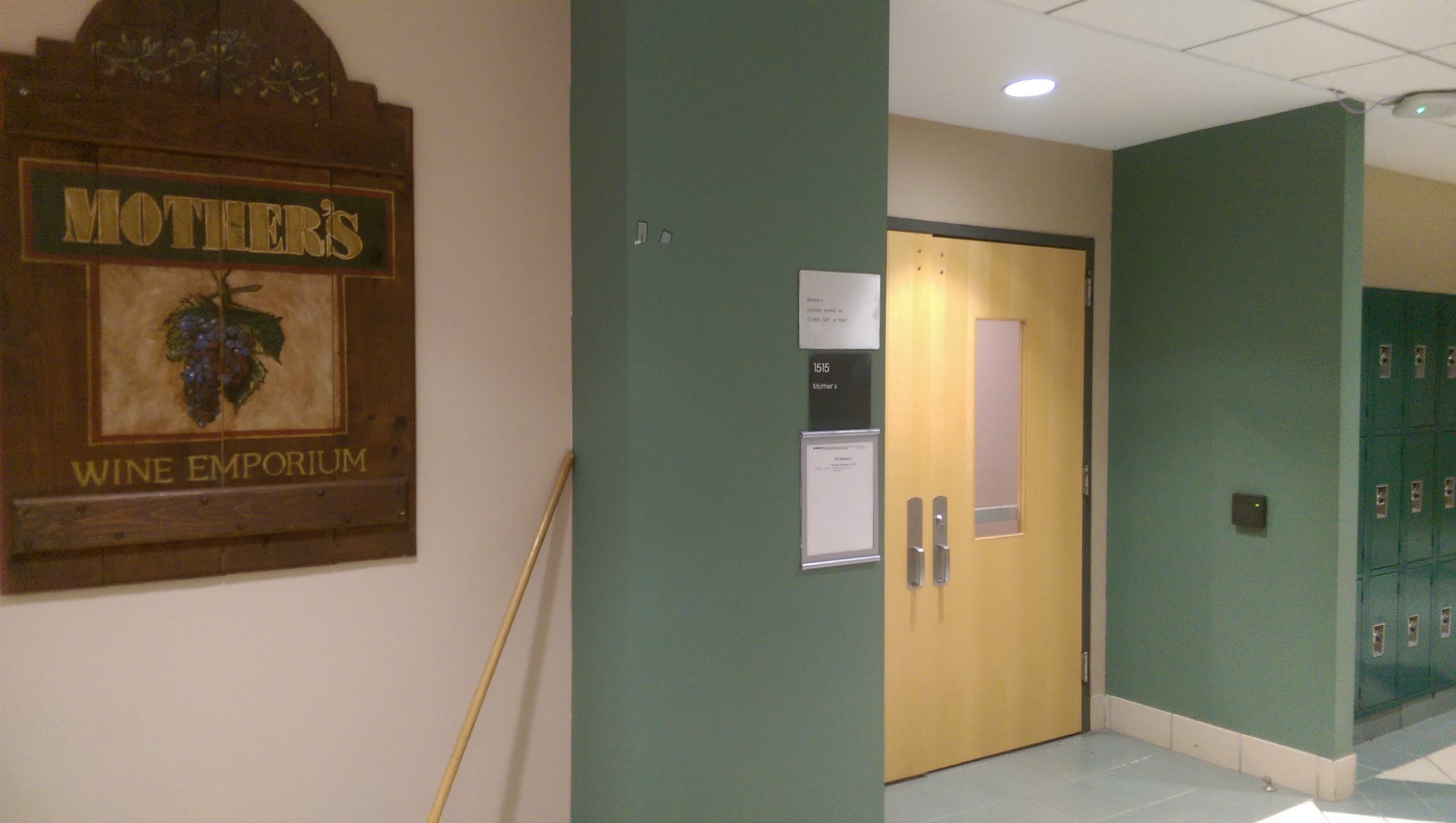
Mother’s Wine Emporium aka Mother’s Coffehouse – For those who don’t know what Mother’s was, it was a magical place at RPI, a place where one could retreat from the hustle-bustle of the busy world and sit back and listen to singers, raconteurs and more. It had moved at least once over the years (the above photo is the latest incarnation). For the longest time, it was the oldest, continuously student run coffeehouse in the nation. Scott liked to talk about how if you made it here, you knew you had probably gotten your ticket to the college coffehouse circuit. Those of us who had the honor of working here were known as “Mothers” and it is were my wife and I met. Due to a variety of circumstances, including the death of Tom Duscheneau, it had its last show sometime in 2007. In 2019, I worked with the RPI to bring back Scott Alarik for a performance, with a hope for future shows. Covid has unfortunately put a hold on that plan, but I do hope in the coming years to again sit back and soak in the music of some great performers.
I think it would be fair to say that like everyone, I’m a bit sick of Covid (thankfully not sick from it.) I just got my booster on Friday and then I’m hearing about the Omicron variant.
I submitted talks for SQLBits in the UK for next year, hoping to present in person. And I’m hearing about numbers rising.
I’m planning a mini-vacation/cave rescue training trip to Hawai’i next year and making sure everything is refundable. Just in case.
So I’m feeling god but…
At the start of each year, I set some financial goals for myself. Some include what things I may pay off, save, or how I’ll spend it (now admittedly most of those are fixed, such as knowing I’ll tax property taxes, etc.) As a contractor I also set a couple of various goals for new work and how much I’ll hopefully earn in the coming year. I find these are important as they help keep me focused and moving forward.
The good news is, financially I’ve hit all my goals, and then some, this year. The downside, with that, and with Covid continually popping up its ugly head, I’ve lost some of my motivation for the rest of the year.
Fortunately, this has freed up some time for some projects around the house. Almost two years ago, with help from the kids, I started on a project to replace some leaking pipes and replace the resulting damaged drywall in the basement. I’m proud to say I’ve finally gotten around to taping and painting the drywall in the basement and patching around where I put in the new bathroom fan. Things get done, albeit slowly.
I’m also feeling good because a major project for one of my clients is mostly completed. But it also came very close to burning me out and I’ll admit I even considered walking away from the client over it. The strange part is that it wasn’t a particularly complicated project, though it did involve a combination of SQL, PowerShell, and using a product called Pentaho. Technically it was fairly straightforward. But, for awhile, the project management was absent and the then lead was actually another agency who, I think it’s safe to say didn’t clearly understand the full scope of the project. With the addition of the client adding their own PM and working with a different agency taking over a bunch of the work, things have gone much more smoothly. Now we’re simply dealing with small niggling details that got missed before.
What kept me from walking away (besides it being my largest client) was a sense of responsibility to the client. Without my efforts, I think the project would have easily been set back a month as they would have had to bring someone else up to speed on my efforts.
Now the upside is that because of the overtime required (and it’s still ongoing) I met my financial goals for the year (and hence now have time for the house projects). So that’s a good thing.
But it did highlight how frustrating being a single-person consulting agency can be at times. It’s made me re-evaluate my goals for 2022. I’ll be writing more about this in a future blog, but it has got me thinking more about getting back to working for an company as a full-time employee, ideally in a management position. Strangely one thing I’ve come to realize is I actually enjoy making decisions and I enjoy managing. I sort of miss it.
And perhaps after nearly 2 years of Covid (and nearly a decade of pure consulting), it’s time I get out of the house more and travel a bit and interact face to face with people.
We’ll see.
But that’s it for today. I’m feeling good but…
P.S. One thing I did finally accomplish is submitting my latest article to Redgate’s Simple-Talk.
One of the holidays I’ve really come to enjoy over the years has been Thanksgiving. It’s also perhaps the one that has varied the most in my life. One of my earliest memories of it was when my parents were still married (I believe) and spending part of the afternoon playing some tag football with some friends the next street over in Falls Village. (Part of the reason that day was so memorable was the inadvertent discovery of some dog crap after sliding through it!)
After my parents divorced, typically my father and I would go to my paternal grandmother’s house in New Haven and then go out to dinner. She never cooked, for a variety of reasons, including the fact that her kitchen was rather cramped. I recall one year having to shovel out her driveway so we could get back out. Her house was a converted carriage barn at the bottom of a hill in the Westville part of New Haven.
We did this tradition for as long as she lived. But once she passed I decided to take up the tradition by doing it, first at our apartment in Troy, and then later our house. Over the years various friends and members of the family have joined us.
Thanksgiving 2014
While in college, I also did a few early-bird Thanksgivings with a couple of the groups I was involved with. One literally was an “early-bird” where it turns out the students responsible for cooking one of the two turkeys didn’t thaw it first and brought it to the event in a half-raw state. Fortunately my mom caught it in time, mentioned it to Dean Dave and we sidelined that turkey! Thankfully the second turkey was properly cooked and we could enjoy that and the other sides and desserts, including the apple pie I brought.
At some point my dad, who was never much of a cook himself, but enjoyed spending time with his family, suggested we start rotating it from year to year. He went so far as to buy a gas stove (haven gotten rid of the wood-fired kitchen stove well over a decade previously) just to have a place to cook the turkey. I suspect it’s the only time of the year the stove got use. Part of the tradition while driving there, at least for me, included tuning the radio until I could find at least one station that was playing Alice’s Restaurant (that’s the name of the song, not the restaurant of course). One year, we even took a very slight detour and took some photos of the family standing outside of a particular former church in West Stockbridge. (I should note, somewhere in the dirt bike race scene my father has me nestled in his CPO jacket while he’s standing next to my mom. Both were extras, as I suppose was I.)
We also would then on the third year, go to his half-sister’s house outside of Boston where she would host. One one hand I missed hosting every year, on the other hand it gave me a chance to enjoy someone else’s efforts. Unfortunately, this tri-yearly rotation did not last overly long. I think we got in two dinners at my father’s before 2015 when he passed away.
Since then, while we’ve enjoyed a few thanksgivings at my Aunt’s, both last year and this year have conspired to prevent us from gathering with here. Last year it was strictly due to Covid and this year, to other health issues. It’s frustrating as we’d love to see her again.
My Dad and my Aunt Thanksgiving 2013 in Boston
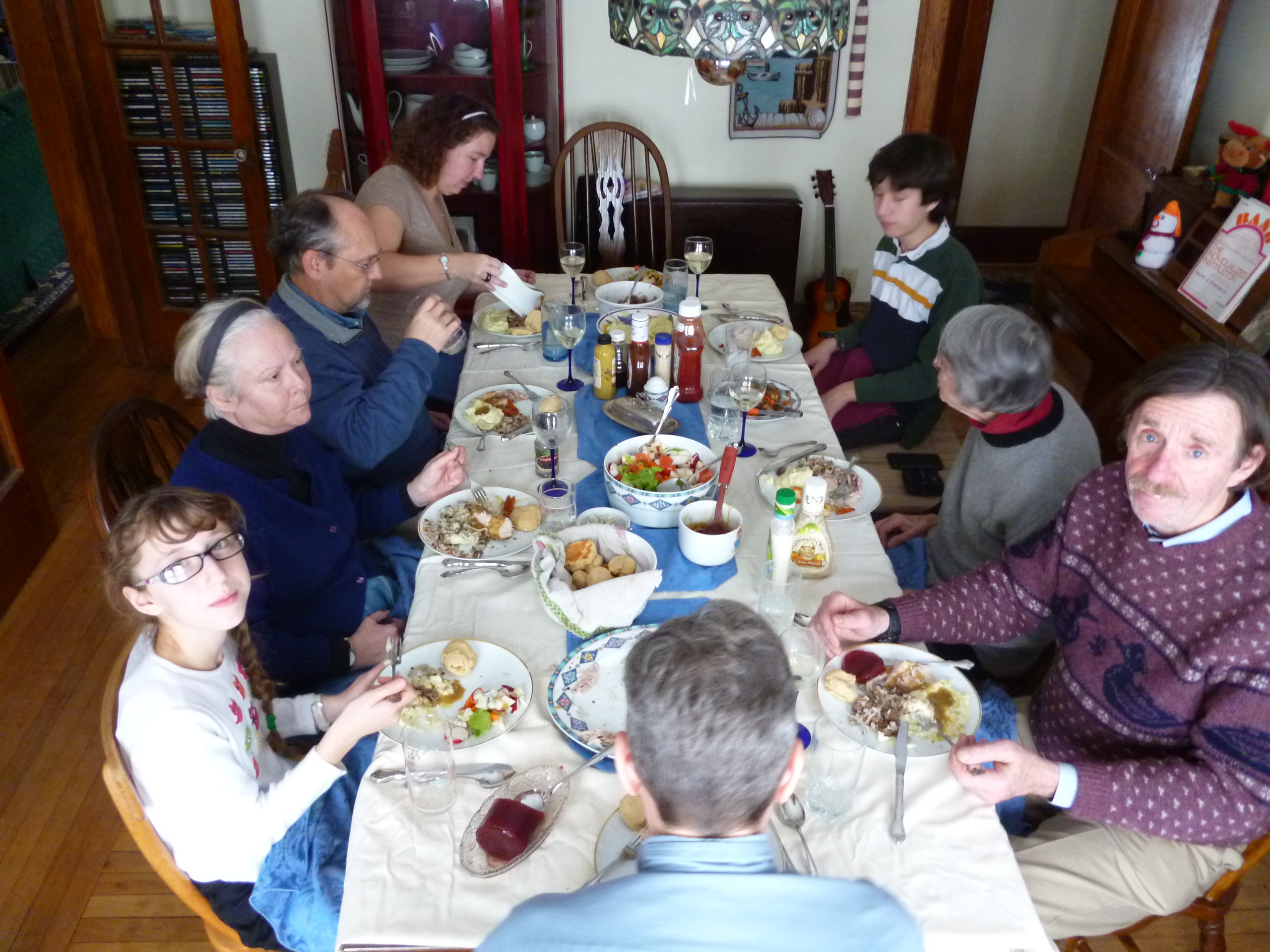
So, on Thanksgiving, I will miss my father and my aunt. But both kids are home from college, my mother will be joining us (since her mother passed several years ago, she’s started doing Thanksgiving at our house when it’s held here) and perhaps a few others.
I’ll watch the Macy’s parade while preparing the turkey and fixings and catch part of the Great American Dog Show.
We’ll go around the table before digging in and each give thanks for something in the last year. I think it’ll be easier this year than last year when the days were darker, not only because of the angle of the Sun, but also the general temper of the year.
And then, at some point, later that evening, probably around 8:00 PM, I’ll go to the fridge, carve off some leftover turkey, grab some mayonnaise, a dash of salt and bread and make myself a turkey sandwich.
Thanksgiving 2011
No matter where you are, or who you are with, I wish you all a Happy Thanksgiving. And here’s looking forward to 2022.
As many of my readers know, last week was the 2021 PASS Data Community Summit hosted by Redgate. In the past I would have travelled to Seattle to attend in person. Last year, due to Covid the Summit became a virtual event. I was a bit disappointed since I had finally been selected to present and was looking forward to doing so in person. I ended up presenting virtually. That alone would have been disappointing enough, but there were other issues and basically the underlying structure that supported PASS and its structure went belly-up and declared bankruptcy.
More Thoughts on Last Year’s Summit
My recap last year was positive but I have to be honest now. I was certainly trying to put a good spin on things. The truth is, I was more frustrated than I originally let on. I’m still not only grossly disappointed by the poor closed-captioning, I’m still a bit offended. I’m as guilty as anyone for probably not being inclusive enough when it comes to things like color-blindness, difficulty of hearing, etc, but to know that the organization had weeks to get good closed-captioning done, and didn’t still offends me.
I was also extremely insulted when weeks before the Summit, User Group leaders were asked to pony up money to attend. A benefit of doing the work of leading a User Group has traditionally been a free ticket to Summit. To have that change weeks or just a few months before Summit, especially one that was going virtual definitely felt like a bait and switch.
This and some behind the scenes factors in regards to PASS had left a bitter taste in my mouth. Then of course we finally got word that PASS as an organization was no more.
There were wails of anguish, and rending of garments, and wearing of sackcloth. (ok, I may be overdramatizing a bit). But I was hopeful. As I stated then, PASS really is the community. It’s the people. And they’re some of the best people I’ve known professionally: #sqlfamily.
This Year’s Summit
So, on to Summit this year. Within months of the demise of the former structure, Redgate announced it was buying the intellectual property associated with PASS. Microsoft in the meantime was rolling out tools to help the user groups. Steve Jones was working on SQL Saturday. Things were looking good. I was hopeful.
Redgate announced the Pass Data Community Summit would happen, albeit virtually. I was excited and looking forward to it. That said, I’ll admit I did not put in to speak this year. I just didn’t have the motivation. This was a mark on me, not on Redgate’s efforts. Redgate also announced that while the precons would cost money, the Summit itself would be free. Last year there was a lot of discussion about charging for a virtual summit and while I defended the concept a bit, because there are still enormous costs associated, I also was not a fan of it, because I knew it would be a hard sell to managers. I think I was proven right there. The very preliminary numbers I heard for attendance this year appear to have FAR outpaced the numbers for last year. I think that’s a good sign.
So, enough rambling, what about Summit this year?
First two criticisms
I common complaint, and one I knew I was guilty of, was it was unclear that for many sessions one was supposed to watch the recorded session first and then attend what was essentially a live Q&A. I know for the first presentation I attended on Wednesday, even the presenter, who was in the Q&A was confused by this. I’ll admit, I never did figure out how to watch the recorded sessions beforehand.
The second was, I didn’t discover the Spatial.Chat system until the 2nd day, and that was only because I am a Friend of Redgate had received a specific email inviting me to a private chat.
Now, partly, I will put the blame for the above two criticisms squarely on myself for probably not reading the emails in enough detail. But, it does seem others had the same issue and perhaps more succinct, clear links or emails might have helped. I honestly don’t know.
The Positives
That said, despite the above criticisms, I really enjoyed Summit and in a huge part because once I learned about the Spatial.chat system and how to use it, I for the first time, felt like I was in a virtual space that closely mimicked real life. The idea of being able to move closer to people to hear them better, or to move away if I wanted to focus on some work but still be “part of the crowd” worked REALLY well. Trying to translate a physical presence into a virtual one is often tough, but I think the Spatial.Chat stuff worked really well. I found myself hanging out there more than anything else.
Since I never did figure out how to watch recorded stuff before the live Q&A, I focused on the actually live sessions and they did NOT disappoint. As usual, while folks talk about how great the social atmosphere is at Summit, the truth is we tell our bosses we go for the technical content and it was topnotch as expected. Once again great content!
I also really enjoyed the Keynotes this year. I’ll admit, because of jetlag and because I’m often up late talking with the college friends whose house I crash at while in Seattle, I am often late to the keynotes (if I make it at all) and sometimes doze off in the large, warm dark room. This year, none of that happened. I was entertained and really enjoyed them. I especially enjoyed Brent Ozar‘s Keynote on Friday and the impact of the Cloud on ones career.
I think this year’s Summit overall felt more positive for a number of reasons. For one, I think many of us are finally hoping to see a light at the end of the Covid Tunnel. For another, I think most of us are far more hopeful about the overall #SQLFamily community and future PASS Summits than we were a year ago. Finally, I think we just all felt the need to socialize again, albeit it virtually.
Redgate has already announced next year’s summit will be in Seattle again next year, but will be a hybrid event. I will be very curious to see how that works, but I can tell you right now I’m already budgeting to attend in person.
End note: I am a Friend of Redgate and write for their Simple-Talk blog. That said, in this case Redgate isn’t paying for my thoughts and my thoughts are my own.
One of my favorite movies for many reasons is Dead Poet’s Society. Robin Williams is excellent in this role. Shortly after his death, Apple repurposed a short segment that I’ve always loved where he quotes my favorite poet, Walt Whitman: What will your verse be?
“That the powerful play goes on, and you may contribute a verse.” – Walt Whitman.
I’ve been thinking more about my legacy and the legacy of others and this week seemed a good time to muse on that. This is the week that in the past many of us would travel to Seattle (or in years before my time, other cities) and gather at PASS SQL Summit. This year things area bit different, but Pass Data Community Summit is happening, albeit remotely. Though at times like this, I can’t but help think of and riff on a line from the Passover Seder, “Perhaps next year in Seattle.” So in any case #SQLFamily is on my mind. And here’s my thoughts on the impact of some individuals.
Let me start with saying this is FAR from a comprehensive list of the people who have had an impact on me. If I didn’t name you, that’s more an oversight on my part and please don’t take it as a slight. And there’s really very little order to this.
Grant Fritchey – I’m sure I remember my meeting with Grant better than he remembers meeting me (is oft the case when a presenter or instructor teaches so many) but it was at a SQL Saturday in Boston where I first heard him speak, in this case on HIPAA. From there I learned not only more about SQL but about #SQLFamily itself and how important this community truly was.
Rie Irish – I want to say it was a SQL Saturday in Philadelphia, but I could be wrong. I was one of two men in her talk Let Her Finish: Supporting Women’s Voices in Technology. Turns out the other was a friend she had asked to attend. I still wish more men had attended, it’s still a great topic. Rie has helped me be more aware of diversity issues in this community and called me out at least once or twice when I needed it. She’ll be speaking at my user group in a few months and can’t wait.
Andy Mallon – There’s just something infectious about being around Andy that no matter what my mood makes me want to smile.
Bob Ward – Despite him being a Dallas Cowboys fan, he’s an all-around good guy. More seriously, despite how hard he works for Microsoft, he always takes time out to speak to the community and I’ve been honored to have him speak at my local User Group more than once. And despite the general advice to “not type during a demo” he’s brave enough (or crazy enough) to pull out the debugger and debug SQL Server live!
Kathi Kellenberger aka Aunt Kathi – At my first Summit I attended a talk by her on writing a book. What a long strange trip it’s been since then. I wrote my first book and numerous articles for Redgate since then. And yes, I did say first book. I have ideas for others.
Jen and Sean McGowan – Not only have I spent plenty of time on their coach in their booth at Summit, I still find Sean’s class on regexp usage in SSMS, especially for find and replace to be one of the more useful technical skills I’ve learned that arguably isn’t really T-SQL specific.
Tracy Boggiano – For being their during Covid and for making me more aware of mental health issues. And I’m proud to say I’ve got her first ever signature on a book she co-authored with Grant Fritchey!
David Klee – My go to man on certain subjects who knows more about VMWare tuning than I’ll ever hope, let alone want to know. His current Twitter profile picture is a bit misleading, as it suggests a rather sedate, mild-mannered person, but the reality is there’s a mischievous streak there.
Deborah Melkin – I first saw her speak at our Albany SQL Saturday and was immediately impressed, especially as it was her first SQL Saturday. I immediately cornered her and didn’t so much ask as told her to prepare a topic to present to our user group. She happily obliged. One of the aspects I really like about her presentations is she can take a topic that may appear to be a 100 level topic, but still have something new to teach to experienced DBAs.
Andy Yun – I of course now can’t mention Deborah without bringing up Andy’s name. We first met at a SQL Saturday Chicago where I had a blast. At the time it was my most western SQL Saturday gig (since surpassed by two in Colorado Springs). Always helpful and just fun to be around.
Steve Jones – If nothing else, his Daily Coping Blog posts have been a light in my day (even I only skim them). That said, I honestly, don’t know how he gets time to write so much AND do actual work!
Hamish Watson – Despite being literally half a world away, great fun to be around and has shared his great chocolate me, and for that alone he gets a mention.
There are so many more folks that have had an impact: Monica Rathbun, Chris Bell and Gigi Bell, Andy Levy, John Morehouse, Matt Gordon, Kimberly Tripp, and so many more. If I’ve left a name off, I apologize. Honestly, there are dozens of members of the #SQLFamily that have had an impact on me. The only folks I’m not intentionally naming are folks local to me, simply because I want to focus on the larger, worldwide community as a whole. The folks local to me hopefully already know how important they are.
In years past, I’d be looking forward to seeing many of them in person at Summit, but this year the best I can do is perhaps see them virtually and remember them this way.
You may notice a theme too: the impact hasn’t always been directly database related. While it’s true I’ve learned some great database tips from everyone above, their impact has been larger than that. And all of the above folks are more than simply folks who “work on the Microsoft Data Platform”. They’re folks who have lives outside of that. Some rock-climb, some run up buildings, some love to cook, others love to bake, others love to work on their houses, or love to talk about their dogs or cats. And I care about all of them
They’ve each introduced a verse (or more) into the powerful play of both #SQLFamily and to my life. And I’m eternally grateful. Thank you.
This is probably far from the last time I’m going to write on the subject, and certainly not as in depth as I plan to someday, but this past week made me feel past my prime.
While in many ways I believe age is just a number, the truth is, it does change us. While I am still very active, such as biking a century ride last year, still caving and teaching cave rescue, the reality is, the body and mind are slowing.
I’ve been working with SQL Server in one form or another since 4.21. I’ve spoken at PASS Summit, I’ve presented at more SQL Saturdays and User Groups than I can remember. I’ve published a book and numerous Red Gate articles and I’ve mentored more than a few people over the decades. I’ve worked at two start-ups (not counting mergers and acquisitions) and been a consultant before, between and after those gigs.
So I think I can safely say I’m comfortable with my credentials.
That said, the past week really made me consider if it was time to hang up my cap, or at least change caps again. I won’t go into details, other than to say a particularly stressful project for one of my clients reached a major milestone. I’m actually just one small cog in a much bigger piece of the project, but it’s a fairly important cog. And, it had issues. Now, I’ll put on my shoulders that a bit was due to issues with my code and some assumptions I had made. Most of the issues actually stemmed at a far higher level and with another consultant agency working on the project. Let’s just say that GIGO still thrives. But some of it I realized was, I was slightly off my game, and I think a bit of brain fog was involved. I don’t know if that was age related, simply a result of being cooped up for well over the last year due to Covid or what.
Regardless, the culmination of all that and other issues, some personal, started to come to a head. By Friday I was seriously wondering how much more I had left in the tank, physically and mentally.
Today I will admit I’m in a better place. The last major piece of code I needed to get working finally succeeded in production last night and the GIGO problems seem to be disappearing.
But that was after a long weekend of introspection about where I’m headed. I am at that age where retirement is no longer some far off nebulous goal, but an actual reality I have to consider. I’ve always known I’ll probably never truly retire; I do enjoy being busy and working too much. However, I have for several years now done the delicate balance between making sure I hit certain target goals for income and actually enjoying my work. Last week that balance was way off. I need to get it back.
This is my long-winded way of saying that for the first time in years, I’m honestly not sure what I’ll be doing a year from now. Perhaps I’ll still be consulting in my current form and enjoying it. Perhaps I’ll go back to a full-time 9-5 gig; I have come to realize, I deeply miss the management side of work. For my two stints as a full-time employee I was a manager and honestly, I loved that. I miss it. Perhaps I’ll be consulting in a very different way going forward. Maybe I’ll invest in real-estate. Perhaps become a vagabond teaching cave rescue across the country (this last one is not as far fetched as it sounds, I am planning on teaching at least 2 if not 3 different classes next year.)
But I think change is coming again. It’s the season.







 Green Mountain Software