Family

Over the weekend on my Twitter feed I saw some tweets about #SQLFamily taking the #SQLTrain up to Seattle for the PASS Conference I’m at this week. It made me reflective.  As some of you may know, I grew up in a train station (no trains though) and have always loved trains. And the ride from Portland to Seattle is one I’ve wanted to make because of the scenery.

But I want to write more about family. Family can mean so many things. It can be your blood family, but it can be those you choose to associate with, or that chose you.  Both have their value and place.

In my blood family, my daughter, as a tradition, has started to take me to see the latest Star Wars film when it comes out. This has led to some amazing moments, such as in 2015 when I got to see through her eyes, the excitement I felt at a similar age of “a new Star Wars movie“.

Unlike some, I loved The Last Jedi, for many reasons. Yes, it had some weak moments, but I think it was a great movie. And it makes me think about family. Something I alluded to in the post linked above. Kylo had his blood family. He had parents that loved him, an Uncle that care for him. But, he rejected all that, trying to find more.  Ultimately, at the end of The Last Jedi we realize, before he does, that he’s utterly alone; that he has rejected everyone in the Universe that cared for him or tried to care for him.

Rey on the other hand, learns just the opposite. Many fans were upset to learn she’s not a Skywalker or a Kenobi or anyone famous. Her parents literally are nobody. She is, in the ultimate sense of the word, an orphan, without family. Or so she thinks. At the end of TLJ, it becomes clear, she is part of a family that has chosen HER, not because of blood, but because of who she is. And she has chosen them.

I am fortunate to have many families. I have my blood family, ones that I hold near and dear. I am fortunate to have them and have such great ones.

I have my #SQLFamily, which is a diverse group of people who all share one passion: SQL Server. It’s a bit nuts at times and we’re all different, but it’s a great group of people for that chosen field. I’m not sure they’re my ride or die family, but I’ll take them!

I have certain friends I consider a family. These are my ride or die family, the ones I would drop anything for if called and asked. I’m visiting some now in Seattle while here for the PASS Summit.

While here, I’ll be visiting yet another eclectic family, my ROC Family: folks who I have shared many adventures with as members of the Rensselaer Outing Club.  We all share a common set of experiences and it binds us.

And finally today, election day, I think of a different family: one that I’m perhaps a distaff member of, but that is my friends and associates who are members of the LGBTQTI+ (and if I’ve left off any letters its through oversight not for lack of caring) community.  They’ve invited me into their homes, to their birthday parties, weddings and more. Today I think about them because for many, today is about more than tax reform, or foreign policy, it’s about in some cases, whether or not their government will support and protect them, or possibly even try to define them out of existence.  So I’m going to again break one of my own rules (what are rules for if not to be broken) and say, if you haven’t voted today, do so. And if you do so, think beyond simply your taxes, your religion and your other views and remember, we are all members of various families and elections can and do have consequences.

I love my families, all of them, in different ways and I hope you all are members of families that love and care. Not every family is of blood nor should it be nor does it need to be.

 

SQL Pass 2018

Next week I’m off to the SQL Pass conference in Seattle.  This will be my 4th peregrination to Seattle in 4 years. This has become an annual trip for me. There’s one very obvious reason for going and then a 2nd also important reason.  SQL Pass is one of the top events for folks who work with SQL Server. It’s a 3 day conference (plus up to 2 days of pre-con events, including at least one meeting I’ll be attending as our local group leader) full of technical sessions covering a wide range of topics related to SQL Server and related technologies.

Four years ago, when I first attended, I was a newbie and wasn’t sure what to expect. My father had recently passed and I wasn’t entirely sure I still wanted to make the trip. But tickets had been bought and the price to attend been paid, so I decided to go. One of the first (perhaps the first) session I attended, was a session by Kathi Kellenberger on how to get published as an author. I had for years toyed with an idea for a book and I figured it couldn’t hurt to attend and perhaps learn something. Her session was quite helpful and I approached her afterwards for more input and she introduced me to one of the editors at Apress. I pitched my idea and a few months later, the contracts were signed.  All I had to do now was actually write the thing.  So, I ended up writing IT Disaster Response: Lessons Learned in the Field. (btw, I do obviously recommend it, it covers IT disasters, plane crashes and cave rescues. It’s not your standard cut and dry boring book on disasters.)

A friend of mine who owns a book shop once said, “anyone can write a book, it’s harder actually publish a book.” I had now done both. It was a bit bittersweet because my dad had been an English major and had always wanted to write a book and be published. Now, admittedly, he wanted to write fiction, which I think is far harder, and in his day, the idea of “print on demand” like what Apress tends to do, didn’t really exist.  And to be honest, at the end of the day, as Kathi warned me, if I was in it for the money, I’d be better off in terms of hours spent, getting a job at McDonald’s.

But, I digress. That book ended up being my first foray into actually getting paid to write.  As I mentioned in an earlier blog post I’ve now contributed to Red Gate’s Simple Talk program with my post on an Intro to PowerShell. And my second post has been submitted and accepted and hopefully is going up in a few weeks or so.

So, to say my first PASS event changed my live would probably be accurate.

Beyond that one session four years ago, I’ve attended many other sessions and learned a wealth of knowledge and leveraged that in my job and in finding speakers for my local SQL Server User Group which I now lead. One of my favorite speakers I had in the last year was Bob Ward who did a remote presentation for us about SQL Server on Linux. And this despite me being a Patriots fan and him being a *cough* Cowboys fan.

So again, I look forward to seeing a lot of my #sqlfamily out in Seattle next week. But I still won’t be doing karaoke, sorry Aunt Kathi!

But I also mentioned a second reason for visiting: my non-sqlfamily, what I might call my #rocfamily.  The Rensselaer Outing Club has a number of alumns who all live in the area and we’ve started a yearly tradition of getting together for take-out Thai food at the house I stay in. ROC in its own way changed my life, among other things, teaching me how to be a leader and an effective decision maker.

In addition to all my fellow ROCcers, there’s at least one from my days on sci.space.* on Usenet (where I can still be found btw) and a few other friends I’ve made over the years. I’m quite looking forward to seeing them all.

So see you all next week in Seattle!

The Color Purple

Ok, I’ll admit this post was inspired by a political article about a state turning purple. But,  it’s not about politics.

It’s about wavelengths and human perception.

What is purple anyway? Historically it was the color of royalty, in part because the secret to making a dye of that color was a closely guarded secret, and expensive to boot.

Technically, it’s a combination of red and blue, but when seen as a spectral color (e.g. splitting white light with a prism) it has a wavelength between 380-420nm and is called violet.  So we can see violet as a distinct wavelength or we can see purple as the combination of two colors. In fact, we can’t really create violet on a computer screen. Any purple you see in this post is a combination of red and blue (if we’re talking RGB space, 127,0,255 btw).

But what are we really seeing? That’s the part that fascinates me.

It’s tempting to think our senses accurately perceive the world, but the truth is that they at best our brains form an approximation of the world, and color is one of them. For example, in our eyes, most of us only have 3 types of cells, cones, that are sensitive to light and they are sensitive over a different range of wavelengths; Graph showing the wavelengths the S, M, L cones the human eye are sensitive to. Looking at this graph (courtesy of Wikipedia Commons) you’ll see that pretty much only the blue cones are reacting to wavelength of violet.  But, if you mix red and blue, the cones react a bit differently, and we see purple.

So, we’re seeing a color that arguably isn’t what we might think: i.e. violet is not purple, even if we normally equate them and for all intents and purposes they can look the same to us.

Even then, we’re missing out. For example, in most people their lens blocks UV light (which is a good thing in the long run). But some people who have had their lens replaced w/o UV blocking materials can see into the UV. And of course some people, mainly men (because two cone genes are on the X chromosome) are colorblind. But even more rare (at this time there appears to be a single individual who has been identified) is tetrachromacy, there there’s a 4th cone, that is most sensitive between the green and red cones above.

Even more weird are “impossible colors” such as Bluish-Yellow, or Reddish-Green. I’ll let you Google those, but they’re pretty cool.

So, next time you see the color purple, stop and think about what your brain is really seeing, or not seeing. Are you actually seeing violet or purple?

P.S: we’ve got nothing on the Mantis Shrimp, which has between 12-16 different types of cones! That said, it doesn’t seem to be much better at picking out colors than your or I. But I do have to wonder what it would be like to have a higher cone count.

P.P.S: A story I once read, that I’ve never been able to verify is that during WWII the English experimented with lighting some airfields with lights in the near UV range (i.e. just outside of normal human vision) because they had discovered some folks could see into the near UV range. The idea was that by using such fields at night, without any normal light, they could safely operate at night without the Germans bombers seeing them. Apparently the idea fell apart when further research discovered that the people most likely to be able to see into near UV were blond-haired, blue-eyed of German descent.  I’d normally write this off as conflating a number of myths, including the carrots make your eyes better, but I’ve seen elsewhere that apparently blue-eyed people ARE more likely to see into the UV range (from what I’ve read, it appears some UV may leak in through the iris). I’d love to find more details on this particular idea (which until I do, I will consider a UL). That said, I’ve got to say, I’ve found my night-vision is far better than most people I know. I guess that makes up for my normal vision for which I need glasses!

Crying Wolf

We all know the story of the boy who cried wolf. Last week we had a nationwide example of that.

I’m about to break an unwritten rule I have for this blog in that I try to avoid politics as much as possible. But here I’m going to try to steer away from any particular partisan position and try to discuss the impact of both certain policies and the resulting reactions.

So, to be upfront, I am not a fan of President Trump, nor do I subscribe to his brand or style of politics. That said, let’s carry on.

So, at approximately 2:20 PM EDT on Thursday of last week, millions of Americans had their phones buzz, beep, play some sort of tune, etc.  By the build up and reaction, you would have thought it was the end of the world. Ironically, the system MIGHT someday be used to actually alert us to the end of the world.  Hopefully not.

The event I’m referring to of course was a test of a new system that many phones classify as a “Presidential Alert”.  It’s really the latest in a series of systems the US has had over the years to alert citizens to potential dangers or crises.
Some of my readers may be old enough to recall AM radios that had two markings on them, small triangles with a CD in them. This was for the CONELRAD alert system that was in place from 1953-1963. This was designed to be used strictly in the event of a nuclear attack and was never intended nor used in the event of a natural disaster.

It was replaced by the Emergency Broadcast System. This system was actually used to alert local and regional areas to extreme weather events and other natural disasters.  In 1997 it was replaced by the Emergency Alert System. The EAS was designed to take advantage of the expanding ways of reaching people. This ultimately included the ability to send text alerts to phones in the US.

There are, and have been from day one of the design for phones, three types of alerts, the “Presidential Alert”, alerts for extreme weather or other events and Amber alerts.  Phones have had the ability to receive these alerts for close to a decade now; and, importantly, for the second two type of alerts, the ability to shut them off. Phones can NOT turn off the Presidential Alert. This is by design and this has been a feature of the system from day 1. In other words, despite what many in social media seemed to believe, this feature was baked in long before President Trump took office.

So enough history, let’s get to the the wolf cry. Both before and after, I saw people all over Facebook and other media proclaiming how bothered they were and upset that the President had the ability to text them directly. He (or ultimately she) can’t.

Ok, that’s not quite true. My understanding is that the President can issue a statement through the White House Communications Director that gets passed on to the appropriate people that would activate the EAS and the WEA and the statement would go out. But the idea of President Trump or any President sitting at their desk and picking up their phone and texting all of America is not true.  It’s a myth and image built up by folks who are quite frankly paranoid. This does not mean that the system can’t be abused. However, there are numerous checks in the system that I’m extremely doubtful that such non-emergency use would ever actually intentionally occur.

But, the fact that people apparently feel so strongly about the risks troubles me. There’s no doubt that this President uses social media in ways unlike any previous President. This President is far more likely to say what’s on his mind without much filter. Some people love him for that, some vilify him.

BUT, this man is the President, NOT the Office of the President nor the entire Executive Branch. This is an important distinction and one to keep in mind. Regardless of how one feels about the State of the Union, there are still checks on the actual authority he can wield.  And ultimately if the system did get abused, one would hope that someone along the chain would say “no” or if it got beyond that Congress would ultimately enact additional safeguards.

For a system like the EAS and the WEA to work, we need to test them. And we need to have faith they are properly used. Yes, sometimes mistakes happen in an unscheduled test going out, or worse, a test mistakenly sending out a message that a real event is transpiring. These mistakes NEED to be avoided and minimized so that people don’t panic (which can cause harm, including death in some cases). But the testing needs to happen to make sure the system DOES work when needed.  We need to have a general faith, though perhaps tempered with SOME caution of abuse of the system.  (BTW, I do realize there’s some controversy over exactly what transpired in the Hawaii incident and in fact might actually illustrate an actual abuse of the system by an individual.)

But we should not let the partisan social media actions of one particular President make us never believe the boy who cried wolf. Someday the cry may be real.

As long as the national level tests like the one that occurred last Thursday remain infrequent, with a clear purpose, and are clearly tests, I will continue to advocate for them.

P.S. Oh, one more addendum, anything you see about John McAfee concerning the test, or the E911 of your phone should be basically ignored.

P.P.S One of the eeriest experiences of my life was walking into my apartment and catching a rebroadcast of the movie Countdown to Looking Glass. It made me better understand how folks could have fallen for the Orson Welles broadcast of The War of the Worlds. Now I would never advocate searching for a bootleg copy of the movie on Youtube, but if you can find a copy it’s worth watching in my opinion, and honestly, the last minute or so still sort of freaks me out.


Social Deconstruction

No, this isn’t an article on deconstructing the relationship between texts and their meaning or anything that deep. It’s about a bit of social disobedience of sorts.

Usually my featured images are only tangentially related to my posts (or sometimes not even at all). This time, however it’s the center of my post. Hopefully your browser/device is showing what I hope it to show: name a chain link fence that’s been partly torn back so that folks can get past it. It’s a bit hard to see in the photo; but basically the section behind the two posts with the chain between them has been ripped apart so that folks can walk through.

Why is even a topic of discussion? Because that opening wasn’t always there. In fact, when I first saw the fence, it wasn’t there.  Now, you may say “obviously it wasn’t always there!” (sorta like if you come across a pile of ash in a stone ring you can, without further evidence presume there was once a pile of wood there.)  This is the story of how fast it all happened and how I could observe it almost in real-time.

First some background. Several months ago I had agreed to give a talk at the DC SQL Server user group in DC this month; this also gave me a chance to catch up with some friends. Being the frugal sort, I found an AirBnB near the Rhode Island Metro station.

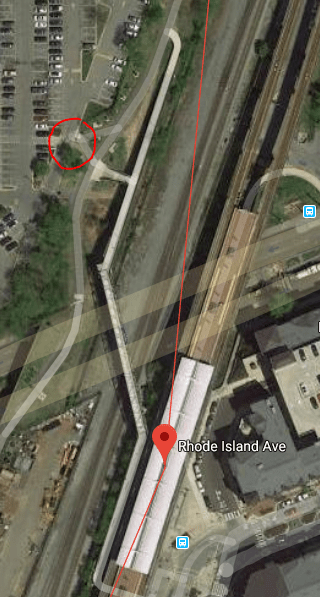
I arrived Thursday and took the Metro up to the stop. At ground level there’s a large footbridge that permits pedestrians to cross some railroad tracks. It connects to a foot/bike path on the north-west end. From here there’s an exit from the bikepath into a shopping center parking lot. If you look on maps, you can even see where this exit is. rhode_island_metroI’ve circled the exit here.  This is where the photo was taken.

After crossing the bridge I discovered workers actually putting up the fence in the featured photo. This was Thursday, around 3:00 PM.

Now, knowing that the next official exit (because of other fencing, etc) was .2 miles in either direction, and because by walking through the parking lot to Rhode Island Ave was very convenient, I made a prediction that the fence wouldn’t last more than 2-3 days.

Sure enough, by the time I came back 2 hours later to take the Metro to my talk, I could already see people figuring out ways to jump the fence.

On Friday, I also headed to the Metro to go see a friend and I could see that the fence was still technically intact, but the area shown had become the de facto route over the fence.

Sure enough, Saturday afternoon when I was back in the area, 48 hours later the fence had been ripped open so that one could walk through.

My limited understanding of some European Common Law is that in some cases, if an “ancient path” exists, the landowner cannot deny access to it. For example, in New York state, if a river is navigable (and court cases have agreed that even simply using a kayak to traverse it deems it navigable) a land-owner can’t deny portage rights. So, I have to wonder if under some aspect of Common Law, the folks who destroyed the fence would be deemed to simply restoring their historical rights. Honestly, I don’t think so. But I’d call this a bit of civil disobedience (ok, not really since it’s not disobeying the state, but you get the idea.)

Now, I have no idea why the mall owners shut down (the entire place was abandoned) and put a fence around their entire parking lot. Presumably they were within their legal rights to do so (and given how litigious society can be, they perhaps felt they needed to).

But, just because they COULD do it, didn’t mean that the public would agree or support it. And they obviously didn’t. They took matters into their own hands and “fixed” the problem to their liking. Now, I can’t really condone destruction of personal property in most cases, nor do I necessarily want to promote trespass. But there’s a bit of me that thinks the property owners had this coming. They had, for years agreed to let the public use of their parking lot as a path  and apparently without any notice suddenly yanked it away. So while not really an “ancient path” it was a path and it had served people for years.

I wonder how long the fence will remain there and if it’s repaired how long before it’s broken again.  But alas, I won’t be around to continue watching.


Defining Dates

No real topic this week, just some thoughts on defining moments, or perhaps memorable moments. It seems that every generation has one or more. I’m going to start with one or two well before my time and then mention several others within my lifetime.

December 7th, 1941“A day that shall live in infamy.” We’re quickly losing the generation that remembers this day as actual history and the speech by FDR the next day that followed. But it set the US on a course in history where we eventually became the sole remaining superpower.  Of course too, we remember the Western version of events, the only real knowledge most of my readers would have of the Japanese point of view would come from the movie Tora, Tora Tora.

June 6th, 1944 – D-Day“You are about to embark upon the Great Crusade, toward which we have striven these many months. The eyes of the world are upon you.” Again, a day that helped shape a nation and one we are starting to remember only from oral or written history as those who were there pass on.  This past summer I had the honor of visiting Arromanches, Omaha Beach, Pointe du Hoc, and walking among the stones of the fallen on the bluff overlooking the beaches. A very somber memory for me. What I have learned later in life is that as horrible as the losses were on the Western Front, it pales in comparison to the sacrifices made on the Eastern Front.  For those who have not read up on the battles between the Soviets and the Nazis, I recommend you do. The scale and scope of the front is incredible. We lost approximately 400,000 soldiers in WWII. The Soviets, depending on the counts, anywhere from 6-8 million military causalities (and millions more civilian casualties).

November 22, 1963 – My dad would tell me he remembered exactly where he was when this happened, history class. Some say a generation died that day.

July 21st, 1969 – This sort of bookmarks the end of the Kennedy dream. Neil Armstrong utters the historic words, “That’s one small step for [a] man, one giant leap for mankind.” Technically I was alive and conscious for this momentous event, but I have no memory of it.

January 28th, 1986 – Challenger Disaster. I found about this in a less than ideal way. I was returning to my dorm room in college to hear a floormate shouting, “Man, I can’t wait to see the full color photographs in the USA Today tomorrow.” Yeah, he had no class. This event forever reminded us that space travel had NOT been made routine.

November 9th, 1989 – Unlike most of the other events that marked my life, this one was a joyous one. For weeks my housemate and I had been following the events in Eastern Europe. We were watching events that we never thought would happen in our lifetime. But even then, I don’t think either of us dreamt that we’d soon be watching men with sledgehammers on top of the wall and them not only NOT being shot at, but being cheered on. I am always reminded of Tom Brokaw’s broadcast that night and Beethoven’s Ode to Joy. I was sitting at my desk at my computer, listening to the TV and looking out the window when I saw my housemate came home. I literally jumped on the desk and opened the window to shout, “The wall is down! The fucking wall is down!”

December 31st, 1999 – Technically NOT the end of the millennium, but who cares about that detail; all the digits were changing. But, I and others had work to do. We setup a command center in the meeting room with the fireplace at “the Mansion” we worked in and monitored our servers. Between monitoring we watched The Matrix and Enemy of the State (which still has one of the best exchanges of all time: “I blew up the building.” “Why?” “Because you made a phone call.”) Despite working (and having to ask two coworkers to be AT our data centers, one in NYC and the other outside of DC) it was actually a wonderful time. Honestly, one of the more fun New Year’s Eve I’ve had.

9/11 – A date that unfortunately needs no year. My best friend was murdered that day.

November 4, 2008 – I had made sure to be home in NY in the morning to vote before heading to my apartment/job just outside of DC.  I took the train down and had made it back to my apartment around 9:00 PM when I turned on the TV to follow the results. I was tired, it was late, but crowds were gathering outside the White House to celebrate. I debated, but realized it was a once in a lifetime experience and headed back into DC and joined them until about 1:30 AM. I even called my boss and told him I’d be late for work the next day.  I finally started to drive home and ended up picking up some folks in their 20s that had been stranded due to lack of mass-transit (and no cab was willing to pick them up at a random street corner) and taking them back to Alexandria.

There’s many personal dates that have special meaning to me, 1996-08-25, 2000-04-10, 2003-04-26, 2015-07-10 and others, but I wanted focus on ones where many of us can share common bonds and that had an impact on a nation or at least a large part of it.

What dates do YOU recall and why.

Conspiracy Theories

If I told you I thought the Earth was flat, you’d probably think I was off my rocker. What if I told you that we never landed on the Moon?  Probably a similar reaction.  What if I told you for decades the government ran a medical experiment on black men and denied them the proper treatment for their disease, a treatment that once discovered basically had a 100% success rate in curing the disease?  If you’ve correctly guessed that I’m referring to the Tuskegee Syphilis Experiment, you’d be right.  But what if I told you this in 1952? You’d probably think I was nuts.

And yet.. that was the truth. The US Government knowingly withheld proper treatment to see what would happen. And didn’t really tell anyone.

If you think about it, this has all the hallmarks of a typical conspiracy theory. And at the time, most likely it would have been dismissed as one.

Now, to be clear, I’m convinced that the Earth is roughly an oblate spheroid, that we did land on the Moon and that vaccines do not cause autism. I also believe that there are over 1 billion people living in China.

But the truth is… how does any of us really know any of that? At some point we have to make a decision to believe certain facts.  Yes, we can say, “but there’s overwhelming evidence” but even then, much of the evidence is something we end up having to place faith in.  Someone can show us the multitude of studies that show no correlation between vaccines and autism, but ultimately, we have to believe THOSE studies.

Some things we can verify for ourselves, or hopefully we can build enough of a logical framework that it makes sense to believe what we’re told. For example, a good question to ask about the Moon landings is, “if they were a hoax, why didn’t the Soviet Union expose it?” (And by the way, I did once get talking to a moon hoaxer who simply and calmly explained that in exchange for them not revealing it we agreed to lose Vietnam.)

But even then, logic may fail us or steer us in the wrong direction. For millennia geometry was based on Euclid’s original 5 axioms. Until someone tossed out the one on parallel lines and we suddenly had various forms of non-Euclidean geometry.

For millennia we believed that we had an absolute reference frame. Until Einstein (and others) tossed out that idea.

Ultimately, even with logic, we have to make some assumptions, and occasionally question them.

For example, you have to believe that I’m really Greg Moore and I’m writing this. Perhaps even that is a lie.

But it’s not. 🙂

So my takeway here is: don’t believe in conspiracy theories, but sometimes it’s worth questioning assumptions and sometimes some conspiracy theories MIGHT actually have a grain of truth to them. You decide.


Sharing and Building

I’ve mentioned in the past that I think it’s important to share and give back knowledge.

This week’s blog post will be short (sorry, they can’t all be great works of art.) But first I want to mention an event that just happened. I’m the leader of the local SQL Server User Group: CASSUG. We had our monthly meeting last night and I was grateful that Hilary Cotter was willing and able to drive up from New Jersey to present on Service Broker.

When I arrange for speakers, I always hope my group gets something out of it. Well, last night we had a new member visiting from out of town. So, it’s probably rare he’ll make future meetings. And today, I read from him: “Hilary’s presentation was very informative and interesting. “ and “Now it has piqued my interest and I’ve started a Pluralsight course to learn more.”  To me, that’s success.

At our July meeting we had lightning rounds. Instead of a single presenter, we had four of our local members present on a topic of their choice for about 15 minutes each.  One of them, presented on using XML results in a SQL query to help build an HTML based email. He adopted the idea from I believe this blog post. Twice now in the last month I’ve used it to help clean up emails I had a system sending out. Yesterday, I finally decided to cleanup an old, ugly, hard to read text based email that showed the status of several scheduled jobs we were running overnight.  A few hours later, after some tweaking I now had a beautiful, easy to read email.  Excellent work and all based on an idea I never would have come up with it my colleague had not shared it from his source.

And that leads me to a bit of self-promotion. When I created this blog, my goal was not to have lots of posts around SQL Server. Several months ago, a mentor of mine (I don’t know if she considers herself that, but I do, since she’s the one that planted the seed in my head for my first book: IT Disaster Response: Lessons Learned in the Field) approached me at SQL Saturday Atlanta and mentioned she was now an editor for Red-Gate’s Simple-Talk blog section and asked me if I’d be interested in writing.  I was.

So I’m proud to say that the first of my blog at the Red-Gate Simple-Talk site is up. Go read it. I’m excited. As of today it’s had over 2000 views! Far more than I get here. And there’s more to come.

And here’s the kicker. Just today I had a client say, “Hey, I need to get this data from this SQL 2014 database to a SQL 2008 Database.”  I was able to say, “I’ve got JUST the answer for that!”

Sharing knowledge is a good thing. It makes us all far more capable and smarter.


Less than our Best

I’ve mentioned in the past that I participate a lot in SQL Saturday events and also teach cave rescue. These are ways I try to give back to at least two communities I am a member of. I generally take this engagement very seriously; for two reasons.

The first, which is especially true when I teach cave rescue, is that I’m teaching critical skills that may or may not put a life on the line. I can’t go into teaching these activities without being prepared or someone may get injured or even killed.

The second is, that the audience deserves my best. In some cases, they’ve paid good money to attend events I’m talking or teaching at. In all cases, they’re taking some of their valuable time and giving it to me.

All the best SQL Saturday speakers and NCRC instructors I know feel generally the same about their presentations. They want to give their best.

But here’s the ugly truth: Sometimes we’re not on our A game. There could be a variety of reasons:

  • We might be jet-lagged
  • We may have partied a bit too much last night (though for me, this is not an issue, I was never much of a party animal, even when I was younger)
  • You might have lost your power and Internet the day before during the time you were going to practice and found yourself busy cutting up trees
  • A dozen other reasons

You’ll notice one of those became singular. Ayup, that was my excuse. At the SQL Saturday Albany event, due to unforeseen circumstances the day before, the time I had allocated to run through my presentation was spent removing trees from the road, clearing my phone line and trying to track down the cable company.

So, one of my presentations on Saturday was not up to the standard I would have liked it to be. And for that, to my audience, I apologize (and did so during the presentation).

But here’s the thing: the feedback I received was still all extremely positive. In fact the only really non-positive feedback was in fact very constructive criticism that would have been valid even had I been as prepared as I would have liked!

I guess the truth is, sometimes we hold ourselves to a higher standard than the audience does. And I think we should.

PS: a little teaser, if all goes as planned, tomorrow look for something new on Red-Gate’s Simple Talk page.

White (K)nights

I apologize for skipping two weeks of blog posts, but I was a bit busy; for about 11 days my family and I were visiting Europe for the first time. It was a wonderful trip. It started with a trip to Manchester UK for a SQL Saturday event.

I had sort of forgotten exactly how much further north we were until it dawned on me how early dawn was.  Actually we had noticed the night before as we walked back from the amazingly wonderful speakers’ dinner how light it was despite how late it was.  When I woke up at around 4:30 AM (a bit of jetlag there) I noticed despite the blackout curtains how bright it was around their edges. I later looked it up, and it appears that technically it never reached “night” there, but simply astronomical twilight.

Ever since seeing the movie “White Nights” my wife has always wanted to experience the white nights of Russia. This wasn’t that, but it was close.

This trip followed up on the heels of the amazingly successful Thai Cave Rescue that I had previously commented on. As long term readers know, I’m a caver who also teaches cave rescue and has a role as the Northeast Coordinator of the National Cave Rescue Commission. During the 18 day saga, I and others were called upon by various media outlets to give our insight and perspective. I was fortunate, I only did a little under a dozen media events. Our National Coordinator, Anmar Mirza did well over 100, and most of those in about a 5 day period. A link to one of my media events is here: The Takeaway.

I don’t want to talk about the operation itself, but I want to talk about White Knights. We love our White Knights: the term often refers to a character who will ride into town and single-handedly solve the town’s problems. The truth is, white knights rarely if ever exist and that most problems require a lot more effort to solve.

We’ve seen this in politics, and we saw this with this cave rescue. Let me start by saying I think the work Elon Musk has done with SpaceX is amazing. SpaceX has in fact single-handedly revolutionized the space launch market.

It was perhaps inevitable that Musk’s name would show up in relation to this cave rescue. Musk has previously gotten attention for attempting to help with the power outage crisis in Puerto Rico and now his vow to help the people of Flint (both by the way I think worthy causes and I wish him and more importantly the people he’s trying to help, well).

But here’s the thing, a cave rescue isn’t solved by a white knight. It’s solved by a lot of effort and planning with a lot of people with a variety of skills and experience. There’s rarely a magic breakthrough that magically makes things easier.

And I’ll be blunt: his “submarine” idea, while interesting, was at best a PR distraction and at worst, possibly caused problems.

“But Greg, he was trying to help, how could this make things worse?”  I actually disengaged from an online debate with some Musk fanbois who couldn’t see why Musk’s offer was problematic. To them, he was the white knight that could never do wrong.

Here’s the thing: I know for a fact that several of us, myself included, had to take part of our allotted airtime or written coverage to address why Musk’s idea probably wouldn’t work. This meant less time or room for useful information to be passed on to the audience. Part of my role as regional coordinator is to educate people about cave rescue, and I can’t do this effectively when I’m asked to discuss distractions.

“But so what, that didn’t impact the rescue.” No, it didn’t. But, it appears from the Twitter fights I’ve seen, and other information, that at least some resources on the ground were tasked to deal with Musk. This does mean that people had to spend time dealing with both Musk and the publicity. This means those resources couldn’t be spent elsewhere. At least one report from Musk (which honestly I question) suggests he actually entered the cave during the rescue operations. This means that resources had to be spent on assuring his safety and possibly prevented another person who could have provided help in other ways (even if it was simply acting as a sherpa) from entering.

And apparently, there’s now a useless “submarine” sitting outside the cave.  I’ll leave discussion of why I had problems with the submarine itself for another post.

But here’s one final reason I have problem with Musk bringing so much attention to himself and his idea: It could have lead to second guessing.

Let’s be clear: even the cave divers themselves felt that they would most likely lose some of the kids; this was exactly how dangerous the rescue was. This is coming from the folks who best knew the cave and best understand the risks and issues.  Some of the best cave divers in the world, with rescue experience, who were on-site, thought that some kids would die in the attempt to rescue them. And, if reports are true, they were aware of Musk’s offer and obviously rejected it (and in fact one suggested later that Musk do something anatomically impossible with it.)

Had the rescuers worst fears come true, Musk fan bois would have second guessed every decision. In other words, people would have put more faith in their favorite white knight, who had zero practical experience in the ongoing operations , than they would have in the very people who were there and actively involved. I saw the comments before and during the operations from his fans and all of them were upset that their favorite white knight wasn’t being called in to save the day. I can only imagine how bad it would have been had something tragic occurred.

This is why I’m against white knights. They rarely if ever solve the problem, and worse when they do ride into town, they take time and energy away from those who are actually working on the problems. Leave the white knights on a chess board.